

Research @datologyai | Previously Postdoc @KhouryCollege, Ph.D. @UVA | Interested in data quality x security & privacy.
San Francisco, CA
Joined February 2016
- Tweets898
- Following958
- Followers745
- Likes15K





Anshuman Suri retweeted

Zephon’s TorchTitan integration preserves identical global batches when training resumes on a different GPU count.
In our latest blog’s 1B-parameter model test, training resumed from a 16-GPU checkpoint on 8, 32, and 64 GPUs, and the SHA-256 hash of every global batch matched the original run.
Zephon tokenizes, packs, shuffles, and mixes data inside the training job, avoiding a preprocessed copy of the corpus.
The data, tokenizer, seed, mixture, context length, and global batch size must stay unchanged when resuming. The lane count must divide evenly across data-parallel replicas, and each optimizer step’s batch must split evenly across lanes. Training losses can still differ because floating-point reduction order depends on GPU count.
✍️ @datologyai @josh_wills @MaxiBoether, Ties Robroek (@datologyai)
Read more: pytorch.org/blog/bringing-el…

Academics are always compute-starved, and data research is where it hurts most. Datology Labs is our attempt to do something about it


Anshuman Suri retweeted

"Not all data is equally valuable" - often yapped about, but Datology have done the work to quantify that and put it into in practice
Anshuman Suri retweeted

Tbh I just found out that Thomson-1 beats GPT 5.6 Sol
That is insane!
That’s our curation is allowing a 400B model to beat the best model in the world at the time on it’s specialized domain: legal

Owning your own intelligence is more critical than ever, but harnessing your data to build a model that can beat the frontier has required deep data curation expertise.
We built @datologyai Curation Studio to change that. Curation Studio enables teams of all sophistication levels to customize curation to their use cases, delivering a massive compute multiplier that fundamentally changes the economics of model ownership.
We applied Curation Studio to the best publicly curated datasets from Nvidia, HuggingFace and others, and were able to deliver a 6x compute multiplier out of the box, all through better use of existing data.
This has allowed us to deliver huge wins for our customers. For example, we worked with @thomsonreuters to help them build Thomson-1 for only $450K in compute, which outperformed GPT 5.6 Sol in head-to-head comparisons and did so for 100x lower cost per task.
Curation Studio brings those capabilities to everyone.
This is a big moment for us at Datology, but it's just the beginning. We'll be expanding Curation Studio support to more modalities and verticals. And stay tuned for more research releases coming very soon!
fr tho look at these gains!! 🌶️ 🔥 it's one thing to know it boils down to data quality, and another to see the actual numbers plotted


There's something magical about taking years of research and turning it into something anyone can use, at scale, right out of the box 🚀
Super excited to see Curation Studio out in the wild!
Zephon is ridiculously efficient & easy to use - take it from a company that plays with data ALL. THE. TIME.

At @datologyai we run thousands of data experiments. Two things keep biting us:
- Same run on 16 vs 8 GPUs → different evals
- Every pipeline change → re-materialize the dataset
Introducing Zephon, the data loader we built to process data on the fly, deterministically. 🧵
Look at him, that’s my 1000x Engineer
Your what?
My 1000x Engineer! My throughput whisperer. Look at him, you notice anything different about him? Look at his face
I’ll give you a hint, his name is Josh. He put H100 in his name before it was cool. Yeah, I’m sure Zephon scales.


Data Loader (n.): The part of your training stack that is too ML-y for the systems folks and too systems-y for the ML folks.
It's the work I love best, and I had a ton of fun building a new one with the team here at @DatologyAI. My three favorite things about Zephon:
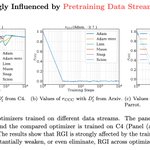
"Overall, changes in the training data distribution can substantially weaken or even prevent the emergence of RGI"
It really is all about the data 🤔


How do optimizers, architectures, and data shape LLM generalization differently?
🚀 We study this through Relative Generalization Invariance (RGI): two models satisfy RGI if their token-wise losses differ by a constant gap.
1. RGI largely holds across optimizers and moderate architecture changes—an approximately uniform shift in token-wise loss.
2. Changing the training data stream breaks RGI.
Data, optimization, and architecture leave distinct signatures on generalization.
Paper Link: arxiv.org/abs/2609.33016
A thread 🧵


Great win for data-poisoning researchers (seriously tho, how is paraphrasing on ZDR data fair game? sounds hella sus)

Synthetic data derived from production user data of consumer AI tools is used for training. I’ve heard this rumour from both large labs’ employees.
In particular, if you’re doing something “interesting” like working on complex math/business/software/bio problems you’re dramatically more likely to get trained on because they filter/up-weight towards those usecases where the model has the most to learn.
Even in ZDR and “we won’t train on you” regimes, derivative data is usually carved out. The promise is only not to train on exactly the data you put in, rewritten data is fair game.
"While unlikely, we cannot rule out that de-identified data derived from their usage of our products helped improve our models."
and this, kids, is why ZDR is so important

We congratulate Levent Alpöge and Tristan Buckmaster on their remarkable mathematical work.
We (the researchers and the agents) did not see any of their work through any means until they released it publicly — in particular, no specific user data was accessed in order to solve this problem.
While unlikely, we cannot rule out that de-identified data derived from their usage of our products helped improve our models.
However, our proofs differ significantly and even the precise results proved are different in the Euler case (forced vs. unforced).
Come for the scaling laws, stay for the bisque 🍜

I had a wonderful time visiting to give this talk!!! Thank you @datologyai for having me!
Huge win for @Cornell 🙌 Having had the privilege of seeing his work and mentorship up close over the past few months has only reinforced my admiration for him as a researcher. If you’re considering starting a PhD next year, he should absolutely be at the top of your list!

Some life updates:
1. I defended my PhD last winter 🎓
2. Starting next January, I’ll be joining the faculty in Computer Science at @cornell_tech! 🗽
I’m incredibly grateful for the past few years at CMU and Datology, especially to @zicokolter and @zacharylipton for their mentorship, and to @AdtRaghunathan, who I’ve had the privilege of working closely with.


Anshuman Suri retweeted

better post:
OpenAI doesn't know what a sandbox actually is and is currently one of the leaders in technology

OpenAI's rogue models roamed the internet for 4 days and staged a second attack dlvr.it/TTlcxn

Insane!

Introducing: The Stack v3
One thing that became very clear over the last few days: we need great open code models for cyber defence. This is the dataset they will be built on!
And it's a behemoth: 5T tokens ready to train and 120TB raw data.
Download: huggingface.co/datasets/Hugg…


Unsafe behavior hides in the long tail trajectories that greedy and few-sample evals never reach. Agent safety should be measured by SEARCH, not sampling 🤖
We extend BOA (our MLSys'26 framework) from single-turn LLMs to full agents: reporting a graded safety score, one scale to rank models, defenses, and attacks.
📍 Poster Session 1, Hall A, 10:10–11:00 KST at the @FAGENWorkshop workshop at @icmlconf

Standard safety evals for models use greedy/default decoding strategy, even though decoding strategies (top-k, top-p, temperatures) may vary wildly across deployments🎲
In our recent work accepted to #MLSys2026, we formalize this gap as the 'Jailbreak Oracle Problem' 🧵 (1/8)
