
Neuroimaging and Brain Biochemistry Research Group, Associate Professor, IISER Berhmapur
India
Joined July 2010
- Tweets1.6K
- Following1K
- Followers864
- Likes4.2K


Vivek Tiwari retweeted

Applications are invited for the following positions in an ICMR-funded research project entitled “Integrated Metabolomics and Clinical Markers for Real-Time Point-of-Care Assessment of Coagulopathy in Severe Trauma using machine learning”.
Last date: 22.11.2026
1. Project Research Scientist–II (Non-Medical)
2. Project Technician Support-III

Vivek Tiwari retweeted

The IBRO-sponsored Neuroimaging School 2026 was held at BRIC-NBRC, Manesar, from 1–5 October, organised by Dr. Khushbu Agarwal, bringing together international experts and participants from diverse backgrounds.
The five-day programme featured lectures, keynote talks, hands-on training, interactive sessions and lab visits, covering neuroimaging techniques and their applications in cognitive neuroscience, sensory processing, brain aging, AI and translational neuroscience.
The school provided a valuable platform for learning, collaboration and scientific exchange. 🧠
#speakers
Dr. Thomas Hummel • Dr. Richard Edden • Dr. Sabine Kastner • Dr. Brigitte Röder • Dr. Lucina Q. Uddin • Dr. SP Arun • Dr. Uma Sharma • Dr. Sridharan Devarajan • Dr. Vivek Tiwari • Dr. Dipanjan Roy • Dr. Abraham Nixon • Dr. Arpan Banerjee • Dr. Raju S. Bapi • Dr. Varsha Singh
#participants
P V Keerthi Vaishnavi • G Nair • Jyoti Singh Kirar • Gargi Shukla • Ankita Chaudhary • Suhas Satish • Rishab Dhiman • Bedanta Gogoi • Ritam Abraham • Abraham George • Abraham Ajeolu Oluwasegun • Mohd Amaan • Bright Worlanyo Aklamanu • Mirela Cunha Cardoso Ramacciotti • Agota Vass • Sivarengani • Daniela Carolina Olivares Vargas • Rosario Huaranca Quispe • Kimberley Clare Williams
@ANRFIndia @IBROorg @Aerobe_ @BricDbt @DBTIndia @DrJitendraSingh @rajesh_gokhale @DrSagarSengupta @Khushbu57737753
Vivek Tiwari retweeted

BREAKING NEWS
The 2026 #NobelPrize in Physiology or Medicine has been awarded to Karl Deisseroth, Peter Hegemann and Georg Nagel “for their discoveries concerning light-gated ion channels and optogenetics.”

Vivek Tiwari retweeted

Congratulations! Their most renowned work:
1. Georg Nagel & Peter Hegemann's work:
Title: Channelrhodopsin-1: A Light-Gated Proton Channel in Green Algae
2. Georg Nagel & Karl Deisseroth's work:
Title: Millisecond-timescale, genetically targeted optical control of neural activity
3. Georg Nagel & Peter Hegemann's work:
Title: Channelrhodopsin-2, a directly light-gated
cation-selective membrane channel


Vivek Tiwari retweeted

Cancer neuroscience: Mechanisms to medicine
science.org/doi/10.1126/scit…

Vivek Tiwari retweeted

NITI Aayog hosted a brainstorming session with the Directors of IISERs on ‘Catalysing R&D in IISERs in India’, chaired by Prof. Gobardhan Das, Member, NITI Aayog. The session reviewed the research and innovation landscape of IISERs, including key findings from Clarivate Analytics and institutional perspectives on emerging opportunities and challenges.
With the participation of the Secretary, Higher Education, discussions explored the proposed IISER Council, strengthening faculty and research capacity, and rationalising PhD fees to make doctoral education more attractive and comparable with leading premier institutions.
The deliberations emphasised strengthening IISERs as centres of excellence in science, research and innovation, while fostering an enabling environment to attract and retain high-quality faculty, researchers and doctoral talent. The need to promote translational research and convert scientific discoveries into technologies and solutions with real-world impact was also highlighted.
The session reaffirmed the commitment to a stronger, coordinated and globally competitive R&D ecosystem, with IISERs playing a greater role in India’s scientific and technological advancement.
#IISER #ResearchAndInnovation #HigherEducation #ViksitBharat
@PMOIndia @narendramodi @Rao_InderjitS @MIB_India @PIB_India @DDNewslive @ashoklahiribjp @dasgobardhan


Vivek Tiwari retweeted

The Principal Scientific Adviser to the Government of India, @AjaySoodIISc, joined the 6th Convocation of the Indian Institute of Science Education and Research, @IISER_BERHAMPUR, as the Chief Guest. The ceremony was attended by Shri Satyabrata Dey, Chairman, Board of Governors; Prof. @arvindnatu, Former Chairman and Member, Standing Committee; Prof. Ashok Ganguly, Director; and Shri P. K. Ray, Registrar, from IISER, Berhampur.
In his address, Prof. Sood underscored the importance of nurturing scientists who are not only researchers but also entrepreneurs, policy thinkers, and educators. He encouraged IISER Berhampur to strengthen interdisciplinary learning that prepares graduates for leadership across science and society.
Highlighting India's rapidly evolving innovation ecosystem, Prof. Sood applauded Skyroot Aerospace's successful Vikram-1 mission as a landmark achievement reflecting the capabilities of India's young innovators. He also commended the outstanding performance of Indian students at the 2026 International Science Olympiads as evidence of the country's growing scientific talent.
Speaking on the future of research, he emphasized the convergence of artificial intelligence, quantum computing, biotechnology, and advanced materials, noting that while AI can extend human capabilities, human intelligence must continue to provide ethical judgement, creativity, and purpose.
Prof. Sood also highlighted the Rural Technology Action Group (RuTAG) Smart Village Centres, citing initiatives such as the Gaushala Model and the 'Weed to Wealth' programme as examples of science driving sustainable livelihoods and inclusive development.
Concluding his address, Prof. Sood urged the graduating students to uphold IISER Berhampur's values of academic excellence, interdisciplinarity, diversity, development, and societal outreach. Emphasizing the "S-LIFE" framework, Prof. Sood called for embedding science into everyday life by promoting hands-on laboratories, integrating research with learning, celebrating science through cultural engagement, and leveraging digital platforms to foster scientific temper.
Watch the full convocation address on YouTube: youtu.be/Ja8xCmJOUfwsi=1_4_W…

Vivek Tiwari retweeted

Alumni from across the globe are sending their heartfelt congratulations and best wishes to the graduating Class of 2026. As we gather tomorrow for the 6th #Convocation2026 of @IISER_BERHAMPUR, their messages celebrate the journey, achievements, & bright future of our graduates.
Vivek Tiwari retweeted
Join us for the 6th Annual Convocation of @IISER_BERHAMPUR on 27 July 2026 at 10:00 AM IST, to be addressed by Prof. Ajay Kumar Sood, Principal Scientific Adviser to the GoI, as Chief Guest @PrinSciAdvGoI @EduMinOfIndia
🎥 Tune in live at 10:00 AM IST: youtube.com/live/IPHlzCNs3Ok

Indeed, a scientifically encouraging moment!! Bringing science to all, and for a purpose is humbling. Kudos to you Niraj @nirajgupta02 for your hard work. Deep regards to our institution @IISER_BERHAMPUR for the support. Thanks to the Scientific Editorial members of The Hindu. White matter connectivity and its integrity seems to be a really important brain event in the aging trajectory.

Well… this happened.
Our recent research on brain vascular and white matter changes with aging just got covered by The Hindu!
White matter isn’t just “wiring.” It reflects vascular health, resilience & biological ageing.
thehindu.com/sci-tech/health…
@iamvivekt @IISER_BERHAMPUR

It was an amazing interaction with Prof Mausam @mishumausam. Super expert in AI (NLP, ML) from IIT Delhi. Got to look deep into his brain as well. Super queue of lectures aligning with AI Summit activities @IISER_BERHAMPUR


1
19
1,496
Vivek Tiwari retweeted

Parkinson’s as a Somato-Cognitive Action Network Disorder? A New Brain Circuit Model Emerges. Somato-cognitive refers to how the body and brain work together by integrating movement, motivation and internal body states in order to guide action. Ren, Zhang Dosenbach, Liu and colleagues describe in a new paper that just dropped in Nature how Parkinson’s disease may be better understood, not just as a movement disorder, but as a disorder of the Somato-Cognitive Action Network (SCAN). The team leveraged a massive multimodal dataset across six interventions to show how SCAN hyperconnectivity might explain both motor and non-motor symptoms and could guide future neuromodulation treatments.
Key Points:
– The SCAN links motor, cognitive, autonomic and emotional systems, and is more tightly connected to PD circuits than traditional motor-only areas.
– Folks w/ Parkinson’s showed hyperconnectivity between the SCAN and key subcortical structures (e.g., substantia nigra, STN, GPi), a pattern not seen in other movement disorders.
– Successful therapies like DBS, TMS, focused ultrasound, and levodopa reduced the SCAN to subcortex hyperconnectivity.
My take: This paper opens the door to rethinking Parkinson’s as a disorder of action readiness and integration, not just movement execution. This is a big step forward for brain network science in Parkinson's.
Here are 5 points that resonated w/ me:
1- Parkinson’s may be better framed as a whole-body network disorder rooted in the SCAN, not just a hand or foot movement issue.
2- Brain imaging showed that the subthalamic nucleus and other DBS targets are functionally linked to the SCAN, not just to movement effectors.
3- Reducing SCAN hyperconnectivity through neuromodulation or dopamine led to better motor outcomes.
4- Targeting cortical SCAN regions w/ repetitive transcranial magnetic stimulation (rTMS) doubled the benefit as compared to traditional motor cortex stimulation.
5- Future neuromodulation strategies have the potential to personalize therapy by matching treatment to SCAN hubs, rather than single motor targets.
nature.com/articles/s41586-0…
Nice write up in Scientific American today:
scientificamerican.com/artic…
@ParkinsonDotOrg @FixelInstitute @sciam

Vivek Tiwari retweeted

📢 Hiring | Project Research Scientist–I (Medical)
If you enjoy out-of-the-box thinking, pushing beyond comfort zones, and thriving on ambitious, cutting-edge neuroscience research challenges — there’s a place for you in our group.
Apply by 12th Feb
@iamvivekt @IISER_BERHAMPUR

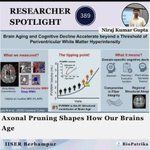
Happy to share coverage of our recently published research on axonal pruning with aging, featured by @biopatrika .
Many thanks to the @biopatrika team for the thoughtful coverage and space, and congratulations to wonderful PhD scholar @nirajgupta02 for articulating complex neurobiology in a clear, engaging, and lay-friendly manner.
Feature: biopatrika.com/academia/rese…
Research article: academic.oup.com/cercor/arti…


#researcherspotlight Niraj Kumar Gupta @nirajgupta02, PhD with Dr. Vivek Tiwari @iamvivekt lab @NIBBRlab at IISER Berhampur @IISER_BERHAMPUR talks about his work on "Axonal Pruning Shapes How Our Brains Age" #aging biopatrika.com/academia/rese… via @biopatrika

Wishing you all a Happy and Prosperous New Year! Immense gratitude to all the mentors, friends, colleagues and dear students for the guidance, learning and continued support. @NIBBRlab @nirajgupta02 @nehayadav1211 @RittikaDutta23
1
8
270


Vivek Tiwari retweeted

Today we completed Neurobiology and biochemistry at @IISER_BERHAMPUR this courses enriched my understanding to next level and big thank to @iamvivekt sir (enthusiasm ,the energy) it was great learning Phineas Gage, the legendary railway worker (iykyk) happy faces.


Had a wonderful experience introducing Neurobiology as part of the BS101 course @IISER_BERHAMPUR . The new students, despite their diverse academic backgrounds, were highly attentive and curious. Their enthusiasm and the insightful post-class questions made the session truly rewarding. Loved the energy!


Vivek Tiwari retweeted
Adult human brains have between 86-100 billion neurons and every single one is unique - like snowflakes! ❄️
In this 3D rendering by our #ElectronMicroscopy team, we see 3 different shapes incl. (from left to right) a basket cell, tufted excitatory cell, and a Martinotti cell.
Same pinch Niraj; Equally excited. In this study, using multiple aging cohorts- including our @IISER_BERHAMPUR aging cohort- we demonstrate that periventricular white matter hyperintensity (PVWMH) volume increases nearly twice as fast with advancing age, with a clear inflection around 61 years. We identified that a PVWMH burden exceeding 2.3 mL, independent of chronological age, is associated with selective deficits in executive, attentional, and semantic cognitive domains, along with widespread cortical and subcortical atrophy involving the nucleus accumbens, rostral middle frontal, pre/postcentral gyri, lingual gyrus, and cerebral cortex.
We emphasize that we age differently because we accumulate PVWMH differently-and once this burden crosses a critical threshold, it rewires the neuroanatomic and cognitive trajectories of aging. academic.oup.com/cercor/arti… Congratulations Niraj and Neha.

Thrilled to announce that our paper entitled "Brain aging and cognitive decline accelerate beyond a threshold of periventricular white matter hyperintensity" is now published. Read it at:
academic.oup.com/cercor/arti…
@iamvivekt @nehayadav1211
NIBBR Lab, @IISER_BERHAMPUR
(1/n)
