

Biomedical Mathematics Group (BIMAG), Institute for Basic Science (IBS), Daejeon, Korea
Daejeon, Korea
Joined March 2021
- Tweets746
- Following7
- Followers317
- Likes478






IBS Biomedical Mathematics Group retweeted

Can we identify firefighters at risk of PTSD without a PTSD-specific questionnaire? Our new BMC Psychiatry study introduces FLARE, using 7 routinely assessed indicators to classify probable PTSD. AUROC: 0.90
link.springer.com/article/10…
#PTSD #Firefighters #MentalHealth

Join the 2026 IBS Biomedical Mathematics Colloquium!
Six online talks spanning single-cell modeling, nonlinear dynamics, reservoir computing, disease trajectories, stochastic calculus, and digital health.
Sep–Dec 2026
Free, online, and open to all
#MathBio #SystemsBiology

IBS Biomedical Mathematics Group retweeted
Can “crappy” imaging still yield informative single-cell experiments?
Brian Munsky will show how FSP-FIM enables efficient experimental design for predictive models of stochastic gene expression.
📅 Sep 4, 11 AM KST | Online
ibs.re.kr/bimag/event/design…
#SingleCell #MathBio

Can “crappy” imaging still yield informative single-cell experiments?
Brian Munsky will show how FSP-FIM enables efficient experimental design for predictive models of stochastic gene expression.
📅 Sep 4, 11 AM KST | Online
ibs.re.kr/bimag/event/design…
#SingleCell #MathBio
IBS Biomedical Mathematics Group retweeted
I had a great time joining Gwahang-eul Boda for a fun conversation with fellow scientists!
We talked about sleep and circadian rhythms, Benford’s law, how water changes with temperature, and many other fascinating science topics.
Watch here: youtube.com/watch?v=-0-jv8bx…

IBS Biomedical Mathematics Group retweeted
Even when the brain is “at rest,” it is not silent.
A new Nature paper suggests that spontaneous brain activity may reflect a critically initialized neural network: stable, but close to the edge of instability.


IBS Biomedical Mathematics Group retweeted
A new PRX paper introduces InVaXMap, a method to infer direct physical links in complex networks from time-series data by combining cross mapping with delay-informed conditioning.
A step from “what predicts what?” to “what directly drives what?”
doi.org/10.1103/kkwg-kv4c

IBS Biomedical Mathematics Group retweeted

Don't miss tomorrow's entry in the NITMB Seminar Series!
Featuring @umichkim, Associate Professor of Mathematical Sciences at KAIS, on 'From Noise to Precision: Structural Buffering and the Law of Large Numbers as Principles for Robust Homeostasis and Rhythms'
🔗 ⬇️

IBS Biomedical Mathematics Group retweeted
Hongtu Zhu from UNC Chapel Hill will speak on “Causal Generalist Medical AI,” integrating causal inference with generalist AI for interpretable, robust, and trustworthy medical decision-making.
May 27, 4 PM KST
Zoom: 997 8258 4700 / PW: 1234
ibs.re.kr/bimag/event/hongtu…

IBS Biomedical Mathematics Group retweeted
Join us this Friday at 11 AM KST for the IBS Biomedical Mathematics Online Colloquium. Alan E. Lindsay will speak on “Mathematics of Diffusive Signaling,” exploring how geometry, randomness, and multiscale effects shape biological signal detection.
Zoom: 997 8258 4700 PW: 1234

IBS Biomedical Mathematics Group retweeted

So how do we got these results? Most prior work evaluates AI reviewers by a simple proxy: does the verdict (e.g., score or accept/reject) match a human's?
🤔But verdict matching doesn't mean the review is good. An AI can land at "5/10" while the specific criticisms it raises are completely off.
💡In our work, we decompose every criticism in the review (both AI reviews and human reviews) and ask expert scientists to verify each one for correctness, significance, and evidence sufficiency.

IBS Biomedical Mathematics Group retweeted
Recently, there's been complaints on low-quality AI reviews at conferences and journals. What if we put the frontier LMs into an agent harness?
With the right setup, on 82 Nature-family papers, 45 expert scientists judged that AI reviewers outperform the best human reviewer!
🤗 huggingface.co/papers/2605.2…

IBS Biomedical Mathematics Group retweeted
Today at 4 PM KST, Prof. Lendert Gelens will give an IBS Biomedical Mathematics Online Colloquium on “Data-driven discovery of biological oscillator models.”
He will discuss how time-series data can be used to discover dynamical models.
ibs.re.kr/bimag/event/data-d…

IBS Biomedical Mathematics Group retweeted
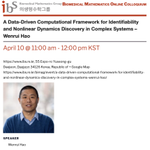
Talk by Wenrui Hao on identifiability—using the Fisher information matrix for quick checks, extended to complex AI models. Elegant bridge between statistics and modern ML.
youtube.com/watch?v=k6bxvtxU…
Data-driven modeling is powerful—but limited by identifiability and nonlinear dynamics challenges.
Join our IBS BIMAG Colloquium by Wenrui Hao.
Apr 10, 11AM KST
Zoom ID: 997 8258 4700
PW: 1234
ibs.re.kr/bimag/event/a-data…
#MathematicalBiology #MachineLearning #DynamicalSystems

IBS Biomedical Mathematics Group retweeted
New paper out!
We developed PANSAM-14, a machine learning–based short form of a sleep cognition scale—maintaining predictive power while reducing burden.
XGBoost + symbolic regression → interpretable & efficient assessment.
🔗 link.springer.com/article/10…

IBS Biomedical Mathematics Group retweeted
최종현 학술원/고등교육재단과 함께 수학의 쓸모에 대해서 이야기 나누었어요..
youtube.com/watch?v=pOHjEJmf…
IBS Biomedical Mathematics Group retweeted
We’ve been evaluating AI the wrong way.
Not “How many points?”
But “Where is it in capability space?”
A new Nature paper maps tasks & models into the same space—
turning evaluation into explanation + prediction.
This is a big shift.
nature.com/articles/s41586-0…

IBS Biomedical Mathematics Group retweeted
Honored to receive my 2nd HFSP Grant. Our project integrates causal inference, AI, and mechanistic modeling to predict climate-sensitive tick–virus dynamics—powered by a highly interdisciplinary, multinational team across biology, ecology, and mathematical sciences.#HFSP


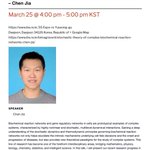
Stochasticity is not noise—it’s the signal behind cellular decision-making.
Join our BIMAG Colloquium with Chen Jia on the stochastic theory of complex biochemical reaction networks.
Mar 25, 4–5 PM (KST)
Zoom: 997 8258 4700 (pw: 1234)
#MathematicalBiology #ComplexSystems
