

The India Human Development Survey (IHDS) is a nationally representative, multi-topic survey of 41,554 households in 1503 villages and 971 urban neighborhoods.
New Delhi
Joined February 2015
- Tweets547
- Following73
- Followers1.1K
- Likes578






Does education move everyone towards better employment at the same pace?
New research by IHDS team members @SonaldeDesai (Professor and Centre Director, NCAER-National Data Innovation Centre; Distinguished University Professor Emerita, University of Maryland) and @Pallavi_Econ (Professor and Deputy Director, NCAER-National Data Innovation Centre) using panel data from @NCAER’s India Human Development Survey (IHDS) examines how college education shapes access to white-collar jobs among young men in India.
The findings suggest that education can facilitate movement away from casual work, but the occupational escalator moves faster for those from privileged backgrounds, potentially reinforcing existing inequalities even as educational attainment expands.
Read More: linkedin.com/safety/go/?url=…

1
100
Using two rounds of @ncaer's IHDS data (IHDS-I & IHDS-II), new research examines how borrowing to meet non-communicable disease-related healthcare expenses can contribute to household impoverishment. By incorporating loan repayments into the measurement of household consumption, the study identifies financial vulnerability that may remain obscured when impoverishment is assessed using conventional consumption-based measures alone.
Read More: ncaer.org/wp-content/uploads…

2
86
Explore the latest findings from the October edition of the IHDS Research Digest📊
Using @ncaer's India Human Development Survey data, this issue features (a) research exploring how healthcare-related borrowing and loan repayments can reveal hidden dimensions of impoverishment, and (b) a study examining how the occupational benefits of college education differ across socioeconomic backgrounds. Together, the findings highlight how financial pressures and unequal returns to education shape economic outcomes in India.
Read the issue to explore the findings:
ncaer.org/wp-content/uploads…

Does housing precarity change the pathways to basic services?
New research by Amrita Vijay Jain and @borateaishwarya utilises @ncaer's IHDS-II data to examine patronage and collective action networks as pathways to accessing water, electricity, sanitation and cooking gas. The findings suggest that materially precarious households make greater use of both, while socioeconomic resources are associated with stronger network-mediated benefits.
Read More:
ncaer.org/wp-content/uploads…

1
92
How does irrigation access shape what farming households eat?
Using @ncaer's IHDS-II data, new research by @rajan_abhis and @OlesyaAgEcon examines the effects of irrigation on household food consumption and diet quality. The findings suggest shifts in the consumption of some foods such as milk and wheat, with effects on several nutrient-rich foods appearing more limited. A stronger correlation between groundwater irrigation and nutrient-dense food consumption in the findings points to the potential for more nutrition-sensitive irrigation policies.
Read More:
ncaer.org/wp-content/uploads…

1
63
Can protecting children online also protect their digital opportunities?
A new op-ed by IHDS Team member @DibyasreeG (Associate Fellow @ncaer), co-authored with @garimaagar54890 (Analyst, Public Policy, @tqh_policy), draws on findings from IHDS-III to examine inequalities in children’s digital access and participation in India. The article highlights the importance of designing child-safety measures with both protection and participation in mind, recognizing that children experience the digital world from unequal starting points.
Read the full article here: thehindubusinessline.com/opi…

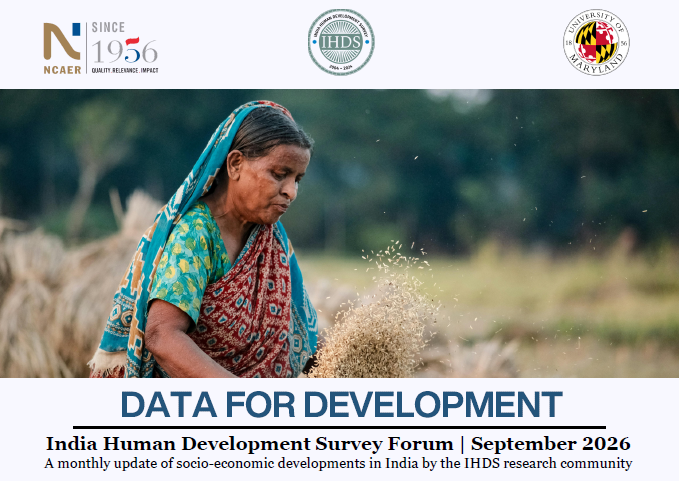
Explore the latest findings from the September 2026 edition of the IHDS Research Digest📊
Using @ncaer's India Human Development Survey data, this issue features (a) research exploring how irrigation access influences food consumption and diet quality among farming households, and (b) a study examining how housing precarity shapes urban households’ reliance on social networks to access basic services. Together, the studies highlight how material conditions and access to resources shape pathways to essential services and household well-being.
Read the issue to explore the findings:
ncaer.org/wp-content/uploads…
One of most striking finding of IHDS-3 is the changing size and structure of Indian household. Fewer children, smaller households, more elderly living alone or only with spouse. We may need to start asking what is a family, not just what is a household.

India Human Development Survey (IHDS) retweeted

Explore the latest findings from the August edition of the NCAER IHDS Research Digest📊
Using @ncaer’s India Human Development Survey data, this issue features (a) a study examining how early-life exposure to extreme heat is associated with children’s learning outcomes, and (b) research exploring the relationship between social networks and household participation in risky financial markets. Together, the studies highlight how environmental conditions and social connections shape human capital formation and economic decision-making.
Read more: ncaer.org/wp-content/uploads…

India Human Development Survey (IHDS) retweeted
The April edition of the NCAER IHDS Research Digest is out now!
Drawing on NCAER’s India Human Development Survey data, this issue features: (a) a study on intergenerational height disparities, highlighting the role of parental characteristics and education, and (b) research on how domestic remittances influence food security through market-based pathways. Together, these studies show how family conditions and income flows shape inequality and well-being.
Read more: bit.ly/4w2GAOd

India Human Development Survey (IHDS) retweeted
How have women’s lives in India changed over the past two decades?
On the occasion of Women’s History Month, this special issue of the NCAER’s IHDS Research Digest draws on two decades of @ncaer’s India Human Development Survey data to examine gender transformations in India. It highlights significant gains in women’s education, evolving family norms, and improvements in everyday well-being, while also drawing attention to persistent inequalities in household responsibilities and labour market participation.
Read more: bit.ly/4dpOJp3

India Human Development Survey (IHDS) retweeted
Can household financial shocks produce gender-differentiated educational setbacks?
New research using @ncaer’s IHDS-I and IHDS-II data shows that gender differences in secondary school dropout are shock-specific, with distinct patterns depending on the type and persistence of household economic adversity. Although girls have lower average dropout rates, their vulnerability increases under certain financial hardships, while boys are more likely to drop out in response to shocks that create immediate income pressures.
Read more: bit.ly/4cElQoW

India Human Development Survey (IHDS) retweeted
📢 The February edition of the NCAER IHDS Research Digest is out now!
Using @ncaer’s data from the India Human Development Survey, this issue features (a) a study examining how household financial shocks produce gender-differentiated impacts on education and (b) research comparing the relative influence of education and wealth in shaping mortality risk in mid-adulthood.
Read more: bit.ly/4cElQoW

India Human Development Survey (IHDS) retweeted
NCAER webinar on Gender Transformation: Insights from the India Human Development Survey (IHDS), March 3, 2026 at 6:30 PM IST.
Celebrate Women’s History Month by joining the NCAER IHDS team, for a discussion on emerging insights from a survey of more than 40,000 households between 2004 and 2024.
@SonaldeDesai | @Pallavi_Econ | @snsharma | @DebasisBarik25 | @jruchi6 | @DibyasreeG | @ihdscorner
Register in advance for this webinar here: ncaer.zoom.us/webinar/regist…

India Human Development Survey (IHDS) retweeted
When migration reshapes livelihoods, who bears the hidden health costs?
Using @ncaer's IHDS-I and IHDS-II data, new research examines women’s health in migrant and non-migrant households in India, finding lower BMI and higher undernutrition among women left behind. The findings highlight how women’s empowerment and social networks interact with migration dynamics to shape health disparities, underscoring the need for supportive social and institutional frameworks.
Read the issue to explore the findings: bit.ly/3O5DOpQ

India Human Development Survey (IHDS) retweeted
When transfers are unconditional, what happens to learning?
Using @ncaer's IHDS-I and IHDS-II data, new research examines whether a Samaritan’s Dilemma arises from in-kind transfers to elementary school children in India. It finds differential learning outcomes between recipient and non-recipient children, highlighting how policy design, particularly incentive alignment, shapes the effectiveness of education-related transfers.
Read the issue to explore the findings: bit.ly/3O5DOpQ

India Human Development Survey (IHDS) retweeted
Explore the latest findings from the January edition of the NCAER IHDS Research Digest📊
Using @ncaer's India Human Development Survey data, this issue features (a) an analysis of how the design of education-related transfers shapes learning outcomes, and (b) an examination of how household migration relates to women’s health and nutrition.
Read the issue to explore the findings: bit.ly/3O5DOpQ

India Human Development Survey (IHDS) retweeted
How can reliable district-level income estimates be generated from limited survey samples?
Using @ncaer’s IHDS-I and IHDS-II data in conjunction with population census data from 2001 and 2011, this study applies a small area estimation framework to assess gaps in direct survey-based income estimates at the district level.
By integrating household survey and administrative data, the analysis demonstrates how model-based approaches enhance the reliability of income distribution estimates in both rural and urban areas.
Read more: bit.ly/4pcZaPb

India Human Development Survey (IHDS) retweeted
📢 The December edition of the NCAER IHDS Research Digest is out now!
Using @ncaer’s India Human Development Survey data, this issue features - (a) a study on how formal credit access influences labour allocation decisions among rural workers and (b) new research employing small area estimation (SAE) to address limitations of survey-based measures of district-level income inequality.
Read the issue to explore more: bit.ly/4pcZaPb
