




A free model that runs fully on your machine. No account, no monthly bill, and nothing you type leaves your computer.
Install Ollama (a free app for running models locally)
ollama pull igorls/gemma-4-12B-it-heretic-GGUF
ollama run igorls/gemma-4-12B-it-heretic-GGUF, then type /set nothink (with thinking on, answers get cut off)
Optional: ollama launch claude connects it to Claude Code, but tool use is still rough
It’s a 7.4 GB download and wants a GPU with 8–12 GB of memory.
It’s a modified Gemma 4 with the safety training removed, so what you do with it is on you. And fewer refusals don’t make it smarter: for real coding, cloud models still win.
Bookmark it. The day you hit a rate limit, you’ll want these 4 commands.

17
ilu4 retweeted
Addy Osmani, who works on Claude Code at Anthropic, has a concern about where AI is taking our minds.
He admits that his AI agents now cover so much of his daily work that he hardly has to think critically anymore.
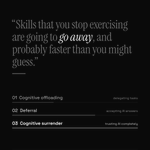
In his view, the slide into mental dependence happens in three steps. First comes cognitive offloading, where you hand routine tasks to AI. Next is deferral, where you start taking its answers at face value. The last step is cognitive surrender, where you trust it without question.
His warning is that any ability you stop practicing fades, and it fades faster than most people expect.
ilu4 retweeted
This repository gives you a free team of AI workers running directly on your hardware
Forget messaging back and forth with single chatbots. This tool deploys an entire company on your computer: the lead manager automatically distributes tasks, while specialized agents write code, research information, and handle routine work without your involvement.
You just set the overall goal, and the system figures out who handles what. Full privacy, zero subscriptions, and 100% local operation.
Bookmark this before it goes viral. Link to the repository is in the comments.

ilu4 retweeted

It is hard to believe, but 66,000 GitHub stars went to a way of running Claude Code without paying Anthropic
1. Open github.com/Alishahryar1/free…, on Mac or Linux run the curl installer from the README
2. Run fcc-server on Linux or open the Free Claude Code app on Mac and Windows, it opens the Admin UI
3. Turn on Proxy Authentication with your own token, by default the proxy is open to your whole network
4. Create an API key at build.nvidia.com, paste it under Providers, NVIDIA NIM, Add key, Save, then click Apply
5. Start the agent with fcc-claude
6. Switch in the native /model picker among providers you set up, 61 in the catalog, free and paid, DeepSeek, Kimi, Groq, Ollama
7. Add Fallback Models so a dead provider rolls to the next one, a failed request can consume usage from more than one
Free routes mean other models, not Claude, Anthropic does not support this, and your code goes to the provider unless it is local
The README claims 1.3B+ free tokens a month, availability and limits are set by each provider and can change
Full guide in the article below


One of them, Haggle Bot, according to the company itself, found more than $100K in savings in its first week by going through spend and contracts and preparing negotiations. And that’s just one bot out of 134.
I put them all into one video and scrolled through them by number. There are bots for outbound sales and lead finding, for hiring and sourcing people, for nightly code audits and testing, for SEO and ads, and for expenses, invoices, and contracts. There are personal ones too: a bot that hunts for an apartment and a bot that picks a credit card.
The main thing is that they work around the clock and actually do the work instead of just answering in a chat.
Links to the bots and the template marketplace are in the comments. ↓
Save this post. When you start building your own bots, this list will save you a ton of time, and I won’t be putting it together a second time.

This prompt turns an AI agent from "writes code however it feels" into "finishes the job on its own"
Drop it into CLAUDE.md and forget the endless "now fix this one more thing":
1. Plan first. Any task with 3+ steps starts with a plan. If something goes sideways, stop and re-plan instead of pushing through
2. Subagents for the side work. Research and parallel analysis go to separate agents, so the main context stays clean
3. Self-improvement loop. Got corrected? Write the rule into tasks/lessons.md. The same mistake never happens twice
4. Not "done" until it's proven. Tests, logs, a diff against main. Ask yourself: "Would a staff engineer approve this?"
5. Elegance, without the fanaticism. Feels hacky? Redo it with everything you know now. Don't overcomplicate small fixes
6. It fixes bugs itself. Got an error, a log, or a failing CI? It sorts it out without hand-holding
Plus three principles: simplicity, root causes instead of patches, and touching as little code as possible
Full text in the video above.
Bookmark this. You'll want it tomorrow, and you won't feel like hunting for it.
ilu4 retweeted
I made AI build a device that’s 2,000 years old, and it works
The Antikythera Mechanism: 33 bronze gears that tracked eclipses and lunar phases before the common era. Now it’s a 3D simulator: spin it, cut it open, explode it into parts, and watch how every gear moves the pointers.
Claude Opus 5.5 built it with Teardown, a free skill from SkillMD. All you need is a reference image and a couple of lines of text.
→ a model driven by real physics equations, not just an animation
→ take it apart and run it with one click
→ open source, works through Claude Code
The skill is in the comments ↓
Bookmark this post: in a week everyone will be asking how it’s done, and you’ll already have the answer.
ilu4 retweeted
You’ve been writing prompts wrong for 2 years. Here’s what the AI actually sees
I took one question: “How do I start saving?”
Then I pulled blocks out of the prompt one at a time. Watch what happens
The full prompt = 4 blocks:
ROLE: who is answering
CONTEXT: who it’s for (25 years old, $3,000 a month, no savings)
FORMAT: what shape the answer takes
CONSTRAINTS: the limits (no jargon, under 50 words)
The answer comes out sharp: move $300 to savings every payday, aim for a 3-month cushion, keep it in a separate account. Straight to the point.
Now remove one block at a time:
• No role: there’s an answer, but the tone is gone. The model doesn’t know who to be
• No context: “save 10-20%, pick an amount.” Advice for everyone, which means advice for no one
• No format: the answer turns into one solid wall of text instead of steps
• No constraints: the AI starts rambling about inflation and the Fed’s rate instead of just helping
The takeaway: a bad answer is usually not the model’s fault. You just didn’t give it one of the four blocks.
Each block controls its own part of the answer:
role → tone and voice
context → numbers and your situation
format → structure
constraints → length and boundaries
Next time an AI answer disappoints you, don’t switch models. Check which block is missing.
Bookmark this post.
ilu4 retweeted
Your notes are dead. Here's how to turn them into a Claude-run "second brain" in 5 minutes (for free)
Obsidian keeps notes as plain text files on your own computer. That means Claude Code can read and write them directly.
Three free, open-source projects handle the setup:
1. obsidian-skills
By Steph Ango, Obsidian's CEO (50K stars on GitHub).
Teaches Claude Code, Codex and OpenCode Obsidian's native formats: wikilinks, Bases, Canvas, the command line.
2. claude-obsidian (16K stars)
Drop articles, papers or notes into an inbox folder. Claude will:
- write linked notes with sources
- answer questions from your vault with citations
- check for dead links
Start with: /claude-obsidian:wiki
3. obsidian-second-brain (5K stars)
Long-term memory for Claude Code, Codex and six other agents, kept right in your vault.
Start with: /obsidian-init
All three are MIT-licensed, so they're completely free.
Link and install command in the comments below ↓

I made AI build a device that’s 2,000 years old, and it works
The Antikythera Mechanism: 33 bronze gears that tracked eclipses and lunar phases before the common era. Now it’s a 3D simulator: spin it, cut it open, explode it into parts, and watch how every gear moves the pointers.
Claude Opus 5.5 built it with Teardown, a free skill from SkillMD. All you need is a reference image and a couple of lines of text.
→ a model driven by real physics equations, not just an animation
→ take it apart and run it with one click
→ open source, works through Claude Code
The skill is in the comments ↓
Bookmark this post: in a week everyone will be asking how it’s done, and you’ll already have the answer.
Teardown skill:
skillmd.com/skills/elvaroffi…
Or via terminal:
npx skillmds add elvarofficial/teardown

2
61
Your notes are dead. Here's how to turn them into a Claude-run "second brain" in 5 minutes (for free)
Obsidian keeps notes as plain text files on your own computer. That means Claude Code can read and write them directly.
Three free, open-source projects handle the setup:
1. obsidian-skills
By Steph Ango, Obsidian's CEO (50K stars on GitHub).
Teaches Claude Code, Codex and OpenCode Obsidian's native formats: wikilinks, Bases, Canvas, the command line.
2. claude-obsidian (16K stars)
Drop articles, papers or notes into an inbox folder. Claude will:
- write linked notes with sources
- answer questions from your vault with citations
- check for dead links
Start with: /claude-obsidian:wiki
3. obsidian-second-brain (5K stars)
Long-term memory for Claude Code, Codex and six other agents, kept right in your vault.
Start with: /obsidian-init
All three are MIT-licensed, so they're completely free.
Link and install command in the comments below ↓
npx skills add github.com/kepano/obsidian-s…

1
38
You’ve been writing prompts wrong for 2 years. Here’s what the AI actually sees
I took one question: “How do I start saving?”
Then I pulled blocks out of the prompt one at a time. Watch what happens
The full prompt = 4 blocks:
ROLE: who is answering
CONTEXT: who it’s for (25 years old, $3,000 a month, no savings)
FORMAT: what shape the answer takes
CONSTRAINTS: the limits (no jargon, under 50 words)
The answer comes out sharp: move $300 to savings every payday, aim for a 3-month cushion, keep it in a separate account. Straight to the point.
Now remove one block at a time:
• No role: there’s an answer, but the tone is gone. The model doesn’t know who to be
• No context: “save 10-20%, pick an amount.” Advice for everyone, which means advice for no one
• No format: the answer turns into one solid wall of text instead of steps
• No constraints: the AI starts rambling about inflation and the Fed’s rate instead of just helping
The takeaway: a bad answer is usually not the model’s fault. You just didn’t give it one of the four blocks.
Each block controls its own part of the answer:
role → tone and voice
context → numbers and your situation
format → structure
constraints → length and boundaries
Next time an AI answer disappoints you, don’t switch models. Check which block is missing.
Bookmark this post.
ilu4 retweeted
After an initial task was set, a Claude research model wrote an exploit that remotely runs commands with root privileges on a Linux server.
No password. No action from the user.
How it works:
The core is CVE-2026-98432, a use-after-free flaw in the kernel’s network stack. During parallel handling of TCP requests, one part of the code frees data while another is still using it.
The attack ran in two stages. First, it bypassed KASLR, the mechanism that randomizes where the kernel sits in memory (48 minutes). Then it took control and ran a command as root (about 5 minutes).
But there are important caveats:
It only works in a specific configuration with Multipath TCP (MPTCP). If you don’t have it enabled, this scenario doesn’t affect you.
Anthropic used an internal, unreleased model. You can’t reproduce this with an ordinary chat prompt.
Risk ratings differ sharply. The Linux team gave it 9.8 on CVSS, while Red Hat gave it 5.9, citing how hard it is to exploit.
What to do:
The patch is already merged into the mainline Linux branch and the supported stable branches. Check for an update from your distribution vendor.

ilu4 retweeted
Still paying for five AI subscriptions? You don’t need to
Making one AI video usually means five logins, five bills and a pile of open tabs.
Sunra squeezes all of that into a single API key.
That one key opens the best image, video, voice and 3D models, including Seedance 2.5, Kling 4.0 and GPT Image 2.5.
Why it holds up:
1. It’s connected straight to the teams that build each model, with no middleman.
2. You get exactly the model you ask for. No quiet swaps behind the scenes.
3. Fast, secure and made for real production work.
Your console shows every call, itemized.
4. You pay what each model’s creator charges. No subscription on top.
The old way: a separate app and account for every AI.
The new way: one key, and everything else follows.
Save this one. The next time your workflow turns into a graveyard of tabs, you’ll know where to look.