

🦞AI Apps investing @ A16Z; A1111; Boards of Ethos, Krea, Deel, Clutch, Untitled, Happy Robot + more; If you’re not at the table, you’re on the menu
San Francisco
Joined March 2009
- Tweets4.1K
- Following3K
- Followers35.7K
- Likes38.7K








Anish Acharya retweeted

Excited to announce the Cosign Awards: celebrating exceptional people, companies, and products that had a massive impact in 2026.
cosign.co/awards
Anyone can nominate and vote. Award winners will be chosen by the public in conjunction with a panel of judges, including industry leaders like @lennysan, @packyM, @amasad, and many more. We’ll host an event in December honoring the winners (10 per category).
For people categories, we’re mostly focused on everyone except the CEO–everyone else building the company behind the scenes.
Companies with the most amount of people nominations will be listed on our “Top Companies to Work For” page.
True to form, at Product Hunt I helped launch the Golden Kitty awards a decade ago to recognize great products. Soon after I launched the Rise Awards, honoring executives and ICs building companies that make them. The Cosign Awards is the next iteration.
We have 41 categories across people, companies, and products.
People categories:
- Future Founders
- Rising Stars
- Engineering
- FDE
- Product
- Design
- AI Researchers
- Marketing
- Comms
- Growth
- Chief of Staff
- Operations
- Talent
- Finance
- Public Intellectuals
- Podcaster of the Year
- Newsletter Author of the Year
- Poster of the Year
Company categories:
- Rising Stars
- Best Place to Work
- Founder Mafia
- Talent Density
- Highest Aura
Product categories:
- Product of the Year
- Launch of the Year
- AI Assistant
- AI Language Model
- AI Coding
- Dev Tools
- Open Source
- Consumer
- Productivity
- Creative & Media Tools
- Product Design & UX
- Enterprise B2B
- Hardware
- Robotics
- Self-Driving
- Healthcare
- Vertical Fintech
- Legal

Anish Acharya retweeted

Krea 3 Ultra lands at #5 on AA-Image-Editing v2.1, with quality similar to Nano Banana 2.1 and MAI-Image-2.6
Krea 3, released on October 15, is Krea's new image editing model and its first on our Image Editing leaderboard. Today Krea adds Ultra, its highest thinking mode, alongside the default Fast mode, and we tested both modes through the Krea API at 2K resolution.
Krea 3 Ultra is the highest-ranked image editing model from outside OpenAI, Google and Microsoft. It places in the top 7 in 15 of our 17 Image Editing categories. Its best results are in Animation & Gaming and Frontier, at #2 in both. Krea 3 Fast, the default mode, lands at #11.
On the Krea API, Krea 3 Fast costs $0.03 per 1K image, plus $0.02 per 1K reference image. Krea 3 Ultra supports 2K output only, and costs $0.27 for a 2K edit with one 1K reference image.
Krea 3 is available on Krea's API and through other 3rd party APIs.
Congratulations to @krea_ai on the release!
See below for our analysis and example outputs of Krea 3 in the Artificial Analysis Image Arena 🧵
There are two really interesting bets here:
- Agents in human group chats require a new social contract. A dedicated app lets you establish it with agents in the room from day one.
- Personal agents need more than a chat interface. Rich mini-apps give people a shared place to plan, play and get things done together.
Very cool to see the personal agents space heat up with thoughtful bets in very different directions. Congratulations @ekuyda & team!

Wabi 2.0 is live!
personal agents are one person, one chat. but the parts of life that matter run on more than one person
Wabi is an agent you use together. you talk to it, it does stuff, builds the apps you need, and anyone can join the thread - your partner, your best friend, the preschool moms groupchat
school changes pickup time → Wabi updates the family calendar, everyone sees it.
a show you’d both love → Wabi finds a night that works, gets the tickets.
the trip everyone keeps talking about → Wabi picks the dates, builds the itinerary, books it
go start a thread with your people 👇
Anish Acharya retweeted

Wabi 2.0 is live!
personal agents are one person, one chat. but the parts of life that matter run on more than one person
Wabi is an agent you use together. you talk to it, it does stuff, builds the apps you need, and anyone can join the thread - your partner, your best friend, the preschool moms groupchat
school changes pickup time → Wabi updates the family calendar, everyone sees it.
a show you’d both love → Wabi finds a night that works, gets the tickets.
the trip everyone keeps talking about → Wabi picks the dates, builds the itinerary, books it
go start a thread with your people 👇
🤖 Made with AI
One of the key ideas that's bouncing around right now is that team productivity != sum of individual productivity in areas outside of coding.
Besides being a beloved product I think Town has the right POV on product architecture and how the gains in software eng get realized by every other team - you need a multiplayer system that you can redesign entire job functions around rather than a cowork style desktop app for better email/spreadsheet etc.
Congratulations @jgreze & team!!

The biggest bottleneck at work is waiting on each other.
Today Town is announcing its $108M Series B, co-led by Forerunner Ventures and Menlo Ventures, to fix it with multiplayer AI assistants for work.
Most AI assistants are built for one person. Work doesn't happen alone. I think the moat is multiplayer. Everyone at a company gets a Townie. Townies ask each other questions, share only what their person would share, and do the work. The more a team works together, the more useful Townies get.
What's the thing you're always waiting on a teammate for?
what we're picturing vs what we're getting 😂
🤖 Made with AI

Anish Acharya retweeted

Sooo incredible. I feel like we’re reliving the early Internet all over again. But juiced 10000x

Лучшее, что я видел за последнее время — чел пилит ASCII MMORPG, в которой вся графика состоит из букв и символов.
Да, буквально весь мир, персонажи, окружение и спецэффекты нарисованы разноцветным текстом.
Автор сейчас экспериментирует с магией, визуалом и боссами. Я прям залип на то, как из нескольких десятков символов получается такая красота.
Буквально сны при температуре 37,2.
Via: tiktok.com/@Ansenjeo
Gaming has got to be the market with the most shattered dreams, unkept promises, and beautiful ideas that never saw the light of day.
People get into it for the love of the craft and end up resentful, ground down by the realities of production schedules and brutal market forces.
If nothing else, it’s going to be awesome that anyone with a game idea can finally see their creation come to life. Even if it’s just to discover that their idea isn’t actually that interesting, and they’d rather work on someone else’s better game instead.

Re everyone can win — yes. Positive-sum outcomes are as hard to intuit as exponential growth, so we tend to underprice the possibility.
IMO we’re in the greatest positive-sum melt-up of all time, where we get to break every trade-off since the Industrial Age started. GDP can grow 10% AND the workweek can compress to four days AND the qualitative experience of every white-collar professional and individual consumer can go way up.
There are lots of precedents for everything getting better — no one would argue that life was better in the Middle Ages, and life today may seem similarly brutish in retrospect.
To use the Baptists and Bootleggers frame, there are a few earnest Baptists who are extrapolating from progress in areas like math/code to non-verifiable domains in ways that probably don’t make sense. Further, Dario has talked about economic diffusion as a point of attenuation for model impact, and anyone who uses models at work can tell you this is true. We may also simply be overestimating the number of problems that are intelligence-bound.
Despite the warnings from Bootleggers whose business models are threatened by a frontier monopoly on tokens, the reality is that token distributions in the enterprise should be very heterogeneous just as different job functions select for different human traits. The best finance leaders are neurotic, and the best design leaders are highly open. It’s unusual to have a model that can capture outlier performance in these two opposing directions. In my view, the most rational model that matches what we’re seeing empirically is a hybrid of frontier, open, and emerging models like Jev that represent a totally different point on the Pareto frontier.
Finally, I think that we're pushing what's possible at a species level to a degree that we haven't ever seen before. It's everything amazing that's happening thanks to SpaceX. It's the rapid possible progress we may make in disease and longevity, and all of the theoretical breakthroughs that were on the doorstep thanks to agent swarms and models.
No one tells you when you're in the good old days, so let this be your warning :) All of which is to say, Gavin is brilliant and right. I think it’s all going to work.

1) Trying again.
TLDR: Everyone can win. Open-source, frontier labs, infrastructure, applications and most importantly the American people.
I understand all of the jitters about Anthropic losing share, real rates, spreads and second derivatives. Still think the most likely future outcome is a hybrid, multi-model future where almost everyone wins, open-weight tokens are likely the overwhelming majority of tokens, the dominant frontier model companies still do well albeit perhaps not the outcome that seemed possible in May and AI infrastructure/applications benefit immensely from the increased fragmentation, competition and lower margins at the model layer.
Lower margins at the model layer mechanically drive higher compute demand as long as someone is willing to pay for the training. And Jensen is obviously willing to be the “trainer of last resort.” As below-market compute contracts signed in 24/25 roll-off and reprice higher, cloud and neocloud revenue should continue to accelerate which will help address financing fears; I think we may be near peak external financing for this buildout. Noteworthy that using data from 3Fourteen Research, B200 clusters will generate a 37% IRR *if* their rental price declines 40% per year. Prices are still going up, but that IRR math is too ridiculous to print. 37% IRRs available at scale should get funded.
Re: this weekends controversy about MOUs, Anthropic’s $413 billion of real contractual commitments sounds scary. Reality is that it works out to roughly $31 billion of annual cloud spend, which is easily internally financed given their reported ARR, and $161 billion of spend at Broadcom which will be financed by Broadcom and private credit.
Continue to believe fragmentation at the model layer is the best outcome for ordinary Americans and humans everywhere. As I have said before, do not trust any 5-20 individuals to make the best possible decisions about the direction of this technology. I want as many AIs as possible to maximize the odds that they encompass the diversity of human values across the world and richness of human variation. And I want an AI that shares my own personal values. Safety, freedom and the maximization of human agency through democratization, distribution and diffusion vs. centralization. History has spoken on the dangers of the latter path.
Finally, from my perspective anything that slows this buildout down is net positive over the long-term as the biggest risk and worst outcome is an *actual* overbuild. We are structurally short watts, wafers and increasingly capital. That is all good. God forbid we were still in ZIRP, TSM ramped capex to 3x their current plan and we weren’t short turbine blades: there would almost certainly be an overbuild and a bubble. That would be terrible. Slower and smoother for longer is better both for investors and for the world. A terrible cyber event is the most plausible near term bear case IMHO, but AI cyberdefense ramping quickly and I was happy to hear Sholto say that cyber probably becomes defense dominant in the near future.
Longer, threaded version follows:

Congrats @typesafeai !!
What's so cool about Jev is that it breaks the tension between expensive, dynamic intelligence at runtime (w/ opex costs) and cheap, brittle intelligence at compile time (w/ capex costs). More:
- One tension between labs and their customers is the economics of coding agents vs general agents w skills / projects / memory
- We went from fat apps (most of 2025) to thin apps that mostly wrap intelligence, with code as a disposable artifact generated at runtime
- Generating code is a crystallization of inference. It captures business logic that could otherwise live in the model as static procedural logic. Cheap to run, but brittle
- The alternative is regenerating everything dynamically at runtime with PhD-level models w reasoning, memory, tools. More elegant / general, but the most token consumptive: you pay opex every time you use the app vs capex once
- This partially explains why labs have pushed so hard for skills / projects / agents over code first - the general agent approach drives far more token consumption
- Most runtime "intelligence" is small decisions: classify / route / score / pick. A fast, cheap System One model gives you dynamic intelligence at runtime for roughly the cost of compile-time code
- So the future stack should be code generated by models at compile time, Jev-style decisions at runtime, and frontier agents + tools reserved for genuinely open-ended work
I LOVE this model & I'm very excited to see what comes next.


What’s so interesting about this is that SpaceX is getting to eat their cake and have it too - they get the benefits of being a lab, vertical integration into inference, and being a Cursor style router.
They have a SOTA model so labs can’t bully them, they can capture margin on 3P models through inference, and somehow (Elon!) they have access to Suno and MJ as well. They can offer the overall best, the pareto best or the best for a tail modality and the house always wins.
Amazing on so many levels.

Anish Acharya retweeted

DO AGENTS HAVE NETWORK EFFECTS?
We are seeing a new wave of general purpose consumer-friendly agents, and it’s causing many thousands of AI startups to re-evaluate their place in the market. Will these new horizontal players take over completely? Will it be winner take all? Can products that focus vertical use cases survive? The new wave of products - Muse, Town, Instinct, Grokbot, etc - come from taking the power and magic of Openclaw/Hermes but wrapping it in polished, secure, consumer-friendly experience. This is only the beginning, and soon every major tech company will throw their hat in the ring and thousands of startups that have been working on vertical agents in X (travel, shopping, family, work, SMB, etc etc) have big existential questions to answer.
The simple case against winner-take-all dynamics: These agents are tools, not networks. They inherently provide a solo experience, and although packaged as chat experiences, they don’t have network effects the way that Whatsapp or phone networks do. They’re more like email clients - I can use Superhuman and someone else uses Outlook and someone else is on Gmail, but in the end we just send email to each other. In that metaphoi, if a Muse agent encounters a Instinct agent, they will just figure out how to talk to each other by building APIs, or using email/messaging/etc., so that there’s no advantage to everyone running the same thing. Further, you can swap out the underlying LLM - as we saw in the Claude vs Clawdbot saga - things will still work. The memory and underlying context are just text files, and AI are great at porting things from one system to another. So where’s the moat?
Just because they are tools today doesn’t mean they can’t evolve into networks. As I’ve written about in the past, instead of discussing “network effects” as a vague/amorphous concept, let’s instead overlay it against core KPIs each product has to build against:
- Acquisition network effects: More users** = lower CAC, higher virality, more signups
- Engagement effects: More users = higher retention, deeper usage, more frequency
- Monetization effects: More users = higher ARPU, higher conversion, more share of wallet
(**PS. and by “more users” of course I actually mean, of course, higher network density with more interconnection within/across networks. Not scale effects)
So looking at these sub-categories of network effects, you might ask: What are the features that you’d build to actually create network effects in agents? How does this category become winner-take-all?
Acquisition:
In the pre-AI world, network effects in customer acquisition were driven by users taking actions that then bring in even more users - whether that’s sending an invite, sharing a piece of content, or getting mentioned in a comment. Those users would then join the network, repeat the same actions, creating more viral loops that would throw off more users. In the post-AI world, both users and agents can initiate these loops. An agent might suggest, “hey, do you want me to help organize a New Years celebration with family” and then might pull together a group chat with your siblings, in-laws, and parents. It might build a microsite for the event and ask people to sign up and RSVP, creating an opportunity to generate a signup. Or for work, you might finish a slide deck and your agent asks if you want to pull together a meeting to present it to your team. When it does that, it might create a prep doc, take notes, and host it all on a microsite that engaged others.
These types of agentic viral loops need a few things to work: They need to be able to plug into your contacts, and to have enough context to know when to loop which people into which projects/events/activities. They need access to communication channels like email/messaging/otherwise, specifically where they can reach potential users, as this serves as the viral substrate for propagation. The magic will be how to get all of these things without being creepy, and to create enough trust to reach out to friends/colleagues/etc on your behalf, without being too push. No one wants an agent that says, “hey Andrew would like to get lunch next week” followed by “and sign up for this agent to agree!” - it has to be better and more subtle than that.
Many viral loops in the pre-AI era, particularly in the workplace, were built on a content creation loop - you use Google Slides to make a thing, you share a link, and then people would view it. Eventually they might make their own. Many products like Figma, spreadsheets, Notion, Canvas, are all built on this loop, and so are YouTube, Instagram, etc. In the agentic world, you might start by talking to your agent about interior decoration ideas, and it might ultimately build you a Pinterest-like board and make it easily shareable with others. It might build you a spreadsheet mini-app with a budget, a schedule, etc., and again, make it easily shareable. It might volunteer to do this inside a group chat with your friends, and if they want to view it, they should sign up and get their own agent too.
If the content creation loop works for agentic virality, I think it means there’s a big incentive for every agent to volunteer to make visually-appealing, shareable content, do this often. AI is so good at codegen that creating a one-off disposable artifact will probably be more useful than not. And there’s a big incentive to drive virality by building/owning the content yourself as the agent. In the interior decoration example, it would be more viral to create a standalone version hosted by the agent, rather than building an actual Pinterest board, or to build a self-contained mini-spreadsheet rather than creating a GSheet. A properly tuned agentic viral loop will do the former because it helps spread the agent, rather than helping spread Pinterest/GSheets.
This might all sound like horrific spamminess to you, but I think it might be done tastefully. If an agent is high-retention and high-usage, you’ll have many shots on goal to gradually invite your friends onto the same platform as you. The first shot might come from an invite loop that says your colleague/friend wants to set up a place to share photos/coordinate calendars/etc., and even if you say no, over time, your friend might share very useful microsites for projects or events or research that’s relevant, and you might decide that you want to sign up to leave a comment, but then eventually you might try the other functionality as well.
Engagement:
It’s easy to imagine that in a world where everyone by default has super intelligent agents that product engagement in agents would go up. The simple argument is that the ubiquity of agents would lead to more successful task completion, making agents more useful and applicable to more problems. Routine tasks like scheduling something or summarizing/sharing notes from a meeting, would happen instantly if it ran through agents and you removed humans completely. As agents become more successful over time, not only with your own tasks but in coordinating larger and more complex multi-user decisions, you’d end up using them more.
However, this does not answer the question of network effects. The question there is, does your agent get better when other people are all using the SAME agent? As I said earlier, the argument for NO is if each type of agent runs on a frontier AI model, can talk to other agents (all different types) in real-time via email/messaging/APIs/connectors/etc. Then there’s not much leverage. If you’re just organizing a meeting or a dinner party or meeting the agents just ask each other in real-time - and even if they are heterogeneous - they can use email and calendars and figure it out.
But some tasks do benefit from everyone running the same agent, because you get the benefits of centralization: Trust, speed, identity, discovery, etc. Some examples:
- “Who are 10 people in San Francisco that I should meet?” - agents can’t just ask each other to find an optimal solution
- “Find me a VP of Engineering who isn’t publicly looking for a new job, but would leave for a fast-growing startup that pays X in stock” - there’s a mix of private and public info here, and an agent of a passive jobseeker might lie if the asking agent is not trustworthy
- “Who’s a trustworthy seller of X that I should buy from?” - reputation might be gamed, and it might be better to have a global source of truth
- “Help me pick out the best dinner in the next 5 minutes that my friends and all their +1s would like, incorporating allergies/schedules/locations” - real-time solution incorporating a bunch of shared context
- … and even more so, if you imagine that there may be agents that lie, exaggerate, or otherwise to benefit their humans
For the above examples, you could imagine Muse/Town/Instinct/whatever building a shared network+context layer that understands the network, its relation to public/private data, acts as a system of record for identity/trust, does multi-sided marketplace matching, etc. Then it would allow only its agents access to this platform, and agents outside of the network wouldn’t have access. If you’re part of this network, and are contributing data, your agent gets more useful over time. The network gets more powerful over time.
The counterpoint to this counterpoint is that perhaps new startups will fill the void as a series of agent-facing point solutions, making it possible for people running agents of all times to interface with each other. Perhaps Muse creates a proprietary ecommerce marketplace that only Muse agents can use, but perhaps there will just be a next-gen eBay for any agent to sell to any other agent, and this service maintains central reputation/identity at that layer. In other words, perhaps the centralization will still happen, but just at a layer above agents. Most likely both will happen - every large tech company adds chat, commerce, search, etc, but also there are pure play versions of each of these. But this feels like more fragmentation than a true winner-take-all.
Some parting thoughts:
My argument in this writeup is simple: Agents don’t inherently have network effects. If all we build are super-intelligent assistants that can use tools and talk to each other, then the category might look surprisingly fragmented. Your agent can talk to my agent, just as Gmail can send email to Outlook, and there’s no particular reason we need to use the same one. Better models, UX, integrations, memory, and distribution might create very large companies, but those are not network effects.
But the next gen of agents have a big opportunity design network effects in their interactions. On acquisition, they can turn the things they create—documents, events, websites, research, group chats, plans—into viral objects that naturally pull other people in. And on engagement, they can create shared networks of identity, reputation, relationships, private context, and intent that make the agent increasingly useful as more of the people around you join.
There’s many ways for these network effects to instantiate. If we’re lucky, things will look more like the open web - mostly decentralized, with bits of centralization to make certain tasks smoother. Identity could become an open protocol. Reputation could live in marketplaces. Commerce could happen through an agent-native eBay. Professional discovery could happen through an agent-native LinkedIn. Agents could remain interchangeable clients sitting on top of a constellation of networks and marketplaces, much as browsers and email clients do today. In that world, enormous network effects emerge around agents without producing a winner-take-all market for the agents themselves.
My guess is that we’ll see a fight over exactly this boundary. Every major horizontal agent will try to pull valuable network functionality inside its walls: host the artifact instead of creating a Google Doc, execute the transaction instead of sending you to Amazon, make the introduction instead of searching LinkedIn, create the event instead of using Partiful. Every time it does this successfully, it converts somebody else’s network effect into its own. Meanwhile, every incumbent network and a new generation of startups will have the opposite incentive: make their networks universally accessible to every agent so that no horizontal agent can recreate and capture them.
This is why I don’t think the interesting question is simply, “Will agents have network effects?” Of course some will. The much more consequential question is: Where will the network effects live? If they live primarily in open protocols and specialized networks, we may end up with thousands of agents competing on intelligence, personality, UX, specialization, and price, all interoperating with the same underlying ecosystem. Vertical agents can thrive in this world. But if a few horizontal agents successfully accumulate identity, relationships, private context, reputation, latent intent, and distribution - and keep those assets proprietary - then switching agents starts to mean leaving your network behind. Next couple years will be very fun to see how this plays out.
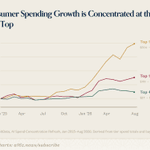
It's crazy that the top 1% of spenders have almost doubled monthly spend to almost $1,000 / month - demand here is very strong and demonstrates the opportunity to build "narrow startups": high-priced software with a very small N of customers.


🚨 The @a16z Consumer AI Top 100 is back - but this time, it's 150!
We added revenue data from @yipitdata to track how consumers are spending not just time, but money, on AI.
The result? A story of heavy concentration among AI's power users. Our takeaways 👇


Anish Acharya retweeted

The problem with consumer AI in a nutshell is if you hand an uninitiated user an agent, it's nothing but a blank box to them.
Coders get it instantly, but for everyone else it’s just not intuitive. Solve that, and you reach the next few hundred million real adopters.

The seventh edition of our Top 100 Consumer AI Apps is here, including a new dimension this time: what consumers are actually paying for.
a16z's Elena Burger sits down with Olivia Moore and Josh Elman to unpack the current state of consumer AI:
The data reveals a striking power-user economy. Only a small share of consumers currently pay for AI, but among those who do, spending is heavily concentrated at the top. Olivia and Josh discuss why developers, creators, and other power users dominate spending today, and why subscriptions may not be the business model that ultimately brings consumer AI to everyone.
They also dig into the rise of personal agents, the different trajectories of ChatGPT, Claude, and Gemini, how ads could reshape AI economics, and the enormous amount of consumer white space still left to build, from shopping and entertainment to social, dating, and marketplaces.
00:56 Inside the 7th edition
05:55 Muse and Instinct's launch numbers
09:14 The privacy wall for personal agents
14:39 The AI spending power law
20:20 Why subscription is the wrong model
23:51 OpenAI's $1B ad run rate
29:21 ChatGPT vs Claude vs Gemini
32:30 Where creative tools still win
45:12 The white space: dating, shopping, entertainment
YouTube: youtu.be/aCvrzhwUxg0
@omooretweets @JoshElman @VirtualElena
Anish Acharya retweeted

🚨 The @a16z Consumer AI Top 100 is back - but this time, it's 150!
We added revenue data from @yipitdata to track how consumers are spending not just time, but money, on AI.
The result? A story of heavy concentration among AI's power users. Our takeaways 👇
anecdotal but ~100% of my web searches have gone through personal agents in the last month or so
and it feels like the web is rapidly going both headless and generative - every UI is an API + just in time software & content will be the default
there is def a new OS emerging

This illustrates the challenge with personal agent unit economics.
It’s hard to play the game without a powerful patron in either venture dollars or lab partnerships.

Fun hanging w @EricNewcomer this week, topics:
- Lots of whitespace for vertical agents in areas like finance; this feels under competed today
- Computer use unlocks consumer fintech ambitions to improve the balance sheet of every American
- Opus 5.5 is as big of a deal for games and entertainment as Opus 4.5 was for code


Our download from the Machine Earning AI Summit newcomer.co/p/machine-earnin…
