

research @blockworks | fundamental investor | prev. @messaricrypto
Joined December 2021
- Tweets1.5K
- Following598
- Followers5K
- Likes7.7K



Pinned Tweet
this bull market feels like one where value investors actually get rewarded.
i'm the type of investor who finds a project i like and holds it for years. in past cycles, fundamentals and revenue were a meme.
that's changed with regulation passing and more projects producing real, sustainable revenue. holding high-quality projects should finally pay off.
so i built a fundamental value investing dashboard.
it ranks tokens mainly on tokenholder value accrual, then on product traction, team and governance, valuation, and dilution/supply.
each token gets bear/base/bull fair values, comps, a catalyst and unlock tracker, and technical analysis. it all rolls up into a quality vs value matrix.
of the 23 tokens in the first run, only $BTC and $HYPE make the buy tier on a 6-month time horizon.
it was built 100% on the @blockworks MCP: price, supply, unlocks, revenue, research, etc.
let me know if you'd want a live, interactive version, and which tokens i should add.

tokenized stocks just hit a record $3.6B.
that's 6.6x since the start of the year, when supply was $542M.
wallets holding them went from 160k in january to 5.1M today.
the growth isn't just riding the stock market either. the nasdaq fell 4.5% last week and tokenized stock supply grew 3%.
the top three chains are BNB chain ($1.46B), ethereum ($810M), and solana ($624M).
demand is already here, and the biggest U.S. venues haven't even launched yet.

appreciate the detailed corrections from @UmbraPrivacy co-founder @Abbasshaikh. i just updated solana:PRVT6TB7uss3FrUd2D9xs2zqDBsa3GbMJMwCQsgmeta on the scoreboard.
new 6-month horizon score is 2.7 (up from 2.3, but still underperform).
the reasons behind the updated score:
> NAV: $2.32M of DAO-owned cash, including the buyback vault and the DAO's AMM liquidity
> NAV per token: excluding the 13.5M locked team tokens (they get nothing in a liquidation until they unlock), solana:PRVT6TB7uss3FrUd2D9xs2zqDBsa3GbMJMwCQsgmeta trades at ~2.1x NAV
> token sales: one 697k OTC sale at ~$0.45 in may, then a 327k buyback at ~$0.20 in sept
> DAAY (dilution-adjusted accrual yield): -12.1% -> -1.5%
the DAO has actually been a net buyer of its own token over the past year, which is a good sign for how the treasury is run.
v1 has been charging fees for ~5 months and v2 is open to everyone. usage is still small tho. v1 did $4.87M of shielded volume from 2,239 depositors, and v2 has $262K of TVL so far.
fees aren't public yet. the team is publishing them with @01Resolved soon, and i'll rerun the score when they're out.


i am bullish privacy and of course ethereum:0xe76c6c83af64e4c60245d8c7de953df673a7a33d, so i wanted to see how privacy competitors like ethereum:0xa12cc123ba206d4031d1c7f6223d1c2ec249f4f3 and solana:PRVT6TB7uss3FrUd2D9xs2zqDBsa3GbMJMwCQsgmeta stack up on my fundamental crypto asset scoreboard.
---
let's start with @zama:
short answer is (unfortunately), like many crypto projects, it is great tech with a weak token.
zama is one of the leading FHE stacks with:
> $647.9M of all-time shielded volume
> $127.5M of shielded TVL
> $104M earning yield in confidential morpho vaults
but almost none of that reaches the token yet.
every protocol fee is paid in ZAMA and burned. the burn is live onchain with 91,064 ZAMA burned on july 17 and another 73,300 waiting for the next batch.
that works out to ~$22.5k a year of burns against an $865M FDV, or ~38,500x.
the supply is also growing a lot faster than it burns. staking mints ~5% a year and the foundation releases 114.6M ZAMA a month from treasury and growth.
net of burns, that's a -19.8% DAAY (dilution-adjusted accrual yield). and even if the foundation holds every tranche, it's -5.7%.
only 22.4% of supply circulates, and the first team and investor cliff hits feb. 2, 2027 (550M ZAMA, ~22% of circulating), then ~302M a month after that.
so even if burns grow 90x to $2M a year by next october, the base case is $0.017, 78% below where it trades today.
working backwards, today's price at fair value needs burns to go from $22.5k to ~$85M a year within 5 years. that's 3,800x, or roughly 5x every year.
in comparison, ethereum:0xe76c6c83af64e4c60245d8c7de953df673a7a33d does ~$4.69M a year in fees on a ~$152M FDV, and nearly all of it reaches stakers through the treasury. that's ~200x the fees at about a sixth of the size.
---
now let's take a look at @UmbraPrivacy:
umbra launched through @MetaDAOProject last october, raising $3M at $0.30 against $155M of commitments.
that makes it an ownership token. the treasury, the mint authority, and the IP all sit with a futarchy-controlled DAO, so the team runs on a $100k/month budget and anything above that needs a DAO-approved proposal.
so structurally, solana:PRVT6TB7uss3FrUd2D9xs2zqDBsa3GbMJMwCQsgmeta gives tokenholders a lot more than ethereum:0xa12cc123ba206d4031d1c7f6223d1c2ec249f4f3 does. the problem is there isn't much to own yet besides the cash.
v1 shielding was free and shielded TVL is only ~$100K.
the first fee sources only went live this week:
> v2 (still invite-only)
> the uUSDv stablecoin (umbra keeps 25% of the yield)
the treasury holds ~$1.4M of stablecoins, or ~$0.06 per outstanding token. at $0.46, solana:PRVT6TB7uss3FrUd2D9xs2zqDBsa3GbMJMwCQsgmeta trades at ~7.8x that, so the market is paying ~$9.5M for a business with no revenue yet.
it has also funded operations by selling treasury tokens, ~3.2M UMBRA over the past year or ~13.5% of outstanding supply. net of a small buyback, that's a -12.1% DAAY.
the positive is that insider tokens only unlock at price targets (2x to 32x the ICO price), and nothing unlocks for at least 6 months.
my base case values the business at ~$6M, roughly where the ICO priced it, plus the cash. that gets to $0.23, ~50% below today after a +136% month.
---
final scores at a 6-month time horizon:
> ethereum:0xe76c6c83af64e4c60245d8c7de953df673a7a33d: 3.0, neutral
> solana:PRVT6TB7uss3FrUd2D9xs2zqDBsa3GbMJMwCQsgmeta: 2.3, underperform
> ethereum:0xa12cc123ba206d4031d1c7f6223d1c2ec249f4f3: 2.2, underperform
FHE and privacy on solana could still become a big part of onchain privacy, but the tokens need to start capturing usage to be valuable.
ethereum:0xca14007eff0db1f8135f4c25b34de49ab0d42766 is up 258% since august.
while stablecoins on starknet are down 7% to $141M.
that's expected for now since price moves first and capital takes months to bridge over.
ethereum:0xca14007eff0db1f8135f4c25b34de49ab0d42766 doubled after oct. 8, when starknet said it is "actively considering" leaving ethereum to become its own L1.
but if that happens, stablecoins are extremely important.
as an L1, starknet can't lean on ethereum's security. ethereum:0xca14007eff0db1f8135f4c25b34de49ab0d42766 has to secure the chain, so its value rests on staking demand, fees, and monetary premium. all three are easier to justify with more activity onchain, and stablecoins are the base that activity runs on.
ethereum:0xca14007eff0db1f8135f4c25b34de49ab0d42766's current market cap is ~$642M, ~4.5x the stablecoins on starknet.
if the oct. 22 vote passes, watch starknet's stablecoins over the next few quarters. a growing base would help justify the rerating.

euro stablecoins are only 0.25% of the stablecoin market.
$768M of euro stablecoins onchain vs. $306.5B of dollar ones. that's around 400 dollars for every euro.
the share has barely moved, staying between 0.15% and 0.27% since jan. 2024.
today @qivaliseu, a group of 37 european banks including BNP Paribas, ING, and BBVA, got a dutch e-money license to issue a euro stablecoin.
licenses were never the bottleneck tho -- MiCA has allowed euro stablecoins since mid-2024. the hard part is demand as onchain trading, lending, and payments are mostly run in dollars.
37 banks bring distribution, so this is the first serious test of euro demand onchain.
if the share doesn't move, the dollar's lead onchain is deeper than it looks.

just refreshed prices on the dashboard for all 47 tokens.
5 moved into the buy tier at the 6-month horizon: $UNI, $SKY, $ETH, $SOL, and $TRX.
none of their fundamentals changed, only the price did.
$UNI and $SKY both fell ~16% this week, which pushed price below the base case. they’re also two of the few tokens on the board with positive DAAY, meaning burns and buybacks outrun new supply.
$ETH, $SOL, and $TRX are closer calls. $TRX’s base case is only ~0.2% above price, so a small bounce puts it back to neutral.

this bull market feels like one where value investors actually get rewarded.
i'm the type of investor who finds a project i like and holds it for years. in past cycles, fundamentals and revenue were a meme.
that's changed with regulation passing and more projects producing real, sustainable revenue. holding high-quality projects should finally pay off.
so i built a fundamental value investing dashboard.
it ranks tokens mainly on tokenholder value accrual, then on product traction, team and governance, valuation, and dilution/supply.
each token gets bear/base/bull fair values, comps, a catalyst and unlock tracker, and technical analysis. it all rolls up into a quality vs value matrix.
of the 23 tokens in the first run, only $BTC and $HYPE make the buy tier on a 6-month time horizon.
it was built 100% on the @blockworks MCP: price, supply, unlocks, revenue, research, etc.
let me know if you'd want a live, interactive version, and which tokens i should add.
seeing a lot of interest for solana:85VBFQZC9TZkfaptBWjvUw7YbZjy52A6mjtPGjstQAmQ on the timeline, especially as $SECZ beta.
@wormhole is @Securitize's exclusive cross-chain provider, but that doesn't pay solana:85VBFQZC9TZkfaptBWjvUw7YbZjy52A6mjtPGjstQAmQ holders anything.
wormhole does ~$45M in daily volume, which generates ~$226k in yearly fees. all of it goes to relayers, and protocol revenue is $0.
W 2.0 added the wormhole reserve, but the foundation runs it at its discretion, and it holds W rather than burning or distributing it.
also ~70.7M W unlocks every two weeks. that's ~28% of circulating supply over the next year, which puts DAAY at -27.9%.
so even with a fee switch, fees would need to be ~0.25% of volume just to offset dilution. and that’s nearly 200x what users pay today.
wormhole is a widely used bridge. solana:85VBFQZC9TZkfaptBWjvUw7YbZjy52A6mjtPGjstQAmQ just doesn’t capture any of it yet.
i have it at underperform on my scoreboard, with a base case around $0.0195, ~20% below today. a fee switch with disclosed reserve buys would move it up to neutral.

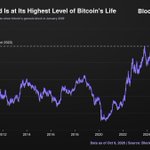
the 10-year treasury yield is at its highest level of bitcoin's life.
on oct. 5, it hit 5.31%, the highest since 2002.
and most recently, it closed at 5.24% on oct. 9. its prior highest close since bitcoin launched in 2009 was 4.98%, in oct. 2023.
higher yields mean investors can earn 5%+ in treasuries with almost no risk, so they need a bigger expected return to hold risk assets like bitcoin.
but so far, bitcoin has kept pumping anyway.
since $BTC bottomed on june 30, the 10-year is up from 4.44% to 5.24%. $BTC is up ~41% over the same period, to ~$82.8k.
this wednesday, the CPI report will released. if inflation comes in above the 0.6% monthly forecast, yields likely rise further and the fed is more likely to hike again before year-end.
but buyers have already absorbed the highest rates bitcoin has ever seen.

institutional ETH buying just flipped negative again.
spot ETH ETFs and ETH DATs are a combined -178k ETH so far in october.
the ETFs have had 8 straight days of outflows.
bitmine is the only treasury still buying, and tom lee says it stops at 5% of supply. it's at 4.93%.

hyperliquid open interest is back above its pre-10/10 level
today its at $15.4B and the day before last year's crash, it was $14.7B
then oct 10 hit and OI fell 54% in a single day, to $6.8B
it bottomed at $4.8B in february, got back above the old level on sept 6, and set a record $18.1B on sept 22.
the mix is different now tho. ~$3.6B of today's OI (~24%) sits in stocks, commodities and other non-crypto markets that barely existed a year ago.
crypto-only OI is still ~19% below where it was

tokenized stocks just hit a record $3.4B.
that's up ~8x from $429M a year ago, while total crypto market cap fell ~35%.
these are actual shares (apple, nvidia, tesla) wrapped as tokens, mostly backed 1:1, that trade onchain 24/7.
BNB Chain went from ~$0 to $1.2B after binance launched bStocks in june. ethereum holds ~$820M and solana ~$650M.
more is coming. securitize put 12 U.S. stocks on solana yesterday, and the NYSE is building a 24/7 tokenized venue.
$3.4B is still tiny next to the U.S. stock market. but it grew straight through the drawdown, and that's demand for blockspace + stablecoins that doesn't depend on crypto prices.

i just updated solana:HZ1JovNiVvGrGNiiYvEozEVgZ58xaU3RKwX8eACQBCt3 on the fundamental token scoreboard after this announcement.
the 6-month horizon score went from 2.8 to 3.1.
why it moved up:
> ARR is $11.5M, up 86% in a quarter, with 276 paying clients.
> 100% of DAO revenue now buys PYTH every month, no vote needed. before it was a third of the treasury per vote.
> ~72x FDV / ARR (down from ~90x), so my base case is now ~22% above price.
so why still neutral and not accumulate?
the bought PYTH goes into a DAO reserve. it isn't burned or given to stakers, so it's buy pressure, but holders don't have a direct claim on it.
and 2.1B PYTH unlocks in may 2027, which is 27% of circulating. at today's price that's ~$175M of new supply vs ~$7M a year of buybacks.
if the reserve gets burned, the score would move up.


maybe i'm midcurving, but i don't understand pearl-2:native as an investment.
don't get me wrong, i loved the idea of proof of useful work when i first heard about it, and i still do. @prlnet is innovative tech. i just don't see it as an investment.
it has:
> no cash flow to holders today, so for now the case is monetary like BTC. but BTC's supply grows ~0.8%/yr. PRL's circulating supply grows ~90% over the next year
> at $1.35, that's ~$1.4M/day of new supply going to miners who have GPU and power bills to pay, against $2 - 6M of daily volume
> AI customers pay for inference in USD, not PRL, so the useful work doesn't create demand for the token
> no moat yet. nothing stops someone from forking bitcoin and swapping in their own proof of useful work for AI compute. BTC's moat is 17 years of network effects, PRL is 5 months old
> only ~16% of the 2.1B supply has been mined, so a ~$455M mcap is a ~$2.8B FDV
> all spot volume is on two small exchanges (SafeTrade and BigONE) with ~$35k of bids within 2% of the price
so if you're trading the narrative short term, i get it. but fundamentally the tokenomics are unsustainable.
stablecoin holders are about to pass 300M.
we hit a record 298.2M this week, up 58% from a year ago.
that growth happened while crypto lost a third of its market cap.
and ~82M U.S. galaxy phones get USDC transfers through samsung wallet later this month.

the @RAILGUN_Project dashboard i built when i joined @Blockworks just got a huge upgrade
(h/t @mrwildcat7)
it's now split into four pages (overview, financials, staking, and privacy) and is much more granular:
> revenue by shield vs. unshield fees
> staked RAIL + amount in 30-day unlock queue
> staking inflows and outflows by type (claimed/unlocked/staked)
> private transfers by network
> private activity as a share of RAILGUN transactions
> anonymity set by notes created and spent
> transactions by type (shield/unshield/private transfer/relay)
a lot has changed since my july post too.
annualized revenue is $4.6M, or ~$382K a month vs. ~$288K in june. that takes the revenue multiple from 41.3x to ~31x.
staking yield nearly doubled from 4.3% to 9.1%.
and weekly transactions just hit an ATH of 5K.
you can access it for free here: app.blockworks.com/projects/…
raillions 🚀


ladies and gents, my first order of business at @Blockworks... creating a highly-curated RAILGUN data dashboard.
this is one of the most detailed @RAILGUN_Project dashboards out there, covering 20+ metrics.
i included data points that are not found anywhere else, such as revenue capture rate, revenue multiple, RAIL staking yield, and more.
here are a few examples of current data (as of july 8):
> cumulative volume: $5.28B
> june monthly revenue: $288.2K
> june revenue capture rate: 3.04%
> june revenue multiple: 41.3x
> circulating supply staked: 71.55%
> staking yield: 4.32%
you can check out the dashboard here: blockworks.com/analytics/rai…
railgun quant back in business 🫡


added 17 tokens to the dashboard, 40 total now.
the common conclusion is good businesses, weak tokens.
$MORPHO does ~$240M a year in fees with the fee switch off. $GRASS does ~$29M in revenue and has done one ~$350k buyback. $MET does ~$80M and pays stakers about 1/10th of it. all three add 15-30% new supply a year.
only $BTC, hyperliquid:native, and $CAKE make the buy tier at the 6-month horizon.
want the reasoning behind any token's score, or a new one added? let me know.

this bull market feels like one where value investors actually get rewarded.
i'm the type of investor who finds a project i like and holds it for years. in past cycles, fundamentals and revenue were a meme.
that's changed with regulation passing and more projects producing real, sustainable revenue. holding high-quality projects should finally pay off.
so i built a fundamental value investing dashboard.
it ranks tokens mainly on tokenholder value accrual, then on product traction, team and governance, valuation, and dilution/supply.
each token gets bear/base/bull fair values, comps, a catalyst and unlock tracker, and technical analysis. it all rolls up into a quality vs value matrix.
of the 23 tokens in the first run, only $BTC and $HYPE make the buy tier on a 6-month time horizon.
it was built 100% on the @blockworks MCP: price, supply, unlocks, revenue, research, etc.
let me know if you'd want a live, interactive version, and which tokens i should add.
hyperliquid:native is the only top-20 token near its ATH.
it's ~4% below the $98 peak.
1 year after $BTC topped at $126k, bitcoin is down 32%. the median top-20 token is down ~53% from its cycle high.
next closest to its high after HYPE is $ZEC, down ~21%.
what makes HYPE different is consistent buy pressure.
hyperliquid did ~$68M of protocol revenue in the last 30 days, ~$825M annualized. ~99% of the fees hyperliquid keeps go to the assistance fund, which buys hyperliquid:native every day.

$CAKE is now a buy.
the -11% pullback over the past week dropped its price below fair value. fees get swapped into CAKE and burned every week, ~$62M a year, about a 7.8% yield on mcap.
supply is down ~7% over the past year, and it trades at ~13x FDV / holders revenue.

this bull market feels like one where value investors actually get rewarded.
i'm the type of investor who finds a project i like and holds it for years. in past cycles, fundamentals and revenue were a meme.
that's changed with regulation passing and more projects producing real, sustainable revenue. holding high-quality projects should finally pay off.
so i built a fundamental value investing dashboard.
it ranks tokens mainly on tokenholder value accrual, then on product traction, team and governance, valuation, and dilution/supply.
each token gets bear/base/bull fair values, comps, a catalyst and unlock tracker, and technical analysis. it all rolls up into a quality vs value matrix.
of the 23 tokens in the first run, only $BTC and $HYPE make the buy tier on a 6-month time horizon.
it was built 100% on the @blockworks MCP: price, supply, unlocks, revenue, research, etc.
let me know if you'd want a live, interactive version, and which tokens i should add.
clarification on how different token types get valued:
every token gets scored on the same 8 things (traction, value accrual, team, competitive position, liquidity, valuation, dilution, catalysts). what changes by token type is how value accrual + valuation get judged, bc you can't value btc and hype the same way
- btc / zec / xmr: valued as money. fair value = share of gold or btc mcap, judged on issuance, security budget, adoption. no penalty for having no revenue
- hype / sky etc: valued on cash flow. price vs revenue that actually reaches holders (buybacks, distributions) vs peers
- eth / sol: these are the hybrid. in my framework L1s are "infrastructure", which has multiple value channels: fee burn, staking, and monetary premium. so value accrual is scored on burn vs issuance + staking, and fair value leans on a monetary premium (share of btc mcap) with REV as a cross-check
reasoning on the eth/sol premium: REV alone doesn't come close to explaining any L1's mcap, and the market clearly prices them partly as reserve/collateral assets (ETFs, treasuries, defi collateral). ignoring that would just say every L1 is 90% overvalued forever, which isn't useful. but they don't get a free pass for it. holder economics still get marked down: eth is Partial, sol is Weak, and both sit at Neutral, not buy.
this bull market feels like one where value investors actually get rewarded.
i'm the type of investor who finds a project i like and holds it for years. in past cycles, fundamentals and revenue were a meme.
that's changed with regulation passing and more projects producing real, sustainable revenue. holding high-quality projects should finally pay off.
so i built a fundamental value investing dashboard.
it ranks tokens mainly on tokenholder value accrual, then on product traction, team and governance, valuation, and dilution/supply.
each token gets bear/base/bull fair values, comps, a catalyst and unlock tracker, and technical analysis. it all rolls up into a quality vs value matrix.
of the 23 tokens in the first run, only $BTC and $HYPE make the buy tier on a 6-month time horizon.
it was built 100% on the @blockworks MCP: price, supply, unlocks, revenue, research, etc.
let me know if you'd want a live, interactive version, and which tokens i should add.