

I still don’t understand why people keep building a Claude second brain by hand when these 10 repos already built the whole system
They turn your Claude sessions into a wiki, let Claude read and write your vault from your phone, and one of them comes straight from Obsidian’s own CEO
01 llm-wiki → your Claude Code and Codex sessions become a searchable wiki, with an MCP server to query it
github.com/Pratiyush/llm-wik…
02 llm-wiki-claude-skill → one skill file teaches Claude to ingest sources, answer from them, lint the wiki and compile it into clean pages
github.com/win4r/llm-wiki-cl…
03 obsidian-skills → Obsidian’s own CEO teaches Claude how Obsidian really works
github.com/kepano/obsidian-s…
04 llm-wiki → a Claude Code plugin with init, ingest, compile, query and lint, where every change is committed to git
github.com/ekadetov/llm-wiki
05 obsidian-dev-second-brain → your tickets, sprints and project docs live in the vault as notes, and Claude keeps them in sync with the code
github.com/jesuslemusco/obsi…
06 obsidian-mcp-server → 14 tools to read, write, search and surgically edit notes, tags and frontmatter
github.com/cyanheads/obsidia…
07 mcpvault → safe vault access with a read-only mode, and Obsidian doesn’t even need to be running
github.com/bitbonsai/mcpvaul…
08 obsidian-claude-code-mcp → connect Claude Code to your open vault with one /ide command
github.com/iansinnott/obsidi…
09 obsidian-web-mcp → reach your vault from your phone or any MCP client, with OAuth and a Cloudflare Tunnel
github.com/jimprosser/obsidi…
10 obsidian-mcp → a git-backed vault with 18 tools, running locally or on AWS Lambda
github.com/eddmann/obsidian-…
Nobody is going to build your second brain for you, and every chat you close without one is knowledge thrown away.
Bookmark this, pick one repo from 01 to 05 and ingest your first source tonight. A month from now you have a wiki, and everyone who skipped it is still opening a blank chat.

Ryven retweeted
Andrej Karpathy co-founded OpenAI, and one post about one idea pulled 21M views: stop using AI only to write code, use it to build a second brain that never forgets what you feed it
He built a wiki of about 100 articles and 400,000 words on a single topic, and the LLM wrote it, not him
“The LLM is rediscovering knowledge from scratch on every question. There’s no accumulation.”
I still don’t understand why people use AI every day and let every answer disappear the second they close the tab. His compounds. Yours resets
5 minutes to set up, no app to build, no database, no code to write:
→ brew install --cask obsidian, mkdir ~/vault, cd ~/vault
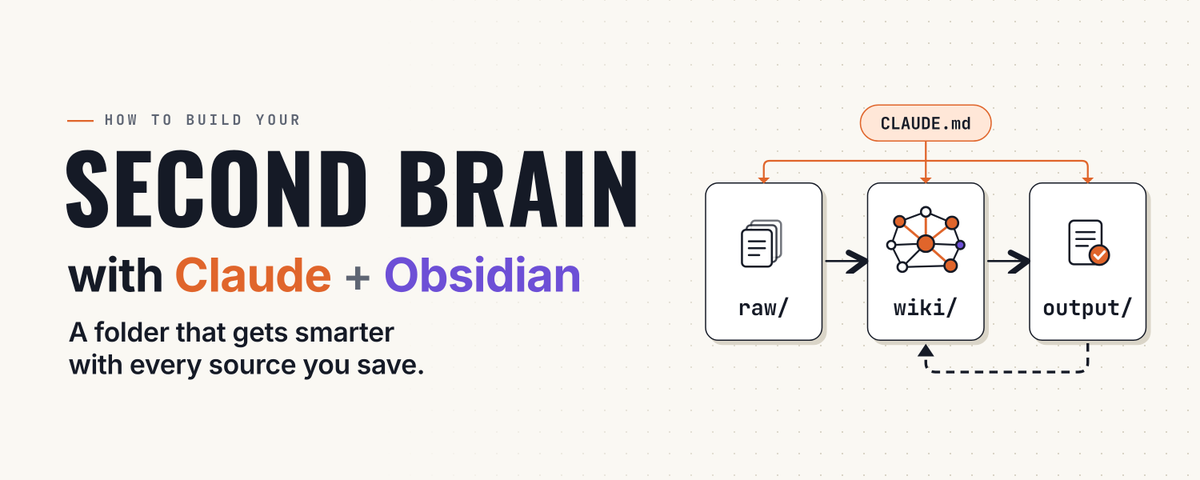
→ run your agent in that folder with CLAUDE.md as the rules, raw/ for sources and wiki/ for pages
→ drop an article, pdf or transcript into raw/ and tell it to ingest
→ it writes the page, links it to the ones already there and logs the change
→ from then on every question gets answered from your own sources, and the good answers get filed back as pages
→ one lint pass a week catches contradictions and orphan pages
“Obsidian is the IDE; the LLM is the programmer; the wiki is the codebase.”
A year from now one of you has a wiki that gets smarter every week. The other is opening a blank chat again. Karpathy already picked a side, and you can pick yours before you go to sleep
The full setup is in the article below
Andrej Karpathy co-founded OpenAI, and one post about one idea pulled 21M views: stop using AI only to write code, use it to build a second brain that never forgets what you feed it
He built a wiki of about 100 articles and 400,000 words on a single topic, and the LLM wrote it, not him
“The LLM is rediscovering knowledge from scratch on every question. There’s no accumulation.”
I still don’t understand why people use AI every day and let every answer disappear the second they close the tab. His compounds. Yours resets
5 minutes to set up, no app to build, no database, no code to write:
→ brew install --cask obsidian, mkdir ~/vault, cd ~/vault
→ run your agent in that folder with CLAUDE.md as the rules, raw/ for sources and wiki/ for pages
→ drop an article, pdf or transcript into raw/ and tell it to ingest
→ it writes the page, links it to the ones already there and logs the change
→ from then on every question gets answered from your own sources, and the good answers get filed back as pages
→ one lint pass a week catches contradictions and orphan pages
“Obsidian is the IDE; the LLM is the programmer; the wiki is the codebase.”
A year from now one of you has a wiki that gets smarter every week. The other is opening a blank chat again. Karpathy already picked a side, and you can pick yours before you go to sleep
The full setup is in the article below
Ryven retweeted
This is f*cking brilliant.
13 free repos turn a folder of notes into a second brain an agent can actually use: it captures what you read, searches everything you saved and never starts from zero
[01] capture
obsidian-clipper: official Obsidian web clipper, saves any page as Markdown github.com/obsidianmd/obsidi…
markitdown: turns PDF, Word, PowerPoint, Excel and audio into Markdown github.com/microsoft/markitd…
yt-dlp: pulls subtitles from videos without downloading them github.com/yt-dlp/yt-dlp
paperless-ngx: OCR and full-text search for every scan and PDF github.com/paperless-ngx/pap…
[02] structure
obsidian-dataview: turns your vault into a database you can query github.com/blacksmithgu/obsi…
obsidian-git: version history and automatic backup for every note github.com/Vinzent03/obsidia…
[03] search
qmd: on-device search for your notes, combines keywords, vectors and re-ranking, has an MCP server github.com/tobi/qmd
meilisearch: search as you type with typo tolerance and hybrid semantic mode github.com/meilisearch/meili…
[04] agent memory
letta: stateful agents that learn over time github.com/letta-ai/letta
langmem: facts, behavior and past interactions for long-term agent memory github.com/langchain-ai/lang…
MemOS: a memory layer for agents, stored as a graph you can inspect and edit github.com/MemTensor/MemOS
[05] own it
quartz: publishes your Markdown notes as a website github.com/jackyzha0/quartz
syncthing: syncs your vault between devices, peer to peer and encrypted github.com/syncthing/syncthi…
A pile of notes becomes a second brain only when an agent can search it and remember it.
Every repo above is free, and most of it runs on your own machine.
This is f*cking brilliant.
13 free repos turn a folder of notes into a second brain an agent can actually use: it captures what you read, searches everything you saved and never starts from zero
[01] capture
obsidian-clipper: official Obsidian web clipper, saves any page as Markdown github.com/obsidianmd/obsidi…
markitdown: turns PDF, Word, PowerPoint, Excel and audio into Markdown github.com/microsoft/markitd…
yt-dlp: pulls subtitles from videos without downloading them github.com/yt-dlp/yt-dlp
paperless-ngx: OCR and full-text search for every scan and PDF github.com/paperless-ngx/pap…
[02] structure
obsidian-dataview: turns your vault into a database you can query github.com/blacksmithgu/obsi…
obsidian-git: version history and automatic backup for every note github.com/Vinzent03/obsidia…
[03] search
qmd: on-device search for your notes, combines keywords, vectors and re-ranking, has an MCP server github.com/tobi/qmd
meilisearch: search as you type with typo tolerance and hybrid semantic mode github.com/meilisearch/meili…
[04] agent memory
letta: stateful agents that learn over time github.com/letta-ai/letta
langmem: facts, behavior and past interactions for long-term agent memory github.com/langchain-ai/lang…
MemOS: a memory layer for agents, stored as a graph you can inspect and edit github.com/MemTensor/MemOS
[05] own it
quartz: publishes your Markdown notes as a website github.com/jackyzha0/quartz
syncthing: syncs your vault between devices, peer to peer and encrypted github.com/syncthing/syncthi…
A pile of notes becomes a second brain only when an agent can search it and remember it.
Every repo above is free, and most of it runs on your own machine.
Ryven retweeted
This is f*cking gold.
One repo from Obsidian’s CEO teaches agents how your vault works. 10 more give them memory, search and everything you save
01 obsidian-skills → teaches Claude Code, Codex and other agents to write notes, bases and canvases in your vault the way Obsidian expects
github.com/kepano/obsidian-s…
02 obsidian-copilot → runs Claude Code, Codex and OpenCode inside your vault, local models included
github.com/logancyang/obsidi…
03 supermemory → remembers facts about you, rewrites the ones you contradict and drops the ones that expire
github.com/supermemoryai/sup…
04 khoj → ask your notes, PDFs and the web one question, on your own server
github.com/khoj-ai/khoj
05 obsidian-smart-connections → finds the notes you forgot you wrote while you type, no API key needed
github.com/brianpetro/obsidi…
06 karakeep → saves anything, tags it with AI and finds it later, on your own server
github.com/karakeep-app/kara…
07 siyuan → you and your AI agents edit the same notes on your own server
github.com/siyuan-note/siyua…
08 zk → a plain-text wiki you run from the terminal
github.com/zk-org/zk
09 silverbullet → Markdown notes you can program with Lua
github.com/silverbulletmd/si…
10 memos → quick notes on a timeline, found by search, tag or date
github.com/usememos/memos
11 trilium → notes in a hierarchy big enough for a whole personal knowledge base
github.com/TriliumNext/Trili…
This is f*cking gold.
One repo from Obsidian’s CEO teaches agents how your vault works. 10 more give them memory, search and everything you save
01 obsidian-skills → teaches Claude Code, Codex and other agents to write notes, bases and canvases in your vault the way Obsidian expects
github.com/kepano/obsidian-s…
02 obsidian-copilot → runs Claude Code, Codex and OpenCode inside your vault, local models included
github.com/logancyang/obsidi…
03 supermemory → remembers facts about you, rewrites the ones you contradict and drops the ones that expire
github.com/supermemoryai/sup…
04 khoj → ask your notes, PDFs and the web one question, on your own server
github.com/khoj-ai/khoj
05 obsidian-smart-connections → finds the notes you forgot you wrote while you type, no API key needed
github.com/brianpetro/obsidi…
06 karakeep → saves anything, tags it with AI and finds it later, on your own server
github.com/karakeep-app/kara…
07 siyuan → you and your AI agents edit the same notes on your own server
github.com/siyuan-note/siyua…
08 zk → a plain-text wiki you run from the terminal
github.com/zk-org/zk
09 silverbullet → Markdown notes you can program with Lua
github.com/silverbulletmd/si…
10 memos → quick notes on a timeline, found by search, tag or date
github.com/usememos/memos
11 trilium → notes in a hierarchy big enough for a whole personal knowledge base
github.com/TriliumNext/Trili…
Ryven retweeted
it is getting f*cking dangerous.
a 23-year-old junior engineer from China makes $10,000 a month with no team, no assistant and no agency. one folder pays him.
the analyst teams he replaced need weeks for what he delivers in one run, and his clients never asked where the team went.
he is not a genius. he built a vault that remembers everything he has ever read, catches him whenever he contradicts himself, and tells the AI who he is before he types a word.
then he pointed 300 agents at it. each one writes, a cheaper model checks every claim against the source in 100 milliseconds, and nothing moves until it passes. 100 company profiles, three sweeps, nothing left to fix by the third.
you spent years collecting knowledge and your AI still meets you as a stranger every single morning.
you are not losing to someone smarter. you are losing to a 23-year-old whose AI remembers him, while yours has never met you.
it is getting f*cking dangerous.
a 23-year-old junior engineer from China makes $10,000 a month with no team, no assistant and no agency. one folder pays him.
the analyst teams he replaced need weeks for what he delivers in one run, and his clients never asked where the team went.
he is not a genius. he built a vault that remembers everything he has ever read, catches him whenever he contradicts himself, and tells the AI who he is before he types a word.
then he pointed 300 agents at it. each one writes, a cheaper model checks every claim against the source in 100 milliseconds, and nothing moves until it passes. 100 company profiles, three sweeps, nothing left to fix by the third.
you spent years collecting knowledge and your AI still meets you as a stranger every single morning.
you are not losing to someone smarter. you are losing to a 23-year-old whose AI remembers him, while yours has never met you.
Ryven retweeted
This is getting f*cking scary.
15 GitHub repos now wrap REA in a desktop studio, a local-model plugin and a scanner that shows what it could pull out of your own app
[01] wrappers and installs
ERA: wraps REA with run records, reports and a desktop studio github.com/dav1dngy/era-agen…
reverseport: turns findings into rebuild specs and ports between engines and languages github.com/laaielichter/reve…
rea-mcp: REA inside LM Studio for local models github.com/Nowng/rea-mcp
rea-flake: REA with Ghidra packaged for Nix github.com/Fractal-Tess/rea-…
[02] check and defend
reaproof: scans your own build for what REA could recover, like source maps and keys github.com/Junhan2/reaproof
antirea: stop directives that tell agents not to run REA on your project github.com/MockirDev/antirea
REA-demo: REA analyzing its own package, graded against the source github.com/az9713/REA-demo
[03] worked examples
OpenBSD_netcat_REA: a static analysis of netcat-openbsd, every claim linked to an evidence file github.com/NullLabTests/Open…
hexgrab: a color picker written from REA’s study of PowerToys behavior, with no PowerToys code github.com/iammukeshm/hexgra…
[04] reading
rea-research: a deep write-up of REA’s architecture and trust model, in Chinese github.com/ringozzt/rea-rese…
reatool: unofficial install guides and a comparison with GhidraMCP and ida-pro-mcp github.com/ZooHero500/reatoo…
[05] maps
Awesome-REA: a bilingual catalogue of REA tools, cases and papers github.com/reacher-z/Awesome…
awesome-rea: every entry names its own acceptance test github.com/yibie/awesome-rea
rea-case-rankings: cases from GitHub, HN, X and Reddit on a 1 to 5 score github.com/miles990/rea-case…
rea-gems: an auto-updated gallery of REA cases github.com/sqwu/rea-gems
how the loop runs: app -> REA -> findings -> spec -> rebuild -> check -> harden
start with an app you own and watch it explain itself.


This is getting f*cking scary.
15 GitHub repos now wrap REA in a desktop studio, a local-model plugin and a scanner that shows what it could pull out of your own app
[01] wrappers and installs
ERA: wraps REA with run records, reports and a desktop studio github.com/dav1dngy/era-agen…
reverseport: turns findings into rebuild specs and ports between engines and languages github.com/laaielichter/reve…
rea-mcp: REA inside LM Studio for local models github.com/Nowng/rea-mcp
rea-flake: REA with Ghidra packaged for Nix github.com/Fractal-Tess/rea-…
[02] check and defend
reaproof: scans your own build for what REA could recover, like source maps and keys github.com/Junhan2/reaproof
antirea: stop directives that tell agents not to run REA on your project github.com/MockirDev/antirea
REA-demo: REA analyzing its own package, graded against the source github.com/az9713/REA-demo
[03] worked examples
OpenBSD_netcat_REA: a static analysis of netcat-openbsd, every claim linked to an evidence file github.com/NullLabTests/Open…
hexgrab: a color picker written from REA’s study of PowerToys behavior, with no PowerToys code github.com/iammukeshm/hexgra…
[04] reading
rea-research: a deep write-up of REA’s architecture and trust model, in Chinese github.com/ringozzt/rea-rese…
reatool: unofficial install guides and a comparison with GhidraMCP and ida-pro-mcp github.com/ZooHero500/reatoo…
[05] maps
Awesome-REA: a bilingual catalogue of REA tools, cases and papers github.com/reacher-z/Awesome…
awesome-rea: every entry names its own acceptance test github.com/yibie/awesome-rea
rea-case-rankings: cases from GitHub, HN, X and Reddit on a 1 to 5 score github.com/miles990/rea-case…
rea-gems: an auto-updated gallery of REA cases github.com/sqwu/rea-gems
how the loop runs: app -> REA -> findings -> spec -> rebuild -> check -> harden
start with an app you own and watch it explain itself.
Ryven retweeted
I still don’t understand why a second brain only stores notes when these 10 repos make it quiz you, retract old claims and run offline
Your agent can critique your notes, pull in fresh meeting transcripts, and one repo compares 15 second-brain tools for you
01 llm-wiki → drop in a book, a PDF or a meeting transcript and Claude writes linked Obsidian pages with citations
github.com/phyllissong136/ll…
02 claude-wiki-verbs → nine commands for your vault, including synthesize, critique, compare and eli5
github.com/daniel8824-del/cl…
03 obsidian-wiki-mcp → an MCP server for your vault with BM25 search and a diff on every write, and it never calls a model itself
github.com/aud1ence/obsidian…
04 llm-wiki-md-cli → a CLI with supersede and retract for outdated claims, and a lint that can block a commit
github.com/ankishraj/llm-wik…
05 WikiSpec → spec-driven changes in Claude: propose, plan, apply, validate, archive, and every archived change feeds the wiki
github.com/christianb93/Wiki…
06 anansi → quizzes you on your own wiki and grades your answers with written feedback
github.com/darthblanc/anansi
07 silt → pulls fresh material from Read.ai and Google Docs into raw/, and your agent merges it into the wiki (Mac)
github.com/psuijk/silt
08 Personal-wiki-using-Gemma-4 → drop files in a folder and a local Gemma model on Ollama writes the wiki, with a chat UI on top
github.com/aswin-pn/Personal…
09 karpathy-llm-wiki-boilerplate → a template repo with four skill files, a CLAUDE.md and a small example wiki already inside
github.com/xiaoyuze88/karpat…
10 awesome-brains → 15 second-brain tools compared by cost, setup and self-hosting
github.com/lakshyabuilds/awe…
I still don’t understand why a second brain only stores notes when these 10 repos make it quiz you, retract old claims and run offline
Your agent can critique your notes, pull in fresh meeting transcripts, and one repo compares 15 second-brain tools for you
01 llm-wiki → drop in a book, a PDF or a meeting transcript and Claude writes linked Obsidian pages with citations
github.com/phyllissong136/ll…
02 claude-wiki-verbs → nine commands for your vault, including synthesize, critique, compare and eli5
github.com/daniel8824-del/cl…
03 obsidian-wiki-mcp → an MCP server for your vault with BM25 search and a diff on every write, and it never calls a model itself
github.com/aud1ence/obsidian…
04 llm-wiki-md-cli → a CLI with supersede and retract for outdated claims, and a lint that can block a commit
github.com/ankishraj/llm-wik…
05 WikiSpec → spec-driven changes in Claude: propose, plan, apply, validate, archive, and every archived change feeds the wiki
github.com/christianb93/Wiki…
06 anansi → quizzes you on your own wiki and grades your answers with written feedback
github.com/darthblanc/anansi
07 silt → pulls fresh material from Read.ai and Google Docs into raw/, and your agent merges it into the wiki (Mac)
github.com/psuijk/silt
08 Personal-wiki-using-Gemma-4 → drop files in a folder and a local Gemma model on Ollama writes the wiki, with a chat UI on top
github.com/aswin-pn/Personal…
09 karpathy-llm-wiki-boilerplate → a template repo with four skill files, a CLAUDE.md and a small example wiki already inside
github.com/xiaoyuze88/karpat…
10 awesome-brains → 15 second-brain tools compared by cost, setup and self-hosting
github.com/lakshyabuilds/awe…
Ryven retweeted

Karpathy published his second brain as an idea with no code. 8 repos have already written it
One rolls back bad edits with git, one turns your Claude Code sessions into wiki pages, and one lets Claude, Codex and Cursor share a single logbook
01 Karpathy-LLM-Wiki-Stack → a long build guide: the vault tree, a CLAUDE.md template and a 15-minute quick start
github.com/ScrapingArt/Karpa…
02 karpathy-llm-wiki-second-brain → an Obsidian and Claude Code template that organizes the wiki into four areas: work, learning, decisions and thinking
github.com/ddenzu/karpathy-l…
03 wiki-skills → seven skills for init, ingest, query, lint and audit, plus a pre-commit hook that blocks broken links and missing frontmatter
github.com/kfchou/wiki-skill…
04 llm-wiki → a Claude Code plugin with six workflows: ingest, query, lint, enhance, compile and evolve-schema
github.com/KaelLim/llm-wiki
05 llm-wiki-stack → schema hooks on every write, git checkpoints with rollback, and an offline mode through Ollama
github.com/odere-pro/llm-wik…
06 llm-wiki (micuintus) → one skill file that turns your Claude Code, opencode and Gemini CLI sessions into wiki pages
github.com/micuintus/llm-wik…
07 llmwiki → upload your documents and Claude writes the wiki through MCP, on localhost or hosted
github.com/lucasastorian/llm…
08 obsidian-second-brain → Claude Code, Codex and Cursor share one logbook, so each knows what the others did
github.com/eugeniughelbur/ob…
Ryven retweeted
I still don’t understand why everyone isn’t using this yet. Three folders cut my costs by $1,000.
Karpathy described the system in April 2026, and his post passed 21 million views.
It’s a second brain that knows everything about you.
It’s not a plugin or an app. It’s three folders of plain text files that Claude reads and writes itself.
raw/ holds your sources, read-only for Claude. wiki/ holds the pages it writes and keeps current. CLAUDE.md holds the rules. Add a source, ask against the wiki, run a check, and every new session starts where the last one stopped.
Setup is ten minutes:
mkdir -p brain/{raw,wiki,output,.brain}
cd brain && git init
claude
Tell Claude to interview you and write its own rules file. It asks about your work, your goals, your strengths and weaknesses, and writes it all down.
Then I tested it. I planted one false sentence in the wiki, and a 95-line script with no AI inside caught it in milliseconds, for zero tokens.
The full guide has the folders, the prompts, the script, the hooks, the nightly run, and where the whole idea breaks.
I still don’t understand why everyone isn’t using this yet. Three folders cut my costs by $1,000.
Karpathy described the system in April 2026, and his post passed 21 million views.
It’s a second brain that knows everything about you.
It’s not a plugin or an app. It’s three folders of plain text files that Claude reads and writes itself.
raw/ holds your sources, read-only for Claude. wiki/ holds the pages it writes and keeps current. CLAUDE.md holds the rules. Add a source, ask against the wiki, run a check, and every new session starts where the last one stopped.
Setup is ten minutes:
mkdir -p brain/{raw,wiki,output,.brain}
cd brain && git init
claude
Tell Claude to interview you and write its own rules file. It asks about your work, your goals, your strengths and weaknesses, and writes it all down.
Then I tested it. I planted one false sentence in the wiki, and a 95-line script with no AI inside caught it in milliseconds, for zero tokens.
The full guide has the folders, the prompts, the script, the hooks, the nightly run, and where the whole idea breaks.
Ryven retweeted
I still don’t understand why people keep building a Claude second brain from scratch when these 10 repos already built the whole system
They take in your sources, link them into a wiki, check every claim, and one of them runs fully on your own machine
01 obsidian-skills → Obsidian’s own CEO teaches Claude how Obsidian really works
github.com/kepano/obsidian-s…
02 claude-obsidian → drop in any source and Claude reads it, links it and files it into one connected graph of plain Markdown you own
github.com/AgriciDaniel/clau…
03 obsidian-second-brain → Claude Code remembers you between sessions, with 48 commands, all inside your Obsidian vault
github.com/eugeniughelbur/ob…
04 karpathy-llm-wiki → one install line, then ingest, query with citations and lint, in Claude Code, Cursor, Codex or OpenCode
github.com/Astro-Han/karpath…
05 second-brain → raw sources in, linked wiki pages out, browsed in Obsidian
github.com/NicholasSpisak/se…
06 second-brain-os → the full kit: a 77-page guide, a starter vault, 18 skills, 72 commands and 6 subagents, four of them read-only
github.com/undefined-ui/seco…
07 llm-wiki → two-layer memory: 10 to 20 rules Claude loads every session, 50 to 200 wiki pages pulled only when needed
github.com/MehmetGoekce/llm-…
08 vouch → agents propose changes, you approve them, and a claim without a source is an error
github.com/vouchdev/vouch
09 ai-second-brain → your ChatGPT and Claude history becomes a linked Obsidian vault, then a wiki
github.com/charlie947/ai-sec…
10 LLM_Wiki_SecondBrain → the whole pipeline on a local model, no cloud API. 32 GB of RAM recommended
github.com/DimitrisLianos/LL…
I still don’t understand why people keep building a Claude second brain from scratch when these 10 repos already built the whole system
They take in your sources, link them into a wiki, check every claim, and one of them runs fully on your own machine
01 obsidian-skills → Obsidian’s own CEO teaches Claude how Obsidian really works
github.com/kepano/obsidian-s…
02 claude-obsidian → drop in any source and Claude reads it, links it and files it into one connected graph of plain Markdown you own
github.com/AgriciDaniel/clau…
03 obsidian-second-brain → Claude Code remembers you between sessions, with 48 commands, all inside your Obsidian vault
github.com/eugeniughelbur/ob…
04 karpathy-llm-wiki → one install line, then ingest, query with citations and lint, in Claude Code, Cursor, Codex or OpenCode
github.com/Astro-Han/karpath…
05 second-brain → raw sources in, linked wiki pages out, browsed in Obsidian
github.com/NicholasSpisak/se…
06 second-brain-os → the full kit: a 77-page guide, a starter vault, 18 skills, 72 commands and 6 subagents, four of them read-only
github.com/undefined-ui/seco…
07 llm-wiki → two-layer memory: 10 to 20 rules Claude loads every session, 50 to 200 wiki pages pulled only when needed
github.com/MehmetGoekce/llm-…
08 vouch → agents propose changes, you approve them, and a claim without a source is an error
github.com/vouchdev/vouch
09 ai-second-brain → your ChatGPT and Claude history becomes a linked Obsidian vault, then a wiki
github.com/charlie947/ai-sec…
10 LLM_Wiki_SecondBrain → the whole pipeline on a local model, no cloud API. 32 GB of RAM recommended
github.com/DimitrisLianos/LL…
I still don't understand why everyone isn't using this yet. Five minutes of setup saved me thousands of dollars
Andrej Karpathy, a co-founder of OpenAI, shared a simple idea that reached 21 million views: stop pointing AI only at code, point it at everything you know.
Drop any article, transcript or PDF into a folder. Claude files it into a living wiki, a second brain linked to everything you already saved.
Every new source makes the next answer sharper, and you stop pasting the same context into every chat.
The whole setup:
> Create an Obsidian vault and open it with Claude Code
> Hand Claude Karpathy's wiki idea file and let it build the structure
> raw holds your sources, wiki holds its pages, CLAUDE.md holds the rules
> Drop a source into raw and type "ingest this"
> Then ask anything, and it answers from all of it
Set it up once, and Claude stops forgetting you between chats.
The full step-by-step guide for Claude and Obsidian is in the article below.
Bookmark this and set it up tonight