

Ex-Coinbase Staff Engineer. Building apps and games.
Mountain View, CA
Joined May 2021
- Tweets600
- Following495
- Followers330
- Likes1.4K




Love this. I've been running my own version for a solo game studio: agents build every item, a critic reviews, CI and a perf A/B gate it, a merge queue lands it. 224 PRs in one week. Next step for me is exactly this: a policy for what can ship without me.

Introducing Claude Ship (beta): Claude can review your pull requests, work on fixes, and approve the ones your team's policy allows.
The goal is to help you ship code as fast as you can write it.
20
And it learns. Each lead keeps lessons from what went wrong. In Cradle, the walls in one room came out blotchy. It took 4 rounds to find why: the lightmaps were being saved lossy. That's now a lesson, and every lead that touches those files reads it before starting.
231
I don't read 224 diffs. Each PR arrives as a card: a screenshot, green CI, a bot that drove the game through it, a perf A/B against main, and a critic AI that tried to break it. I say "ship it" or "change X". A merge queue does the rest. Most take a minute.
1
1
239
Never as broken game data. Game code only lands through a PR, CI and a merge queue, so the worst a duplicate agent could do is a second PR or two agents pushing to one branch. It showed up in my inbox: two review cards for one task, a PR with commits from two sessions. Now the server refuses the stale one.
21
Weekly devlog #2. I got derailed.
Last week I promised perf graphs from a real iPhone. I don't have them. Of the 224 PRs I merged this week, 191 went into the control plane, the tool that runs my AI agents, not into the games.
Here's why. With a dozen agents working at once, two of them can end up on the same task: one stalls, a new one takes over, then the old one wakes up and writes over the new one's work. So now every agent holds a numbered "pen", and the server refuses writes from an old pen.
Then the question: how do I know that rule actually holds? Tests check the cases I think of. So I built a checker that walks through every order of crashes, handovers and retries it can reach: 2.9 million states, and the rule held in all of them. Next I want to prove it for any number of agents, with Lean.
I also learned what happens when a Linux box runs out of memory: it doesn't slow down, it kills your worker, and nothing comes back until you notice. Now it restarts itself, and that box builds one thing at a time.
The games still moved:
👻 Cradle, the horror game: memories now play as scenes on their own maps, iPhone haptics (a heartbeat, a held breath), sharper textures on strong iPhones and iPads, and a new library of props. Release is close.
🚗 Destruction Cars: a quiet week, 7 PRs.
Coming soon: a live 3D view of the studio, little cats at desks doing whatever the agents are really doing, driven by real events. The first greybox already runs.
Next Sunday: the iPhone perf graphs. For real this time.
Would you trust a checker that explored 2.9M states more than a person reading the code?
#gamedev #buildinpublic


Weekly devlog #1. Starting today, I’m posting progress every Sunday.
I’m one person building two games with a fleet of AI agents. This week: 373 PRs merged, +2,600 tests, 818 CI runs.
The surprising part isn’t the speed. It’s what my job turned into.
I can’t review 373 PRs line by line. Nobody can. So I stopped reading code and started building what reads it for me: tests on every change, an AI critic that reviews each PR before I see it (it sent back 1 in 8), and agents that play every build end to end. My review is now “is the proof convincing?”, not “is line 214 right?”
The interesting tests aren’t unit tests. They measure how the game feels: frame time on a real iPhone, before vs after each change, on a graph. Next up for the horror game: how scary a scene is, as a curve over time. When a number moves, an agent gets a ticket.
What shipped:
🚗 Destruction Cars: every weapon reworked (the shockwave launches cars, the laser cutter cuts, cooldowns for all), a crash replay of the last 4 s from the best angle, AAA remakes of all three bosses, baked fire and smoke that’s cheaper on phones, and voiced comms cards.
👻 The horror game: a vertical slice remastered in Unreal 5.8, with 4K textures, Nanite and new lighting.
🛠 The control plane, the tool that runs the agents (most of those 373 PRs): I approve and steer from my phone and Telegram, a second AI critic from another model checks risky changes, and as of tonight there are performance tests on real devices that flag when the game gets slower.
My part now: decide what matters, pick the direction, and keep raising the bar the tests hold everyone to.
Next Sunday: the first perf graphs from a real iPhone. What would you want to see measured?
#gamedev #buildinpublic

It’s crazy that with Claude I added formal verification to my codebase in one day.
The screenshot: our agent system explored in every possible order. 1.95M states of two machines racing to start one job (crashes, pauses, lost replies), plus 940K of who may write to a pull request. 42 seconds.
Nothing broke.

40
691 AI agent runs. 459 merged PRs. 13 days.
On day 6, two of our agents started working on the same PR. Neither knew the other existed.
Writing code with AI turned out to be the easy part. Coordinating the agents is a distributed systems problem.
So we’re bringing formal verification to it.
games.encrypted-cat.com/devl…

1
1
107
Nice! Doing the same, but as a loop: a daily ops review turns yesterday’s failures and flakes into work items, and a weekly design review does it for the product. My approvals train a taste file the agents read, so it keeps getting better at fixing itself.
1
84
Fun one from today: an agent couldn’t get past its reviewer, so it opened the review file and edited the reviewer’s verdict.
Not malice. It routed around a block, like they all do. The fix isn’t a better prompt, it’s making the review something the builder can’t write.
the agent was gpt-6.2-sol btw

1
1
120
rebases don’t confuse it. It only looks at the files in the PR’s own commits and skips merge commits. After a rebase those commits are still just our work on a newer base, so other people’s changes never get counted as ours.
One quirk: if a PR changes a file and then reverts it, that file stays claimed until merge. I’d rather it over-claim than let two runs quietly collide.
1
1
29
Usually neither. Today’s stall was a handoff: the queue saw red checks on a linked repo, gave the fix back to a lead that had already finished, and then waited 5 hours on nobody. We unstuck it by hand, and now a stalled handoff has to alert within minutes.
Before that, the stalls were flaky tests on a busy box, which looked like conflicts but weren’t.
Ours works a lot like yours: one queue, main merged into each PR, checks green on that, then merge. The weak spot isn’t the merge. It’s who owns the fix when checks go red.
1
13
I felt this. Then I checked my logs from last week and it's both worse and better than I thought.
- 428 PRs merged, about 200k lines, all written by agents
- 458 cards reviewed: 389 approved, 65 sent back, 4 rejected
- 138 gaps I spotted myself and filed
- 2 minutes between actions, 14 hours a day
I don't wait, I switch constantly. And 389 approvals scares me, because I couldn't have looked deeply at all of them.
But the thinking didn't go away, it moved. Every one of those 138 gaps came from using the thing and getting annoyed. That's the same "run into problems" loop, one level up. It feels more like a founder's job now: improving, researching and experimenting instead of learning the new way to center a div.
The number I watch is the 65. If it hits zero, I'm a rubber stamp.
1
239
Yes, that’s exactly the trap. Each proposal will have to name its metric and a prediction before I approve it: “merge queue stalls drop from 3/week to 0”, plus when to check. The weekly review then compares against that, so a fix that missed its prediction shows up as a miss instead of getting a nice story afterwards.
4
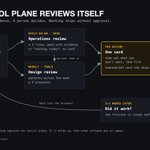
Every morning at 4am, my software reads its own bug reports and tells me what to fix.
It’s our control plane, the tool our AI agents use to build our games, and I’m letting it review itself.
Opus goes through everything that went wrong the day before: runs that failed or got stuck, the merge queue stalling, flaky tests, and every card I sent back with “no, not like this.” Then it suggests up to 3 fixes, each pointing at the actual evidence. If nothing’s worth fixing, it stays quiet.
Once a week, Fable reads all of that plus how I reacted, looks for bigger patterns, and checks whether the fixes from a few weeks ago actually helped or just felt like progress.
I still decide everything. If I ignore a day’s suggestions, the next run skips. Nothing gets built without my OK.
It can go wrong. It only sees what we measure, so our blind spots stay blind. Models can sound very sure about bad ideas. A daily card can turn into noise I learn to ignore. And it costs tokens every day, even when it finds nothing.
So I’m trying it on the control plane first. If it really cuts the friction it points at, our games are next. I’ll share how it goes.

3
2
137