

buchi laba stan account| furlanese hater
Gashager, Nigeria
Joined January 2022
- Tweets2.7K
- Following336
- Followers67
- Likes8.2K




Omari Parkinson retweeted

🚨 عاجل: أصبح Claude قادرًا على إنشاء قناة يوتيوب من الصفر والعمل على تطويرها حتى تحقيق شروط الربح خلال 90 يومًا فقط، وبشكل مجاني 100%.
إليك 8 أوامر (Prompts) لتحقيق ذلك:
Omari Parkinson retweeted

HOLY F*CK, CAPCUT IS COOKED.
Claude Opus 5.5 + 13 free GitHub repos = your own editing desk
raw clip in. finished short out. no editor, no subscription ↓
01 yt-dlp → pulls any clip from 1,000+ sites
github.com/yt-dlp/yt-dlp
02 LosslessCut → instant cuts with zero re-encode
github.com/mifi/lossless-cut
03 auto-editor → deletes every silent gap for you
github.com/WyattBlue/auto-ed…
04 faster-whisper → word-timed transcript in seconds
github.com/SYSTRAN/faster-wh…
05 remotion skills → word-pop captions that actually sync
github.com/remotion-dev/skil…
06 chatterbox → voiceover and voice cloning, runs locally
github.com/resemble-ai/chatt…
07 DeepFilterNet → kills background noise
github.com/Rikorose/DeepFilt…
08 demucs → splits voice, music and drums
github.com/facebookresearch/…
09 rembg → green screen without the screen
github.com/danielgatis/rembg
10 Real-ESRGAN → blurry footage to sharp 4K
github.com/xinntao/Real-ESRG…
11 davinci-resolve-mcp → Claude grades your footage inside Resolve
github.com/samuelgursky/davi…
12 OpenCut → the open-source CapCut timeline
github.com/OpenCut-app/OpenC…
13 hyperframes → titles, motion and the final render
github.com/heygen-com/hyperf…
grab → cut → transcribe → caption → voice → clean → grade → render
591K stars combined. all free. all open-source.
Bookmark this. How to build a fully functioning 0$ motion studio is explained in the article below ↓

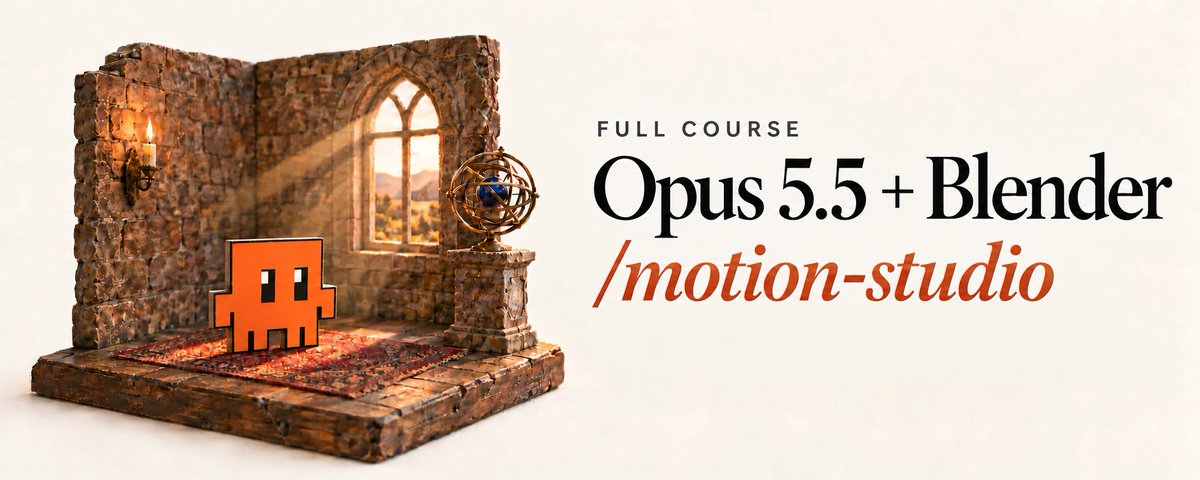
Omari Parkinson retweeted

Mentre tutti fanno i sommelier dei videogiochi..
il sottoscritto stanotte ha provato a sfondare, per 10 minuti buoni, la porta del bagno dove era rinchiusa Mandy


Omari Parkinson retweeted

Datemi pure dell’eretico, ma credo che da centrale puro #Bastoni possa fare una carriera pari a quella di Nesta (che ho ammirato visceralmente).
Grazie, Sandro, per essere così forte e interista.

Omari Parkinson retweeted

just found a banger gta 6 format, 5M views on his first 4 videos
ill save u a $100 course and make ur claude create this fully automated for $0
give my prompt to ur claude code
thank me later
<inputs>
Ask me for, in one message:
1. The subject (a game, a phone, a car, a film, a city, an app) and the angle, picked from: "5 crazy things you can do in ___ that you couldn't in ___", "5 realistic things in ___", "how ___ works in ___" (one system explained), "everything you need to know before ___".
2. The voice: an ElevenLabs voice id and key if I have them, otherwise a free local voice. If it is paid, tell me the character count (about 1 credit each) and wait for my yes.
3. A music bed if I have one; otherwise pick a free one with no vocals.
If I have no subject, pitch me 3 that people are searching for this week and say why each one is hot. Research fresh on the day; never copy another Short's script or order.
</inputs>
<direction>
A 1080x1920, 30 fps YouTube Short / TikTok / Reel of 60-68 s, built entirely on real footage of the subject (official trailers, gameplay, product films), reframed to 9:16. No face-cam, no AI-generated footage.
It is relentless: the voice runs at 240-265 words a minute with no pause longer than 0.3 s, a music bed sits about 7 dB under it the whole time so there is never silence, and the picture changes 85-125 times a minute (a new shot or overlay about every 0.5-0.9 s).
Text system, all heavy italic sans in uppercase (Montserrat Black Italic) with a 6 px black stroke and a soft shadow:
- Top block (y 5-20%): the subject's logo, centred, about 34% of the width. Under it the title of the Short or the current item.
- Item header: a green number ("1.") plus the item in white ("THROW DOG POOP") and one emoji-style icon under it, held for the whole item.
- Captions (y 70-78%, centred, max 3 words a line, 2 lines): every spoken word appears on its own syllable, white, with the key word of each phrase in neon green #39FF3C for good or exciting and red #FF2E2E for bad or impossible.
Every concrete claim gets a mock-up layered on the footage within 0.5 s: a game or app UI element rebuilt in HTML (a star meter, a weapon wheel, a button prompt, a minimap, a phone screen), a big counter that ticks up to the number ("600,000 ANIMATIONS"), a simple map with an animated route or zone, or a tiny cartoon illustration of the action with a comic burst. Each sits in a dark rounded box with a thin green border and a small "ILLUSTRATION" tag when it is not real footage.
Banned: a greeting, "hey guys", the channel name, an intro longer than 3 s, any pause in the voice, any frame without text on it, letterbox bars, a 16:9 shot pasted small in the middle, a shot held over 3.5 s, the same shot twice, and any claim with no source behind it.
</direction>
<structure>
Length: 60-68 s, 250-290 words. The voice starts on frame 1.
0-3 s, the hook: "Here's five ___ things in ___ that ___" (or "The ___ in ___ has been fully revamped") over the single most absurd or best-looking clip of the whole Short, with the title building word by word in the top block. Show the comparison visually when there is one (the old version's logo popping up and getting crossed out in red).
3-60 s, the items: five items of about 11-12 s each (45-55 words), always in this shape: "Number one, [label]." (the item header slams in on the word) → the claim in one short sentence → the most specific concrete example, told like a story ("You wait for somebody walking their dog, you hit them so they drop the bag, then...") → what it changes for you ("So you've got to change clothes, switch cars, or split up.") → sometimes a one-line reaction ("No, really." / "It's basically a heist movie."). Order: the most viral item first, the most important second, the strongest visual last. For a one-system explainer, replace the items with 6-8 rules of the system in the order a player meets them.
60-65 s, the ask: one question that invites a comment ("So which one are you going to try first?") over the hook clip again.
The loop: the last words are "And in case you missed it," and they cut, mid-sentence, straight into the first frame, so the end flows into "here's five ___ things..." and the Short replays seamlessly.
Voice rules: sentences of 6-12 words, plain words, "you" in almost every sentence, numbers said the way people say them, contractions everywhere, no filler.
</structure>
<build>
1. Tools (all free, all local). Install what's missing and tell me what you installed: Python 3.10+ with numpy and Pillow, FFmpeg with ffprobe, yt-dlp, Playwright with Chromium (for drawing the text and mock-up layer), faster-whisper large-v3-turbo (int8, CPU), Montserrat Black Italic, and Kokoro if I have no ElevenLabs key.
2. Research: search the web and open the pages. For each item keep the claim, the source, the exact words and the date. Use only what the maker showed or said, or what a named outlet saw in a demo; say "reportedly" out loud when it is one outlet's report, and never use leaks. Show me the five items with sources before writing.
3. Script: write it to the structure, read the word count, and cut until it is 250-290 words. Write out how the voice should say names and numbers ("GTA 6" as "G T A six", "600,000" as "six hundred thousand"). Show me the script before recording.
4. Voice: one take for the whole Short. Transcribe it with faster-whisper and match the words to the script with difflib; take every time from that, never from the voice service's timestamps. Cut every pause down to 0.12-0.25 s, only inside real silence, and speed up by at most 1.12x if it is still under 240 wpm. Level to -15 LUFS integrated, music bed 7 dB under the voice, true peak under -1 dB.
5. Footage: the maker's own uploads only. Split each source into scenes with FFmpeg's scene score, make a numbered sheet, and look at it; drop logos, rating boards, title cards and anything intimate or graphic. For every scene, pick the subject's position on a contact sheet and store a 9:16 crop window (full height, 56.25% of the width) centred on it; let the window drift a little with the action, never jump. You need 60-90 different shots per minute: pull from several trailers and trim each scene into 0.5-1.5 s pieces, and for every item pin the exact shot that shows what the voice says.
6. Timeline, every time keyed to a word: a new shot every 0.5-0.9 s (median about 0.8 s, nothing over 3.5 s), cutting on stressed words. The item header lands on "Number one" and stays until the next item. Captions: each word appears 0.03 s before it is spoken and the line clears at the end of its phrase or at a cut. Mock-ups come in within 0.5 s of the claim they prove, scale up from 92% with a quick overshoot over 0.15 s, and hold until the next claim. Counters tick from about 10% of the value to the value in 0.6 s.
7. Draw the whole text and mock-up layer as one transparent HTML page, export it frame by frame with Playwright, and lay it over the cropped footage with FFmpeg. Render a 540x960 preview first, pull 4 frames a second from the first 15 s and from one 15 s window later, and read every sheet: text never over a face, captions in sync, every claim proven on screen, no bare frame. Then render 1080x1920 and measure: cuts per minute, median shot, words per minute, longest pause, loudness, and the loop seam (play the last 2 s into the first 2 s). Show me the numbers next to the targets and fix what is off.
</build>
<gotchas>
- A 9:16 centre crop of a 16:9 trailer cuts the subject out of half the shots. Pick a crop window per scene from a contact sheet, never one fixed crop.
- Trailers are cut for mood, so the most beautiful shot is often the wrong picture for the claim. Pin the shot that literally shows what is being said.
- At 250+ wpm the voice must still sound like a person. Tighten pauses first; past a 1.12x speed-up it sounds like a chipmunk.
- Speech-to-text writes "80 bucks" as "$80" and respells names. A missing or different word is a real error; redo the take.
- Voices read "6" as "six" and "600,000" as digits unless you write it out. Respell for the voice; keep the screen text as written.
- If the loop seam has a gap or a level jump, the replay feels broken. The last word must end within 0.05 s of the cut, and the music must not restart.
- Age-gated gameplay uploads cannot be fetched without a login. Use the open trailers, the maker's site and official screenshots.
- Re-uploads carry other channels' watermarks. Check the channel name before downloading.
- Green and red keywords lose their meaning if every word is coloured. One coloured word per phrase, at most.
- A mock-up of a game UI must look like the real one in spirit but carry an "ILLUSTRATION" tag; never pass it off as a real screenshot.
- Exporting the text layer is about 2,000 frames per minute of Short; render the preview first.
- This is commentary over quoted footage. Keep a source list and let me decide what gets published.
</gotchas>
<start>
Ask me the three input questions in one message. Then research, and show me the five sourced items and the script before you record or download anything.
</start>





Omari Parkinson retweeted

John 10:36 (NIV)
what about the one whom the Father set apart as his very own and sent into the world? Why then do you accuse me of blasphemy because I said, ‘I am God’s Son’?
John 10:37 (NIV)
Do not believe me unless I do the works of my Father.


Omari Parkinson retweeted

As promised here is the free prompt
made this really quickly but itll be really close to the OG if you want even better result send his video to claude and ask it to analyze it
anyways follow me for more shit like this
Enjoy :
<inputs>
First ask me: short or long form?
- Short: 1080x1920 vertical, 30 fps, 45-70 s, one story, about 130-190 words.
- Long form: 1920x1080 horizontal, 30 fps, 8-15 min, chaptered, about 150 words per minute.
Then ask me for my topic, or pitch 3.
- A good one is a real, current money or business event that looks impossible at first: a giant loses billions in a morning, a market crashes on good news, a company pays to lose. The reveal is a chain of plain causes the viewer can follow.
- Give each pitch with its first line, the big number, the hidden cause, and a title phrased as a question ("Why the ___ Just ___").
Ask which voice I want:
- Free, the default: Kokoro, run locally on the CPU.
- Optional upgrade: ElevenLabs with a stock library voice. Tell me the credit cost before you generate anything, and make one take.
Tell me everything is free: Python, Node with Playwright and a headless browser, FFmpeg, faster-whisper, Pixabay music and Mixkit sound effects. No image, video or 3D model generator is used anywhere. Everything is drawn in code on an HTML canvas.
Then write the script and the beat list with seconds, and show me both before you build anything.
</inputs>
<direction>
A narrated "why did this just happen" money explainer in a flat 2D vector cartoon style: simple cartoon people and talking objects acting inside lit, dressed flat sets, one calm storyteller voice, numbers and labels drawn inside the world, black typed-text cards for the big questions, and a camera that slowly pushes on every hold.
Sets (2D, drawn in code on an HTML canvas):
- Build every place from simple flat shapes: rounded rectangles, circles, ellipses, bezier curves. No downloaded art, no AI images.
- Every shape has a medium dark outline (warm near-black, about 4-5 px at 1080 p) with round joins.
- Turn every idea into a physical object: a stock index becomes a skyline of bars, a rally becomes a balloon, a bubble is a real glass bubble with the company inside, a loss is a giant chip crushing its owner, a budget is a shopping list.
- Dress every place: windows, signs, pigeons, clocks, plants, papers, crowds. Never an empty set.
- Put the facts inside the world: price counters, signs on buildings, labels on boxes, clipboards, calendars, clocks with times.
Palette and light:
- Each place gets one mood: night green glow for tech, clean daylight blue for the street, off-white grid paper for charts, deep blue-grey spotlight for the question shots, red trading floors for panic.
- Light comes from inside the scene: soft radial light pools behind the subject, a spotlight cone, a glowing object. Add a vignette on every shot.
- Numbers: red with a soft red glow for losses, green for gains, white with a dark outline for names.
- Finish with a soft glow (screen-blend a blurred highlight pass at about 0.4 opacity).
People and objects:
- The look, kept simple:
- a round skin-tone head with a soft shade on one side, outlined
- small dark oval eyes with a white catch-light, simple brows, a tiny nose curve, a small mouth that changes shape
- a bean-shaped body in one flat colour (suit, hoodie, uniform, lab coat), thin stick arms and legs, small dark shoe ovals, a soft floor shadow
- one marker each so the viewer knows who it is: grey hair and glasses, a cap and badge, a white coat
- Companies can be talking objects (a fruit, a cloud, a box) with the same eyes and outline, never a real logo.
- Real public figures appear only as generic cartoon types (an exec in a black jacket), never a likeness.
- The face set: neutral, grin, smug, worried, shock (white ring eyes, open mouth), sweat drop.
- Pose-to-pose acting: arms up holding something, hands on hips, pointing, holding a clipboard. Blinks and small breathing keep holds alive.
Camera and editing:
- Hold each picture 2-4 s with a slow push-in or slow drift, then a hard cut on a word to the next picture. This style cuts often (about every 2-3 s); it never sits still.
- One small shake on each impact (a crash, a stamp).
- Black cards for the big questions: the line types on word by word in a white handwritten font (Caveat), centred, timed to the voice.
- Long form: open with a 30 s cold open (the shocking fact, the "nothing was wrong" beat, the numbers, the big question), then chapter cards on black ("The Top", "Crack One").
Text:
- In-world labels use a bold hand-drawn font (Kalam Bold) in caps, white or coloured fill with a thick dark outline.
- Counters animate: they tick up on the word that says the number.
- No burned-in subtitles; the words in the world and the black cards do that job.
Banned:
- AI images or video, downloaded art, real logos, real likenesses
- a camera that sits still for more than a second
- half-cut faces, legs-only frames, empty backgrounds
- a time-stretched or whispered voice
- jargon left unexplained
</direction>
<structure>
Short (about 60 s):
0-4 s, HOOK: the shocking number, shown happening ("lost $400 billion in a single morning").
4-12 s, NOTHING WAS WRONG: three quick "No ___" beats, one picture each.
12-25 s, THE DAMAGE: two more numbers, each as an object that breaks (a skyline crumbles, a balloon deflates against a stopwatch).
25-30 s, THE QUESTION: a black card that types the question.
30-50 s, THE CAUSE: two or three plain causes, one prop each, joined with "and" and "so".
50-60 s, THE TWIST: who actually won, shown, not explained. The last line calls back to the hook.
Long form (8-15 min):
-0:30 cold open as above, then "The short answer is..." in one line.
Then 4-6 chapters, each opened by a black chapter card: the setup with one exact number, then each cause as its own small story with one visual metaphor, then the day it broke minute by minute (clocks in the corner), then who won and what happens next.
Every 40-60 s, change the location and the colour mood so the eye stays fresh.
</structure>
<build>
1. Tools (all free): Python 3, Node with Playwright, FFmpeg, faster-whisper, numpy, plus the fonts Kalam and Caveat Install what's missing and tell me what you installed.
2. Script:
- Tell it the way you'd explain it to a smart friend: plain words, exact numbers, one funny comparison per minute.
- Join related sentences with commas, because a voice resets after every full stop and leaves a gap.
- Short punchy fragments are fine for the "No bank failed. No law passed." beat.
- Show me the word count and the seconds per line.
3. Voice:
- Free route: Kokoro on the CPU, one line per call, joined with short gaps.
- Paid route: ElevenLabs, one take, cost stated first.
- Only trim silence, never inside a word. Then run faster-whisper on the finished track to get word times.
4. Characters and objects: draw the cast in code, show me a sheet, then build the scenes.
5. Shot table: one file that lists every shot with its start and end anchored to a word time, never a typed time. Every animation (counters, crumbles, typing, entrances) is also keyed to a word time.
6. Scene file: one draw function per shot, plus a camera function (zoom, focus point, small roll, shake) and helpers for outlines, labels, light pools and the vignette.
7. Exporter: a headless browser page draws every frame on a 1920x1080 (or 1080x1920) canvas and writes JPG frames, skipping frames that already exist so it can resume.
8. Contact sheet before the full render: a still from the middle of every shot, labelled with time and the line being spoken. I approve or ask for changes.
9. Sound:
- Music: one low, tense-but-curious bed under a free licence, about 20 dB under the voice.
- Effects: real Mixkit sounds on the actions (cash-register dings on counters, crumbles on crashes, a typewriter tick on black cards, whooshes on cuts).
- Duck music and effects under speech. Normalise to -14 LUFS.
10. Finish with FFmpeg: the soft glow, the mix, H.264.
11. Give me a one-click .bat (or .sh) that runs the export and the finish. It must refuse to encode if any frame is missing, and never overwrite an older video.
12. Upload text:
- Title: "Why [the thing] Just [happened]".
- Thumbnail: the hook frame (the giant object crushing the worried character) with the big red number, no other text.
</build>
<gotchas>
Script:
- Starting with background (dates, names, context) loses people. Line 1 is the shocking number happening.
- Long form drifts if a chapter has no picture idea. Every paragraph needs a prop before it's written.
Look:
- Empty sets read as cheap. Dress every place.
- Objects that should be held (a chip, a sign) must touch the hands, or they float.
- Text on signs must fit its board; measure it and shrink it if needed.
- Labels over a prop get hidden; check every label is readable.
Camera:
- is narrow: re-frame every shot for vertical, don't just crop the horizontal one.
- A pan that passes over half a building between beats is fine, but every hold must land on a full face or a full object.
Render:
- A render that stops early must not be encoded into a short video. Check the frame count first.
Sound:
- Music only a few dB under the voice makes the narrator hard to hear. Keep it low and measure.
</gotchas>
<start>
Ask me short or long form first. Then ask for my topic or pitch 3. Then show me the script (word count and seconds per line) and the beat list before any voice is generated or any scene is drawn.
</start>


Omari Parkinson retweeted

SOFTWARE + CLAUDE CODE y a farmear GTA VI
Os dejo 3 canales en francés, alemán y polaco que están consiguiendo muy buenos resultados con GTA 6 replicando lo que funciona en el Ingles
Fijaos especialmente en las miniaturas de la chica sujetando el cartel de qué hacer el primer día en GTA 6. Es prácticamente la misma idea adaptada a diferentes idiomas y está consiguiendo cientos de miles de visitas
Para que veáis el potencial que tiene encontrar una buena idea en un idioma y adaptarla a otros ( Titulo y Miniatura )
Eso sí, si estáis empezando en YouTube Faceless, personalmente no os recomendaría centraros en GTA 6. Va a haber muchísima competencia y gente con bastante experiencia detrás
Aunque si os llama la atención el nicho, siempre podéis probar con algunos vídeos y ver cómo responden, pero solo si veis que igualáis la calidad de lo que ya hay
Ingles -> Aleman | Polaco | Frances


Omari Parkinson retweeted
De generar casi 5.000€ al mes con un canal de YouTube a perder la monetización por estar relacionado con otro canal.
Si tienes bastantes canales de YouTube Faceless, te recomiendo que tengas cuidado con estas cosas, porque cuando empiezas a mover bastante dinero te puedes llevar un buen susto ( Tengo un amigo que de 30.000€/mes se fue a 0 prácticamente… )
Yo utilizaría lo siguiente:
AdsPower: para tener cada canal en un perfil de navegador diferente
Webshare: para comprar proxies y utilizar una conexión estable en cada perfil
AdSense: intentar no depender de una sola cuenta para todos tus ingresos
Canales Aged: comprar canales antiguos que ya tengan las funciones avanzadas activadas o dejar que se verifique con historial del canal
NADIE sabe exactamente por qué YouTube relaciona unos canales con otros. Cada uno tiene su teoría y se dicen mil cosas, pero la realidad es que no se sabe al 100%.
Por eso, aunque nada de esto te garantice que no te vaya a pasar, yo intentaría tomar todas las precauciones posibles
Tiene solución… pero en 90 días


Omari Parkinson retweeted

dont sleep on these kurzgesagt stlye animations
they cost $0 and are fully automated
prompt in the article below


Omari Parkinson retweeted
claude fable 5.2 is f*cking insane
it can turn 2d blueprints into full 3d walkthroughs that you can tour
these go for $5k to $10k per plan and there's a huge market for them:
> home builders selling homes off plan
> architects presenting a design to a client
> interior designers presenting a renovation
> developers selling apartments off plan
> kitchen and bath remodelers selling upgrades
here's how to start this business:
> pick one niche and find businesses with plans on their site
> give fable the blueprint and their photos
> it renders a few rooms with gpt image 2.5 or a short clip with seedance as the sample
> send them the sample of their own plan before you pitch
> once they pay, fable builds the full walkthrough to scale
> charge per plan to do the rest of their catalog
give this prompt to fable to get started:
<role>
you find businesses that sell spaces from drawings and turn their 2d floor plans into photoreal homes you can walk through in a browser. you handle the outreach and the build. every room is judged against the client's own photos, and nothing ships until it holds up next to them.
</role>
<brief>
- niche: [home builders / architects / interior designers / developers / remodelers]
- area: [state or city]
- offer: a free sample of their own plan, then the full walkthrough per plan
- my details: [name, email, calendar link]
- i'm away and won't answer questions. make the calls yourself and keep going.
</brief>
<find_leads>
- use the apify google maps scraper to pull every [niche] in [area] with a website
- use the apify website content crawler on each site and keep the ones with floor plans or renders on their pages but no walkable 3d tour
- for each one, save the plan drawing and photos of their best plan, the sales or owner contact, and a one line note on how they sell today
- only use public pages and plain requests. never work around bot checks
</find_leads>
<sample>
- before any 3d work, render three rooms from the plan with gpt image 2.5, matched to their photos, or a short walkthrough clip with seedance
- draft a short email with the sample and the offer. no invented prices, numbers or claims
- put business, plan, sample, contact and email in a sheet and show me before anything is sent
</sample>
<build>
once a client pays:
- trace the drawing into one data file of walls, openings and rooms. draw it back over the original and measure the overlap before any 3d work
- build only the main rooms. entry, main living space, kitchen, patio, yard. close the doors on the rest
- build everything in code. blender with python for the shell, furniture and textures. three.js for the viewer. no downloaded models or textures
- bake the light with a film quality renderer so the browser only displays it. direct sun in every interior, picked by measurement not by eye
- fidelity isn't appeal. style each room so it looks photographed and sells
- their listed upgrades as options you can step into inside the room, with a running price and a lead form that records what the buyer explored
- the deliverable is the live page, not a video. host it and make it run on a phone
</build>
<critic_loop>
the builder never grades its own work.
- after each room, send renders and the client's photos to a fresh critic that has seen none of the work
- it answers with a yes or no, at most five problems ranked, each with a fix in numbers, and what is already good
- fix the worst first, render again, send to a new critic. repeat until yes
- for choices of taste, show a critic both versions labelled a and b and let it pick
</critic_loop>
<deliverables>
- the lead sheet with samples and drafted emails, for my approval
- per paid client: the hosted walkthrough link, a contact sheet of every room, the critic log, and a note on anything a human should still check
</deliverables>
Omari Parkinson retweeted

Gerald Joseph vieni a prenderti il perdono @RedBirdCap
Omari Parkinson retweeted

This is what the skill makes:
link to skill here:
ernesto-x-resources.vercel.a…