







Own your intelligence is the future. Open source will help bridge the gap but we need more companies to support that ecosystem that is why @fastinoAI we help you train your own models :)


Javi retweeted

Insane work from the team to achieve this on Decision Index - Use GLIDEIS1 for $10 free credit on us and try it out on agent.fastino.ai/


Our newest decision model is the world's best decision model.
Introducing GLiDE v1.2, the #1 model on the @huggingface Decision Index.
With an overall score of 71.5, GLiDE v1.2 also has one of the lowest calibration errors on the entire Decision Index, meaning its confidence more closely reflects how often its answers are correct.
Beyond improved benchmark performance, it also adds support for multimodal inputs, enabling decision-making using text, JSON, and images.
We are excited to release the model weights on Hugging Face. For hosted inference, you can also run GLiDE v1.2 through the Fastino API at $0.04 / million input tokens.
Use promo code GLIDEIS1 for $10 in API credits.
Model weights: huggingface.co/fastino/GLiDE
API: agent.fastino.ai
Blog: fastino.ai/blog/training-gli…

Since joining Fastino Labs, it's been nonstop! We're building and shipping something new every single week, and the pace has been incredible!
Loving every minute of it! 😄

Javi retweeted

This is a good work
I figured they distilled the reasoning into the model when you look at their performance on knowledge task. Happy they went this way, which is much much closer to the decider non-generative philosophy
The second big part imho is also something I noticed and is puzzling me. A lot of task with a big swing in the index (e.g, ACOS), are not really due to a model be better or worse, the AUC are the same despite big swings. It is mainly that you model a prior on the yes/no rate which change the accuracy value you get with a 0.5 threshold. Scoring all questions at once for those tasks changed the calibration and helped reach higher accuracy value for the default threshold, but again, the difference in AUC are almost 0
I don't know if we want to match benchmark priors about those rate, and I still think it's better to look at distribution-level metrics, because in the end, if you want to get the best out of a model for your use case, you need to tune the threshold for your use case, we cannot choose the precision/recall trade-off for you, imho

Have you ever wondered “How do the top labs train a Frontier Model?”
Read this technical report I wrote on how we trained the Best Decision Model in the world (according to Hugging Face’s official rigorous rankings). fastino.ai/blog/training-gli…
Keep in mind, that we did it with a fraction of the resources that the other brilliant frontier labs on the leaderboard have. They have made incredible models and deserve applause as well.
Official Jev Decision Index leaderboard: huggingface.co/spaces/multim…

I work at @FastinoAI, where we're building some pretty incredible small AI models.
Have you tried GLiDE yet?
Curious to hear what you think 👀
Guess what... we have a new version of GLiDE :D check it out!
Our newest decision model is the world's best decision model.
Introducing GLiDE v1.2, the #1 model on the @huggingface Decision Index.
With an overall score of 71.5, GLiDE v1.2 also has one of the lowest calibration errors on the entire Decision Index, meaning its confidence more closely reflects how often its answers are correct.
Beyond improved benchmark performance, it also adds support for multimodal inputs, enabling decision-making using text, JSON, and images.
We are excited to release the model weights on Hugging Face. For hosted inference, you can also run GLiDE v1.2 through the Fastino API at $0.04 / million input tokens.
Use promo code GLIDEIS1 for $10 in API credits.
Model weights: huggingface.co/fastino/GLiDE
API: agent.fastino.ai
Blog: fastino.ai/blog/training-gli…
Make sure to check our training API ;)
We're proud to be a post-training partner with @NVIDIAAI, advancing the future of open weight models.
The way @JensenHuang handles the person interrupting his keynote is a mastery in leadership
Kudos to him. Hats off
Javi retweeted

The Fastino Training API now supports Qwen3.6-35B-A3B for training and inference.
It’s strong at coding and reasoning, with tool calling to plan and execute multi-step agentic workflows, making it a great foundation for production AI that needs to make decisions and take action.
The model is also multimodal, supporting text, image, and video inputs.
Start training: agent.fastino.ai

Pre-training isn't dead, but scaling up is getting expensive.
That's why post-training is having a moment.
Fine-tuning and RL are showing how much more we can get from models we already have.
The next big leap might be teaching AI to do a job better, not just know more.

Javi retweeted

The Top AI Papers of the Week (October 12 - 18):
- Harness^2
- ReHarness
- LongHarness
- The Agentic Scientist
- Hybrid Reasoning Agents
- Quantum Circuit Discovery
- Scaling Discovery Requires Forgetting
Read on for more:


If you're training specialized models, give our training API at Fastino a try!
It's fully compatible with Tinker, cheaper, and you can also fine-tune our GLiNER models.
If you've already tried it, I'd love to hear your feedback. What worked? What could we improve?
Let us know 👇
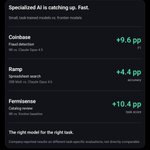
The case for specialized AI keeps getting stronger:
Coinbase: 9B beat Opus 4.5 on fraud (+9.6pp F1).
Ramp: 35B MoE beat Opus 4.6 on spreadsheet search (+4.4pp).
Fermisense: 9B beat frontier on catalog review (+10.4pp).
Knowing the job can matter more than knowing everything.


The future of AI is local.
We spend so much time talking about bigger models that I think we're overlooking how important smaller models are going to be.
For AI to be truly useful in everyday life, it needs to run directly on our devices. A robot can't wait for a round trip to the cloud to react, and a personal assistant shouldn't need one for every interaction.
As smaller models become more capable, the possibilities for everyday applications become big