

CEO @ JDAQA | Host of The First Customer podcast | Founder of Friendly Cosmos Astrophotography | Dad x6
Churchville, PA
Joined January 2022
- Tweets308
- Following142
- Followers57
- Likes329



Here's a number that will ruin a CTO's morning.
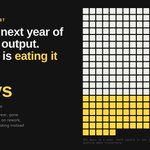
110 days.
On the current trajectory, that's how much of your engineering year quality debt is on pace to eat. Nearly a third of it, gone before a single feature ships.
Rework. Incident response. Manually retesting code nobody fully trusts. It's compounding like interest while you rack up velocity on credit.
The "AI made us 10x faster" story leaves a lot out. Output went vertical in the spring. The trust to actually ship that output didn't move. And the gap between those two lines has a name and a price tag.
I keep seeing the same chart in my head: engineering output plateauing, not because the models slowed down, but because there's a mountain of AI-generated work nobody trusts enough to release. Your test coverage can read 90%, but it might as well be zero if no one believes it.
That's what quality debt is. Not messy code. Untrusted output piling up faster than your team can verify it, quietly eating the year you thought AI just gave you back.
So before you plan next quarter on the assumption you’re moving faster, what's your number? How many of those 110 days are already spoken for?

Your senior devs reviewing AI’s pull requests is not QA.
I'll say it louder for the CTOs quietly cutting the testing budget because “code review covers it now.”
There are two different questions you should be asking.
Code review asks: Is this code acceptable? One developer, reading a diff, checking style, patterns, and obvious bugs. It’s one person's read of an artifact.
Testing asks: Is the software correct? Running the actual system. Behavior, edge cases, integration, real users. Proof it works.
Strong developers are strong reviewers. That has nothing to do with whether they're the right answer to “Does this work for the person using it?” A passing review is not a working product.
And the fix everyone’s reaching for—throw an extra reviewer on the PR so they “test it as they go,” gives you feature-level checking with zero integration or system coverage. It feels like diligence but it won’t stand up in production.
We’re generating code faster than ever and pretending the thing that catches the diff is the thing that catches the failure.
It isn't. It never was.
Tell me where I've got this wrong.
Quality across product, engineering, and validation. That's the whole game.
Once you see it that way, the endless "shift left" debate gets simple. You're not reorganizing the universe. You're moving two things into product and engineering: building the thing, and proving it works.
Building got stupid cheap. Proving it works is where everything now breaks.
When it comes to validation, you cannot win in the weeds. When machines are writing the code, and you've got thousands of commits a month, if you hand hold individual tests, you'll drown. The only way through is to abstract up. Stop managing tests one at a time, and start managing the layer that orchestrates them.
This Thursday, Ole Lensmar, CTO of Testkube, and I are going there. My "QA is dead" argument says abstract quality up and out because you can't handle it down in the details. Testkube is that same idea one level down, at the test orchestration layer. Two halves of the same shift.
If you're a CTO or VP of engineering in Philly and want a seat, DM me for an invite.
I asked a CTO on a call recently a simple question.
"If I handed you 100 senior QA engineers, for free, with unlimited time, would that solve your problem faster than the thing you're trying to build?"
He went quiet. Then: "I can't think of a reason I wouldn't take that."
This is a guy on the bleeding edge of AI. Genuinely brilliant. And he was pulling his hair out trying to build a verification harness for 40 engineers. Trying to make AI human enough to test the work of other AI.
Dude. It's okay. You need testing.
We’re here because the most AI-forward teams kicked the can furthest down the road, and they're the ones hitting the wall first. Piles of features they can't ship because they can't test them. 7,000 commits a month and no way out the door. The cute fix, besides an extra reviewer thrown in at the pull request, is feature-level testing with zero integration or system coverage. It doesn't hold.
They keep trying to sell us on "we'll eventually get there." Fine. But what are you doing right now, while the backlog rots?
I think the answer, today, is more humans. AI-enabled, surface-area maxed, absolutely. But humans hold the green light.
Come argue with me about it in person this Thursday in Philadelphia. Engineering leaders only. DM me for an invite.


Everyone’s celebrating that code is basically free now.
Nobody’s honestly talking about what that does to validation.
Squishing a QA check into your code reviews and pretending that covers it doesn’t count. That’s not testing your software. That’s reading it.
Here’s the uncomfortable math. You don’t get to delete the cost. You just move it. All that output your engineers ripped out when your traditional SDLC became an AI SDLC didn’t get cheaper to trust. It got more expensive, because now there’s an aging backlog of agentic code nobody fully understands sitting between you and a clean release.
The industry is going to have to get over the fact that validation costs money. For 20 years the split was something like 80% development, QA slapped on at the end for whatever budget was left. That ratio is breaking. The 1:4, 1:3 you used to get by with is turning into 1:2.
And by the way, I don’t think code stays free for long either. Remember Netflix was once 8 bucks.
The check-signers are about to learn that the bill for all this velocity didn’t disappear. It just hadn’t arrived yet.
Where’s this landing for you?
Holy smokes things have changed so much since my keynote in Chicago a month ago.
A lot of is maybe still relevant? Maybe not?
Check it out and let me know.
youtu.be/7e-ERhZyk_4?si=RktG…
Agree or disagree?
A human is irreducibly required in software quality at any point that involves one of four things:
deciding what correct means
determining whether something is true
accepting risk and accountability
judgment about the unknown and the adversarial.
Do we need humans to create high-quality software products? (spoiler alert: yes)
A lot of engineering leaders are hesitant to talk about where they have and need actual humans to deploy high-quality software at the speed AI-engineering can produce code.
It's not sexy. It's not what's hot. It's not what execs want to hear.
I see so much hand-waving around fully-agentic-harness-engineered-dark-factory-stacks that are tapdancing around the obvious issue.
We can opine about the day where AI can tell us if something is fun or exciting or engaging or a fantastic user experience or if we should be 100% confident a product or release is "bug-free" ...
Until then, to get feature output anywhere close to the code output, we need a sh*tload of a people to get this done for now, right?


Meetings …. Blah …. Emails …… Blah ……. Calls …… Blah ….. LinkedIn …….. BLAH BLAH BLAH
Catch yall Monday✌️