Jon Zink (@jonKzink) header
Jon Zink (@jonKzink) profile picture

Exoplanets | Hubble/Sagan Postdoctoral Fellow @Caltech

Los Angeles, CA
Joined February 2019
Photo by Jon Zink (@jonKzink)Photo by Jon Zink (@jonKzink)Photo by Jon Zink (@jonKzink)Photo by Jon Zink (@jonKzink)Photo by Jon Zink (@jonKzink)Photo by Jon Zink (@jonKzink)Photo by Jon Zink (@jonKzink)Photo by Jon Zink (@jonKzink)Photo by Jon Zink (@jonKzink)Photo by Jon Zink (@jonKzink)
We have a new paper out today diving into the architectural facets unique to Hot Jupiter systems: Hot Jupiters Have Giant Companions: Evidence for Coplanar High-Eccentricity Migration arxiv.org/abs/2310.01567
1
8
1
25
3,618
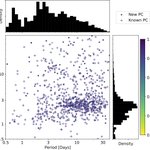
My new paper is on arxiv! We surveyed ~110K stars and found a metallicity "cliff" in super-Earth formation. This one has been in the works for a while. Check it out here: arxiv.org/pdf/2407.13821
3
22
2
109
19,065
Yesterday was my last official day as a professional astronomer. It’s been a good run and I have made amazing friendships along the way. Looking forward to the next chapter of my career at Google.
12
1
120
9,541
Don’t sleep on this result! We have put a pretty important constraint on the timescale for sub-Neptune mass-loss (about 700 Myr).
This Post is from an account that no longer exists. Learn more
5
1,474
Jon Zink retweeted
We have a new paper out today diving into the architectural facets unique to Hot Jupiter systems: Hot Jupiters Have Giant Companions: Evidence for Coplanar High-Eccentricity Migration arxiv.org/abs/2310.01567
1
8
1
25
3,618
🌟Characteristic 3: Eccentricity Unveils Secrets🌟 In Hot Jupiter (HJ) systems, outer companions tend to have mid-range eccentricities, while comparable non-HJ outer companions appear more circular. This suggest a rich dynamic history between HJs and their outer companions.
1
3
142
Putting all of these features together we favor coplanar high-eccentricity migration ---which predicted a >3X mass correlation for HJ outer companions--- as the dominant mechanism for hot Jupiter formation.
2
132
Stars that travel high above the galactic plane, shown here in many wavelengths, may have fewer small, hot planets than those nearer the plane, according to a new study. Planet formation might differ from one galactic neighborhood to the next! go.nasa.gov/3E5YcPp
7
83
3
415
66,471
Discovery Alert! 📣 A meticulous study finds that stars on the fringes of the Milky Way possess fewer of the most common planet types. Planet formation – and the resulting families of planets – might differ from one galactic neighborhood to the next! go.nasa.gov/3E5YcPp
7
155
4
798
112,975
I am looking to do some talks this fall about exoplanets and their interactions with galaxy itself. If you run a colloquium/coffee/group-meeting and are interested please email or DM me.
1
4
428
I would love to chat/coffee/lunch with #Sagan2023 folks tomorrow (Wednesday). Reach out if you're interested.
1
1
4
1,807
Apparently people are having trouble with the DMs. Just email me. [email protected]
98
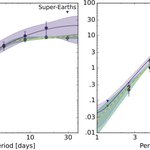
New Results! 🌟Stars making significant vertical excursions from the Milky Way plane host fewer super-Earths and sub-Neptunes. Metallicity alone cannot explain this intriguing observation. Galactic influences leave their mark on the planet population. arxiv.org/abs/2305.13389 🧵
1
34
5
139
33,479
🔬 These results provide fresh insights into the distribution and formation of planets around FGK dwarf stars. We've only scratched the surface of understanding the rich diversity of worlds beyond our own. #PlanetaryExploration #Astronomy #KeplerMission #K2Mission #Exoplanets
1
5
471
Shout out to all my co-authors on this paper: @kevinkhu, @aussiastronomer, Erik Petigura, @KierstenBoley, @sakheebhure, @malena_rice, Sam Yee, @HowardIsaacson1, Rachel Fernandes, Andrew Howard, @SarahCBlunt, @LubysLemmas, @ashleychontos, @AstroDaria, Mason MacDougall.
8
631