

Annenberg Professor of Natural Sciences, University of Pennsylvania
Joined September 2010
- Tweets5.1K
- Following1.1K
- Followers3.7K
- Likes10.9K





This piece assumes much of the reader, but gives much more in return.
Sadly I don’t imagine the AI overlords will even understand this eulogy.
doomslide.substack.com/p/aga…
Joshua B. Plotkin retweeted

We are searching for a new colleague in our Department of Biology at University of Oregon!
This is a super special opportunity-- an endowed chair position in Genetics/Genomics. Come join us!
I'm happy to answer any questions folks might have
careers.pageuppeople.com/726…
Joshua B. Plotkin retweeted

Applications are open for the NITMB Fellows program!
NITMB is seeking early-career researchers who have an interest in transforming biological research and inspiring new mathematical discoveries
Apply by November 15, 2026: nitmb.org/nitmb-fellows-prog…

Opportunity: Penn MindCORE Fellowship!
MindCORE seeks to recruit outstanding postdoctoral researchers for our Research Fellowship for Postdoctoral Scholars. Housed within the School of Arts & Sciences of the University of Pennsylvania, MindCORE is an interdisciplinary effort to understand human intelligence and behavior.
Applications due December 1, 2026.
mindcore.sas.upenn.edu/post-…

Thank goodness.
(Clarification would be required in my department, for real. Also, my standard reaction to claims that algebraic geometers say are obvious..)


I can only infer that’s a joke. Because the idea of a committee on the role of mathematics writ large, and the impact of AI, but lacking applied expertise …

Credits: lyrics by me and Claude · music and vocals by Suno · video written in code by Claude on @_mexicat's pdoom engine
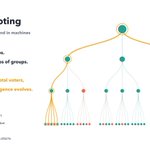
An evolutionary origin of collective decision making in humans and machines. New paper, with Guocheng Wang and Qi Su:
arxiv.org/abs/2610.05676
Human institutions and machine-learning algorithms both decide by layered, non-linear voting. Engineers train networks with back-propagation. Institutions have no engineer.
We find that rewarding individuals only when their vote is pivotal, at every layer, lets collective intelligence evolve by peer imitation alone. That reward scheme plays the role of back-propagation in ML.
This result gives a naturalistic, evolutionary account of decision making, by human institutions and machines alike.

...and if Wolfram does read it: iterating his tournament would make a nice project for one of his summer programs.
Likewise, Steve. And talking into the void is a respectable strategy here: TFT also cooperates first and hopes for the best.