

Principal Economist at @Gallup/@GallupNews, posting mostly about markets and wellbeing. Forthcoming book on ancient parenting. Catholic, father, husband.
Washington DC
Joined December 2010
- Tweets4.7K
- Following706
- Followers3.2K
- Likes1.8K






I love to see this, a superstar professional athlete publicly taking pride in caring for his newborn baby and reinforcing the masculinity of meeting paternal obligations . Now, to provide the full benefits of this enthusiastic commitment, I’d like to see him marry the mother :)

Tyrese Maxey on whether he changes his baby's diaper:
"I'm a big diaper changing guy. I take pride in the speed that I'm able to change a diaper and keep her from crying. So I'm a big diaper change guy, big feed guy, big nap guy. I'm all of it, wake up in the middle of the night, go get it. I do it all man. I try to cherish these moments, cause it feel like already now she trying to crawl and do different things. So she's already moving too fast for me"
When I was young, the “systems” theory of mental health was very appealing to me in its assertion that mental illness was essentially impossible under good societal conditions. It offered a vision for heaven on earth with the right rulers.
I came to realize that mental health is largely caused by a combination of genetic and family circumstances.
The benefit of this view is that it flips power. People don’t need a “great society” or great leaders to be mentally healthy. A good family will do, loving parents, and friends, grounded in deeper beliefs about life’s purpose.

The president of @APA Division 39, Dana Charatan, has responded to @Hartz_PhD's and my essay in the @WSJ exposing the ideological takeover of the APA.
She ignored every substantive point we made and seemed to defend the activist nature of the conference by claiming that "Patients are affected by the systems in which they live and may be particularly vulnerable to the harms those systems produce. Therapists must attend to power dynamics within and beyond the consulting room."
There are many problems with this statement, which appears to be informed by some of the worst zombie ideas in pop psychology, such as the blank slate and the notion that mental health issues are primarily caused by minority stress and the accumulation of trauma.
When you believe that poor mental health and bad behavior are caused by "oppressive systems," treating the patient feels to them like blaming the victim. There's nothing wrong with them. It's society's fault!
The target of therapy is therefore no longer the individual patient, but society itself. Many therapists now seem to view their job as becoming full-time social justice warriors, agitating for a revolution to overthrow the "system(s)" supposedly responsible for causing so much psychological harm.
But even if their diagnosis of the problem were correct (it isn't), therapists simply don't have the ability to carry out the societal upheaval they believe is necessary to help their patients. And so the patients never get any real help.
Instead, they're told things that take them further from reality and are almost guaranteed to make their mental health worse: you're a perpetual victim, family structures are bad, you're a woman if you say you are, etc.
I was really hoping she'd address why the conference had a talk titled "Feel the F--king Fantasy (Redux): Drag, Desire, and Queer Theory at WERK in Psychoanalysis" that concluded with a drag performance that gave attendees 1.75 Continuing Education credits.
The APA Division 39 president is totally clueless in her response. She's not even driving the field off a cliff. It's already airborne and she's somehow still oblivious that she is seconds away from smashing into the jagged rocks.
🔗wsj.com/opinion/a-true-crisi…

The financial incentives to rent out a home are extremely weak when housing price growth is weak, as is now the case, and they are weakened further by regulations like this that override contractual terms between tenant and landlord.

Tariffs, the Iran conflict, and the lowering of the Federal Funds Rate have probably each contributed to inflation, which notably increased starting in the Spring (2.8 to 3.4).
These effects, however, seem rather small compared to what happened after the COVID stimulus in March 2021 (1.5 to 7.2)

The temptation to portray one's identity--in this case agnosticism--as the target of mass discrimination and suppression appears to be so high in some people that even respected scientists will succumb to the slightest hint that it might be true in the face of insurmountable evidence to the contrary.

New research shows that 80 million Americans are afraid to express religious doubts. The documentary HEATHENS follows five of them when they stopped pretending, paid the price of truth, and rebuilt free, joyful lives. I found the film moving, even shocking.Catch an upcoming screening in SF, LA or NY. With US mid-terms coming up, it's a good time to examine beliefs and values.heathens.movie
Imagine that you pay $1 bil/year in taxes AND you created a business that employs tens of thousands of people with high wages and benefits AND you created a product that lower prices for huge numbers of people, creating a large consumer surplus, not to mention many large charitable donations.
You might find it at least a bit frustrating to have French academics living in the USA devoting their lives to arguging that you have not contributed your fair share to your country or humanity.

What amazes me is the attitude of so many of the centibillionaires.
A 5% tax will not make any difference to the way they live. Their spending may be extravagant, but it is still much less than their (correctly measured) income.
They know that, as gifted as some of them indeed are, they have benefited from extreme luck (and the help of the state, and, to speak like an economist, monopoly rents).
They know that their effective tax rate is low, relative to what many others pay.
They know that extreme inequality is extremely unpopular, and can lead to political unrest, backlash, or worse.
They must admit that, morally, it is hard to argue for a society in which some become obscenely wealthy, while so many are poor and see their income stagnate.
They typically have not indicated that they are building their wealth to eventually make the world a better place.
But they are still willing to fight the tax, spending hundreds of millions in California to avoid paying the tax. Why?
They simply think what is theirs is theirs, end of story.
They believe in the slippery slope, and if they do not take a stand on this levy, the government will come back for more.
They hate the state and the notion that their money will be misused?
Or?
The French actually used to value entrepreneurship, a French word meaning one who undertakes
Here's how Victor Hugo describes Jean Valjean's enterprise in 1862:
"In less than three years the inventor of this process had become rich, which is good, and had made every one about him rich, which is better...It was from this slender capital, enlisted in the service of an ingenious idea, developed by method and thought, that he had drawn his own fortune, and the fortune of the whole countryside. . .At first, when they watched his beginnings, the good souls said, “He’s a jolly fellow who means to get rich.” When they saw him enriching the country before he enriched himself, the good souls said, “He is an ambitious man.” Hearing of this, the king was so pleased that he was appointed mayor.
The top four billionaires in Gabriel's database paid $1 Billion per year in total taxes from 2019 to 2026 based on his estimates. Their contribution to CA taxes was about $68 Mil each per year.

The second big issue in their work involves their estimate of how much income tax the top California billionaires (those they assume will leave) actually pay.
They overstate it by a factor of 5.
That’s because they do not have data on the income tax paid by those top billionaires (e.g., Brin and Page).
By contrast, we have direct data on this, from the Securities and Exchange Commission, where we can see compensation, dividends, and stock sales for Page, Brin, and other top billionaires.
gabriel-zucman.eu/files/BSZ2…

Portraying fraud as a social experiment is quite a creative attempt at a cover story!

We were investigating Wedgewood for faking their data and emailed them for comment this morning, ahead of publishing the findings tomorrow. They are trying to cover up their fraud with the "we were doing a social experiment" excuse.
Full story here: blog.fiftyplusone.news/p/fif…

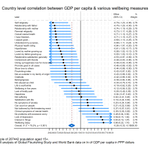
Economic modernization is positively associated with many wonderful things, like longevity, how people evaluate their life on a 0-10 scale, & lack of psychological distress, but it is negatively associated with religiosity, hopefulness, gratitude, self-reported virtue adherence, and the quality of relationships with parents, friends, & others.

Jonathan T. Rothwell retweeted

California's Billionaire Tax Act would collect roughly $30 billion. Accounting for lost income taxes from departures, the mean Net Present Value is negative $39 billion, from Benjamin Jaros and Joshua Rauh nber.org/papers/w35899

I'm enjoying the recent trend of scientists debating metaphysics, as if we were back in the early Enlightenment.
I've been reading @FeserEdward's excellent summary and defense of Thomas Acquinas's careful arguments on final causality, essence, and related topics.
Logical discussion about esoteric religious topics and the limits of a mechanistic view of the universe are suddenly extremely relevant to understanding what to make of our friendly AI bots.

Spectacular Nature piece on why AI is not conscious and probably will never be.
Three arguments:
1) Intelligence is not consciousness.
Intelligence is about solving problems. Consciousness is about having subjective experiences.
AlphaFold can solve super difficult problems. By contrast, our brains performs complex operations entirely outside awareness.
Problem-solving and consciousness are two separate things.
2. Biology is essential.
Our brains are alive, down to every cell. Their activity is inseparable from the living tissue that produces it.
The idea that consciousness can be reproduced simply by running the right computations on silicon components who do not fight for their life is a very far fetching and, I would add, almost religious, assumption.
3) The physical organization may matter more than the computation.
According to integrated information theory, consciousness requires specific causal relationships between a system’s physical components.
The computer architectures running today’s AI lack this organization.
The comparison with AlphaFold is particularly revealing:
Almost nobody things AlphaFold is conscious, despite its inner working is very similar to an LLM
Why?
Because it does not speak.
LLMs do speak like us and therefore we fall into an illusion:
Since they speak like us, they must be like us.
But this inference is wrong.
LLMs are just a series of matrix multiplications.
They are not conscious, and they will never be.
*
Paper in the first reply

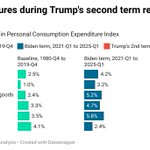
Inflation continues to be a problem during Trump's second term, but price growth has come down substantially. Unlike during the Biden, inflation now is primarily driven by energy prices.

Housing price growth has been a clear weakness during Trump's second term; this is not surprising since the 30-year fixed mortgate rate and federal funds rate remain elevated relative to recent years, though still lower than the 1980 to 2019 era.

In the first century, 31 cities in the Roman Empire had pop>30k. The Christianization of these cities is strongly and almost equally predicted by its having a Jewish diaspora and Hellenic/Greek community.
This is consistent with biblical, historical, and philosophical analysis; sociologist Rodney Stark analyzed the actual data predicting Christianization, measured as 0 if none, 1 if congregation by 180 CE and 2 if 100 CE.


Stark argues that Christianity spread
most rapidly among urban Hellenized elites, whether Jewish or Gentile, who appreciated its combination of Greco-Roman philosophy with Jewish monotheism, providing a novel universal religion centered on Reason and virtue that, in contrast with many competing ideas, did not reject worldly practicalities or require extreme asceticism.