
Research scientist @googledeepmind. Formerly @UWproteindesign @ginkgo @HMS_SysBio.
London, UK
Joined March 2009
- Tweets3K
- Following787
- Followers3.1K
- Likes1.7K





Jue Wang retweeted

Avengers assemble: 1 year BakerLab + NVIDIA GenAIR = 🔥 rfd4-proteina.org
Presenting RFD4-Proteina, our latest protein design model, significantly better and faster than everything we compared against, both in silico and in the lab! 1/30
Jue Wang retweeted

Public preview of BioEmu2! @MSFTResearch AI for Science’s new foundation model for biomolecular structure, dynamics and function. Open weights, MIT license.
github.com/microsoft/bioemu2
Movie: BioEmu2-simulated binding of intrinsically disordered peptide PUMA to MCL-1 receptor. 🧵⬇️
Jue Wang retweeted

Today we are excited to release Artios, a fully open source system for designing functional de novo enzymes.
Enzymes present a new frontier for de novo protein design models due to the challenge of coordinating precise chemistry, rather than binding a target.
Enzymes are life’s biological machines and by designing them we can truly start to engineer biology.
We believe these fundamental capabilities should be built in the open and shared with the community to progress science faster.
🧵 1/6
Jue Wang retweeted

Today we're sharing an update on our diffusion method from last year, RFdiffusion3, in @ScienceMagazine. Notably, we show significant improvement in design of sequence specific proteases for amyloid sequences and metallohydrolases for pesticide degradation.
Jue Wang retweeted

Today, RFdiffusion3 is out in @ScienceMagazine!
science.org/doi/10.1126/scie…
We have many exciting updates to share! We're also releasing Chaperone, an agent harness for general bio-molecular design. 1/n
Jue Wang retweeted

Over the past few weeks, we have been putting Gemini 4 Argon to the test on protein engineering workflows at Google DeepMind, and we have some interesting initial (zero shot!) results to share. 🧵👇
Jue Wang retweeted

We are officially expanding the Biosecurity Initiative within the Google DeepMind Science Unit! We are hiring one Research Scientist and up to two Research Engineers. Job postings linked in the comments.
Jue Wang retweeted

Enzymes are incredibly complex machines and designing them is one of the grand challenges of our time. Amazing experience to try and make some progress on these problems with this group of people!

In collaboration with the @francesarnold and @pengliu_group research groups, we @GoogleDeepMind are proud to release AlphaProtein Novo, a pipeline for small-molecule enzyme design.
We developed AlphaProtein Novo on a few standard model reactions, and validated designs in our own wet lab. We then wanted to challenge this system against nascent chemistries, so we asked leading scientists in biocatalysis whether we could partner on the reactions they cared about.

Jue Wang retweeted

In the rapidly developing field of de novo enzyme design, we always wonder what the portrait of design and evolution should look like. Competitive? Successive? Complementary? Synergistic! @francesarnold @pengliu_group @GoogleDeepMind ! biorxiv.org/content/10.64898…

Jue Wang retweeted

Today, our team is sharing a preprint on our new system for generative de-novo enzyme design, AlphaProtein Novo.
At @GoogleDeepMind, we have long focused on the building blocks of life (proteins). We developed AlphaFold to predict structure, trained language models to understand function, and built AlphaProteo to design de-novo binders. But proteins play many important roles in nature, such as enzymes that catalyze chemical reactions.
Designing entirely new enzymes from scratch to catalyze custom reactions has long been a holy grail for scientists. Our team has shown how AlphaProtein Novo can produce new-to-nature enzymes with state-of-the-art activity on 2 benchmark reactions. We’ve also designed custom enzymes to synthesize the pharmaceutical motif piperidine, and others to degrade the environmental plasticizer toxin DEHP.
While there is much more work to do in this direction, we’re excited to have demonstrated the ability to design functional proteins that go beyond what is known in nature. Huge congratulations to @jueseph, @ZvxyWu, Josh Abramson, the @GoogleDeepMind protein design team, and our collaborators in the @francesarnold & Liu Group! 🎉
🔗 Preprints and code:
biorxiv.org/content/10.64898…
biorxiv.org/content/10.64898…
github.com/google-deepmind/a…
Jue Wang retweeted

In collaboration with the @francesarnold and @pengliu_group research groups, we @GoogleDeepMind are proud to release AlphaProtein Novo, a pipeline for small-molecule enzyme design.
We developed AlphaProtein Novo on a few standard model reactions, and validated designs in our own wet lab. We then wanted to challenge this system against nascent chemistries, so we asked leading scientists in biocatalysis whether we could partner on the reactions they cared about.
Introducing AlphaProtein Novo, a pipeline for de novo enzyme design! In collaboration with @francesarnold's group, we developed AP Novo and used it to get SoTA "novel-scaffold" activity on 2 benchmark reactions and create enzymes to synthesize the pharmaceutical motif piperidine and degrade the environmental toxin DEHP.
Work led by @ZvxyWu @ZiqiLi0513 with teammates @alexechu_ @kelly_ruijie @schulluc @jacobjinkelly @rosaliags @davidla @solserpens @j_reisenbauer, @pengliu_group, Josh, Thomas, Amy, Tristan, Harshnira, and others. It was a joy and privilege to work with you all!
Preprints and code:
biorxiv.org/content/10.64898…
biorxiv.org/content/10.64898…
github.com/google-deepmind/a…
Enzymes are proteins that speed up chemical reactions. They power all living organisms, and are also incredibly useful for human purposes. Biochemists dream of having made-to-order enzymes for any reaction. Directed evolution is great at engineering enzymes, but needs starting points. De novo design can potentially create starting points with new-to-nature functions, but nobody has compared natural sequence mining and de novo design side-by-side on the same target reaction. Can design succeed where nature fails?
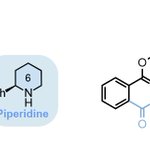
Piperidines are a 6-atom ring common in medicines. Enzymes could help produce them more cheaply. Screening 188 natural enzymes found 0 with high specificity to piperidines. In one round of design with AP Novo we achieved higher piperidine specificity than any natural enzyme. DEHP is a plastic additive and toxic pollutant. Some natural enzymes can degrade it but are very rare. We designed DEHPases and found they were still active in 75% acetonitrile or 90C, which destroys most enzymes. This could be useful in harsh industrial processes.
We also push the envelope on model reaction rates. Recent advances in de novo enzyme design are amazing, but high rates usually still require design iteration. How fast an enzyme can you get "straight from the computer" by maxing out in silico filters on previous data? We made a Kemp eliminase with kcat/Km=14,600 M-1s-1 and serine esterase on 4MU-Ac with kcat/Km=360,000 M-1s-1 and kcat=5/s, both without redesigning previous designs. This is SoTA "novel scaffold" (not strictly zero-shot because we iterated on filters).
AP Novo is a generator-MPNN-AF3-filter pipeline. The generator does seq-struct co-diffusion via a simple transformer and no protein-specific inductive biases. It is SoTA on in silico benchmarks but for wetlab success, filters do the heavy lifting. Our key filter scores a backbone by redesigning multiple sequences on it and aggregating over the ensemble. You can think of this as measuring preorganization of catalytic geometry due to a backbone rather than a single design sequence. We think this idea, which is related to methods like NISE, ProteinHunter, Halludesign, RFOptimize, beam search, and iterative MPNN/partial diffusion, will be key to improving generation and evaluation going forward.
We are excited by our results, but of course there are limitations: our best esterase borrows a natural structural scaffold; backbone-level preorganization does not get all the way to high natural-like activities; input motif can matter more than generator/filters. More research is needed!
Please try the model and tell us what you think, and let us know if you are working on a hard problem where we could help!

ALT Reaction schematics for piperidine synthesis and DEHP degradation

ALT Schematic of sequence-ensemble-based design filtering. See preprint for details.
Co-sign. Argon is a game changer for our research on the Protein Design team and I love using it on a day-to-day basis.

Jue Wang retweeted

Today in @Nature, we introduce SynthID Bio, a family of watermarking methods for protein sequences and structures, that we believe will contribute to responsible development of AI for biology. Learn more in our blog and this thread 🧵 - deepmind.google/blog/introdu…

Jue Wang retweeted

It’s been incredible to see how capable Claude is at optimizing biological ML models! Neither @amirshanehsaz nor I had much experience with performance engineering starting this 4 weeks ago, but with Claude we found significant speedups we hope will be helpful for the community

Biologists use specialized open-source models for tasks like modeling the structure of molecular systems, designing drug-like molecules, and predicting the effects of genetic mutations. But these models are often expensive to run, potentially limiting their impact.
In our latest Science Blog, we share how Claude was able to optimize inference for more than 30 open-source models, making them 4x faster on average, partly by writing custom software for GPUs. We’re open sourcing all of the optimization code.
Read more: anthropic.com/research/claud…
Jue Wang retweeted

1/
What could we discover if we had a binder for every protein in the human proteome?
We are excited to introduce the Bindome, an open and free resource of over 300,000 designed protein binder candidates against over 8,000 human target proteins.
🧵
Jue Wang retweeted

the discovery of PCSK9 inhibitors being downstream of finding people with bizarrely low LDL from the Dallas Heart Study implies that a high-value biobank would be one in which the criteria for acceptance is that each participant believes something is deeply wrong with their body
