

building with AI in public / tools, systems, experiments / dm open
Everywhere
Joined April 2023
- Tweets15
- Following41
- Followers27
- Likes187

Anthropic just published how Claude's memory actually works, and it's the opposite of what most people build
They let two Claudes play Pokémon.
Sonnet 3.7 wrote 413 memory files across 225 folders. 1 badge.
Fable 5 wrote 10 files. 4 badges.
More memory ≠ better memory. Here's what they found:
1. Every note is a bet. A memory is a prediction that it'll matter later. Fable 5 only saved what the game didn't already show on screen.
2. Memory alone is a massive upgrade. On CL-Bench, Opus 4.7 went from 0.383 to 0.700 just by keeping notes between sessions. Same model.
3. Strict rules backfire. A "record only failures" rule cost Opus 5 0.234 of its memory gain. Tell it what memory is for, not how to use it.
4. Older models need a nudge. Sonnet 4.6 read its notes less than half the time. One refined instruction took it from 0.364 to 0.641. Sonnet 5 reads memory 9 out of 10 times on its own.
5. "Dreaming." Between sessions, Claude rereads its old transcripts and fixes wrong notes. In Pokémon, the run with dreaming got through Mt. Moon to Cerulean City. The run with raw memory never made it.
6. Self-written wikis beat search. On 24 merger questions, Claude scored 87% using its own wiki vs 73% with search alone.
7. Never let agents share one file. 4 agents writing into one shared table kept 41 of 57 facts. One page per contract: 57 of 57.
Keep the top layer tiny. Claude Code only loads the first 200 lines of MEMORY.md.
Your agent doesn't need to remember more. It needs to remember better.


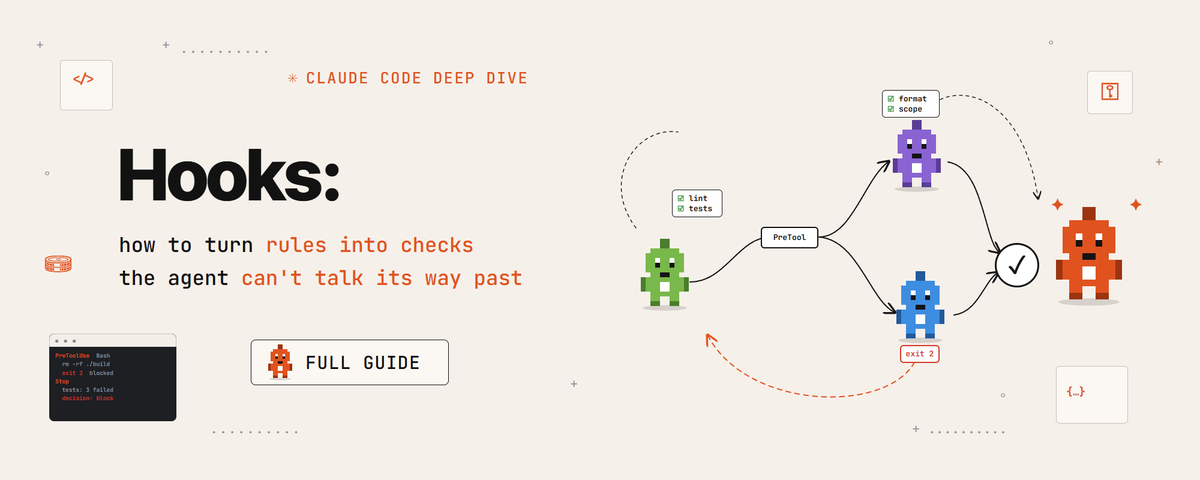
your CLAUDE.md is a wish list
the agent reads it, weighs it, and skips it at step 40
hooks don't ask. they check
6 events, 3 exit codes and the Stop hook that makes "done" mean the tests passed
9
10
292
