

Tech, games and whatever the internet did today. I also build small apps.
Joined April 2024
- Tweets613
- Following215
- Followers49
- Likes630








Node.js Security Advisory: a high-severity RCE flaw in Node's Brotli decoder affects Node.js 22, 24, and 26.
Vercel WAF rules are live for every project and block known exploit patterns.
vercel.com/kb/bulletin/node-…

a new survey says more than half of managers find it harder to evaluate their team's work after bringing in AI. if a report looks good, they can't really tell how much of it the person did techcrunch.com/2026/10/21/ai…

if you only follow AI news from openai, anthropic and google, you miss stories like this one. spacex made $4.4 billion in net income last quarter and AI was the main reason, like how? techcrunch.com/2026/10/20/sp…

i think bug hunting is one of the better uses of AI. going through a huge old codebase looking for holes is slow work, and when something like PHP has a hole, a lot of sites are exposed at once wiz.io/blog/php2shell-php-rc…

openai bought a biotech startup called orchestra bio to work on rosalind, their ai model for life sciences research. after the math thing, i hope this one gives credit to the people whose research it builds on. techcrunch.com/2026/10/20/op…

google has gmail, calendar, maps and a car platform all under one roof. i think they have all the pieces for great ai products and still somehow flop hard, so i'll wait and see if this one actually works well in a real car before getting excited. theverge.com/tech/1014999/go…

i'd take a boring write-up of what actually happened over a dramatic AI doc any day. but "full doomer mode" probably gets more views on netflix than "here's what really went on"

Just watched the @netflix Instadocs about the @OpenAI cyberattack on @huggingface. Super disappointing, as they went for maximum anthropomorphism of the technology and full doomer mode.
I spent more than two hours with them trying to correct all their mistakes and ground this in reality, explaining that agents are technological systems, not aliens. But it looks like the drive to scare people for maximum views was too strong.
Also, they didn’t mention the lack of containment and monitoring of the agents, how closed-model safeguards blocked our defensive work, or how we defended ourselves with AI using an open model. And that we still lack a lot of information and transparency, including full agent traces and that companies need to remain accountable for what their agents do.
It ends up being a fun sci-fi movie though!

I think building with ai got easy enough that the slow part now is getting someone to pay. the first dollar is a sales problem, and most of us making small apps never practiced that part
AI can have a little bit of mass casualties (up to 49 people and $999M), as a treat.
tomshardware.com/tech-indust…

claude with REA is on crack. also since when does it do what i tell it to do? it used to refuse a lot before

claude with REA is on crack. also since when does it do what i tell it to do? it used to refuse a lot before REA was out
Karabo on X: "say less, behole the result for the github.com/morluto/rea https://xitter.cf/t.co/KottrrStfF" / X


Karabo retweeted

Technical moats are mostly over at this point. If you’re building something that is meant to be durable, the only moats now are:
• Proprietary data
• Network effects
• A physical component
free open-source tools are still my first pick, but once you plug your own paid API key into one, a breach on their side can end up on your card xitter.cf/opencode/status/211151…

We had a security breach last night related to a large scale distillation attack that impacted 1.4% of OpenCode Console users
We have notified them all this morning via email. If you did not get an email you were not impacted, it was a subset of users who had external providers linked
The incident is ongoing so we cannot share more details at this point but we are working with Anthropic, OpenAI, and Google to remediate
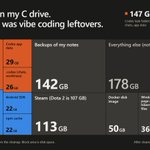
I vibe code and never clean up after it. My C drive had 30 GB left, so I finally looked.
273 GB of it was leftovers. More than half of that was Codex.
Codex alone: 55 old task folders (92 GB), a 26 GB .codex folder, and 29 GB of app data that is mostly a second Android SDK. Then ten emulators (82 GB), another Android SDK (22 GB) and a 22 GB npm cache.
To see how bad yours is, send this to Claude Code or Codex:
“Scan my drive read-only. Check folder sizes only and do not open any files. Find what AI coding tools and the apps they built left behind: chat history, old task outputs, git worktrees, emulators, SDKs, caches, Docker images. For each one show the path, the size and what breaks if I delete it, and mark it safe to delete or ask me first. Do not delete anything yourself.”

opus 5.5 on medium has been extremely slow for me since the recent updates. high runs okay. somehow the middle setting is now the slow one
AI benchmarks mostly test the work that was easy to write a test for. the rest of a normal job is unclear emails, half-broken setups and people who can't explain what's wrong, and nobody is scoring that (for now!!)

Mercor Research mapped AI benchmarks to actual US jobs.
Only 208 of 923 occupations in the US economy are represented by existing AI benchmarks. 90% of hours worked in the US aren't covered well by a relevant AI benchmark.
Today, we’re releasing the 𝗕𝗲𝗻𝗰𝗵𝗺𝗮𝗿𝗸 𝗠𝗮𝗽 𝗼𝗳 𝘁𝗵𝗲 𝗨𝗦 𝗘𝗰𝗼𝗻𝗼𝗺𝘆, an interactive breakdown of which economic tasks are covered by AI benchmarks.
Benchmarks are how we measure AI’s progress and anticipate its impact on real work. They’re crucial to understand which jobs AI can automate, where the biggest gaps are, and how those capabilities are changing over time.
The Benchmark Map is our first step toward building a resource that makes it easier to answer: 𝘋𝘰𝘦𝘴 𝘵𝘩𝘪𝘴 𝘈𝘐 𝘮𝘰𝘥𝘦𝘭 𝘸𝘰𝘳𝘬 𝘧𝘰𝘳 𝘮𝘺 𝘰𝘤𝘤𝘶𝘱𝘢𝘵𝘪𝘰𝘯?
Explore it here: mercor.com/research/labor-in…

AI benchmarks mostly test the work that was easy to write a test for. the rest of a normal job is unclear emails, half-broken setups and people who can't explain what's wrong, and nobody is scoring that (for now!!) xitter.cf/mercor/status/21105570…
Mercor Research mapped AI benchmarks to actual US jobs.
Only 208 of 923 occupations in the US economy are represented by existing AI benchmarks. 90% of hours worked in the US aren't covered well by a relevant AI benchmark.
Today, we’re releasing the 𝗕𝗲𝗻𝗰𝗵𝗺𝗮𝗿𝗸 𝗠𝗮𝗽 𝗼𝗳 𝘁𝗵𝗲 𝗨𝗦 𝗘𝗰𝗼𝗻𝗼𝗺𝘆, an interactive breakdown of which economic tasks are covered by AI benchmarks.
Benchmarks are how we measure AI’s progress and anticipate its impact on real work. They’re crucial to understand which jobs AI can automate, where the biggest gaps are, and how those capabilities are changing over time.
The Benchmark Map is our first step toward building a resource that makes it easier to answer: 𝘋𝘰𝘦𝘴 𝘵𝘩𝘪𝘴 𝘈𝘐 𝘮𝘰𝘥𝘦𝘭 𝘸𝘰𝘳𝘬 𝘧𝘰𝘳 𝘮𝘺 𝘰𝘤𝘤𝘶𝘱𝘢𝘵𝘪𝘰𝘯?
Explore it here: mercor.com/research/labor-in…