








Pinned Tweet
👋now live!
💻COSPR - Children's Online Safety & Privacy Research investigates the intersection of children’s safety, privacy, tech policy.
We aim to prevent abuse of children, not archive it. We do this by identifying effective interventions.
cospr.net


Dr. Kate Sim retweeted

Hey! I'm looking for people who moderate online spaces for girls and women in the Global Majority to discuss sexual and reproductive health—be it WhatsApp, Facebook groups, forums, or any social media pages. We want your insight for a UNICEF report on GBV-focused moderation!
About to take off and theres blood splatter on the window of my @lufthansa flight 🫠


Dr. Kate Sim retweeted

Join the launch of the Peoples Technology Coalition and build power & fight for rights for workers and communities. South Bay community orgs will demand a seat at the table to lead a local movement and ensure policy makers regulate AI responsibly.

Dr. Kate Sim retweeted

While everyone debates the Guardian letter, here are some much more important letters, written at great risk by the very political prisoners currently being treated as mere footnotes to ideological arguments.
These are the voices that actually deserve our attention. ⬇️
Dr. Kate Sim retweeted

Anwar, a child from Gaza, wrote this letter to his amputated leg:
"A letter to my dear leg,
Today, with you in front of me, I wanted to tell you: I was sad, and I felt weak and ashamed when I lost you, because something in me was missing and I felt I was less than other people and would never do anything again. But today I have become a strong person, and I feel confident every time I look at you. I went out and sold things, I made friends, and I started walking long distances. I do things that people with two legs cannot do.
I love you so much."

Dr. Kate Sim retweeted

“In its push to draw users to its unregulated platform, Polymarket has flooded social media with videos like Makihara’s, which appear genuine at first glance. In reality, Polymarket built near-perfect copies of its website, then instructed creators to make simulated trades on those dummy sites and hide that they were being paid by Polymarket.
To get the videos to go viral, Polymarket has recruited a social-media army to copy and re-post creators’ footage.”
Gift link: wsj.com/business/media/polym…


Dr. Kate Sim retweeted

Joe Lim estimates that 90 percent of what you see on the internet is advertising in disguise, and he should know. For three years, Lim ran a company called Floodify, which at its peak operated 65,000 dummy social-media accounts used to drum up attention on behalf of paying clients.
The point of this kind of marketing is that nobody is supposed to notice it. But lately, the machinery has started to show.
In April, Justin Bieber headlined two consecutive weekends at Coachella. Coachella is the biggest stage in pop music save only for the Super Bowl, the kind of event that in theory generates its own attention. And yet on both weekends, a Discord server writer Lane Brown had been monitoring hosted paid campaigns for Bieber’s Coachella performances, offering clippers — people who are hired to turn a song, trailer, interview, stump speech, or whatever into short, social-media-friendly fragments — as much as a dollar per thousand views.
“On social media, popular opinion is being formed, measured, and manipulated all at once, and every signal the platforms produce — a trending song, a backlash, a talking point, the feeling that ‘everybody’ is suddenly talking about the same thing — can now be fabricated by unseen actors with hidden agendas,” writes Brown.
“Everybody is doing this now,” Lim says. “And if you’re not, you’re behind.”
Brown reports on how the same techniques are now being used to fool people on every app they go to in order to find out what other people think, not just in music but across entertainment, politics, consumer products, and celebrity gossip: nymag.visitlink.me/w6Bu9N

Dr. Kate Sim retweeted

"t’s the same moral panic playbook we’ve seen deployed against cyberbullying, then against social media, and now against generative AI." techdirt.com/2026/05/06/more…

Dr. Kate Sim retweeted

Oh my…as I mentioned in my analysis of the GUARD act, age-based restrictions on AI resources could incentivize Big
Tech to far more harm by setting new dangerous precedents in technology capabilities and use.
Here is a prime example of that.

🚨Meta just published a blog post about their new "age assurance" AI.
Their AI will scan:
📌 Posts, comments, bios & captions for contextual clues about age
📌 Instagram Reels, Live & Facebook Groups
📌 Photos & videos for visual cues like height and bone structure
📌 Behavior patterns...including when users try to change their listed age
If their AI flags your account as possibly underage, your account gets deactivated until you submit ID or complete facial age estimation through a third-party digital identity vendor called Yoti.
They're also training AI to review user reports of underage accounts, applying what they call "consistent evaluation criteria" across every report, faster than human review.
But wait...there's more 🧵


Dr. Kate Sim retweeted

“If you think your child is not talking to chatbot companions, you’re probably wrong,” said Mitch Prinstein, co-director of the Winston Center on Technology and Brain Development at U.N.C. Chapel Hill.
I talked to teens to see what they're doing with those A.I. chatbots. nytimes.com/2026/04/04/techn…

Dr. Kate Sim retweeted
Some creepy info related to targeted ads :)


Dr. Kate Sim retweeted

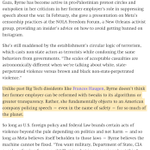
The biggest shortcoming of social-media age-gating is that it fails to address the real problem: Big Tech's business model of behaviorally targeted advertising, @juliapowles and @katejsim explain.
bit.ly/4rEVlDp

Dr. Kate Sim retweeted
Not only is social-media age-gating ineffective. It is also potentially hazardous, introducing new vulnerabilities to data breaches, cyberattacks, and censorship, @juliapowles and @katejsim warn.
bit.ly/4rEVlDp

Latest from me and @juliapowles for @ProSyn on social media band and age-checks:
It's not just that this proposal is faulty, unreliable, and unfit for purpose. It's actively harmful.
project-syndicate.org/magazi…


Dr. Kate Sim retweeted
When are liberals and leftists going to wake up to this

FTC issues COPPA policy statement to incentivize the use of age verification technologies to protect children online: bit.ly/46qN5zl /1

Readers added context they thought people might want to know
Contrary to their claim, using age verification has numerous issues, including but not limited to:
1. Easily bypassed
wired.com/story/robloxs-…
pcgamer.com/hardware/someo…
anapolweiss.com/blog/roblox-ju…
2. Risks of security data breach
newamerica.org/oti/reports/ag…
fortune.com/2026/02/24/dis…
3. Inaccuracies (Placing adults into underage groups, vice versa)
usatoday.com/story/tech/202…
theguardian.com/news/2025/sep/…
And many more... (sigh, I need a break).