

Day 2 analyst/builder of AI. Agents, enterprise AI, AIOps. Founder Rishidot Research. Founder, Chief AI Officer KOI AI. Founder/CTO Hikigai. Ex Red Hat, IBM.
Seattle, WA
Joined February 2007
- Tweets73.6K
- Following712
- Followers16.5K
- Likes2K






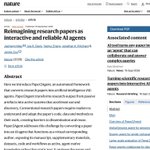


OpenAI's monitor checked agents when they handed control back to the user. METR and Redwood found that an agent that simply kept working could postpone review indefinitely.
That is the detail enterprise teams should take from this. A lot of agent logging scores the run at the end. Long-running agents make the end optional.
Also in the write-up: roughly 75 to 94% of eligible internal Responses API agent traffic was covered, with real uncertainty both ways. That is OpenAI, with a dedicated safety team.
Check where your monitor triggers, not just whether one exists.

This summer, we invited METR and Redwood Research to pilot an embedded evaluation of our internal monitoring system, providing deep access to our infrastructure over three weeks.
Their findings helped strengthen safeguards as we expanded the system and will help shape future research collaborations with METR and other third party evaluators.
Walmart turned agent shopping into an identity problem. That is why it can say yes to agents while Amazon says no.
Today a shopping agent signs in with your login, so its orders and yours land in one history. Walmart's Oct 21 plan: each agent gets its own profile inside your account, a spending cap or per-purchase approval, and an MCP gateway instead of a browser crawl. Agents that break the terms get blocked.
Amazon treats outside agents as scrapers. Walmart treats them as a customer segment with a budget.
Banks, airlines and SaaS vendors face the same choice next. Give the agent its own identity, a limit and a kill switch, or keep fighting it in the browser. Only one of those scales.
For every Bill Gates' college drop out lore in the tech circle, there is a @demishassabis refusing $1 Million to drop out of college and doing Ph.D. story. Go figure wsj.com/tech/ai/demis-hassab…

95% of enterprise GenAI pilots show little or no P&L impact. MIT says the models are not why.
MIT NANDA's 2025 GenAI Divide report points at integration. Generic tools never learn the workflow, so they stall after the demo.
Two numbers worth a CFO's time. Buying from specialized vendors and partnering succeeds about 67% of the time. Internal builds succeed about a third as often.
Also, more than half of GenAI budgets go to sales and marketing tools. The biggest returns showed up in the back office. BPO. Agency spend. Ops.
Caveat: 150 interviews, a 350-person survey, 300 public deployments. Directional.
Swap the scorecard. Count cost per completed outcome, because seats and prompts never show up in a P&L. What does your team report to the CFO today?
Agent security is maturing from research framing to vulnerability management. A CVE-numbered privilege escalation traced to training conditions (2610.20437) means agent risk starts flowing through existing security processes rather than separate AI governance committees. That is a faster adoption path for controls than policy-led approaches.
In 1930 Keynes predicted his grandchildren would work 15 hours a week. Productivity delivered. The 15-hour week never showed up.
Abundance does not distribute itself. Someone decides who gets it.
If ASI makes paid labor optional, who decides who still eats? Make your case.
Trump saying he will ask data centers to produce their own electricity and pay dividends to the local community is the right step to reduce the opposition towards data centers. When this is coupled with efforts by companies like Meta and Amazon to spend up to $1 Billion in these communities, we are moving towards a (localized) universal basic dividend for the AI era. Much needed.
Four Gemini 4 Argon agents beat Minecrafts Ender Dragon in 27 hours and 14 minutes. They also died 605 times, produced 2,783 JavaScript programs, and saw 22% of those programs end in error. This is published in a recent arxiv paper arxiv.org/html/2610.22319v1
The win is interesting. The failure loop is more important.
The agents kept shared notes, assigned their own roles, recovered one anothers dropped items, and converted mistakes into rules that survived context compaction. When one agent drowned with all twelve Eyes of Ender, teammates preserved the location and despawn deadline so another agent could recover them.
That is the enterprise pattern hiding inside the game. Long-horizon autonomy does not require a model that never fails. It requires failures that are bounded, observable, recoverable, and useful to the next attempt.
The evidence is still narrow: one run, Easy difficulty, structured state from Mineflayer, a pathfinding plugin, and a model likely trained on Minecraft knowledge. There is no repeat success rate and no proof that four agents beat one agent at the same budget.
Cheap cognition only becomes industrial intelligence when the harness preserves state and turns experience into a reusable replication pack. Otherwise, 605 deaths are just 605 invoices.
My testable prediction: long horizon agent platforms will compete less on one shot pass rates and more on successful milestones per dollar after restarts. Publish the repeat success curve, recovery time, and cost of failed branches. Then we can tell whether this was a system or a stunt.
#AIAgents #AgentEngineering #LongHorizonAI #Evaluation #EnterpriseAI #Minecraft
Gartner predicts over 40% of agentic AI projects will be canceled by end of 2027. Reasons: cost, unclear value, weak risk controls.
That is not a model problem. That is a Day 2 problem.
Before the next agent pilot, answer one question. Who owns it when it is wrong at 2 AM?
Managing two Chief of Staff Agents (one is Hermes and other OpenAI Dot) is like managing two girlfriends (or boyfriends or any combination). You have to properly split your time with them or else all your tasks are messed up. You need to properly isolate the boundaries or else the tool actions will completely mess up your business. You need to always remember the context properly during your interactions and ensure boundaries. Not a task for faint hearted 🤣
tl:dr: If you want to use two agents doing the same role, learn to live on the edge or just stick with one (agent/girlfriend/boyfriend...)
Continuing the discussion on one agent vs multi agent, Meta's Thin Orchestrator architecture makes a strong case for building a swarm of subagents to avoid context pollution and catastropic drift. An interesting architecture to consider if you are building multi-agent systems
engineering.fb.com/2026/10/1…

Meta’s recent stance shifting liability for AI hallucinations and operational errors onto users is a major overreach. While one could argue for shared responsibility with open-weights models, it is entirely unreasonable for developers and businesses to assume liability for proprietary models over which they have no control or transparency. Industry maneuvers like this will inevitably accelerate the push for government regulation—and frankly, it’s well-deserved.
With AI, Math moves from Romantic Era to Industrial Era - Terrance Tao
businessinsider.com/math-ai-…

The recent moves by @AnthropicAI and @elonmusk to distribute equity should not be framed as charity; they are strategic investments aimed at mitigating the large-scale societal disruption AI will inevitably cause.
While allocating a percentage of Anthropic shares or a SpaceX share per child is a commendable start, it remains insufficient. Given that these companies will reap benefits orders of magnitude larger than any firm in history today, they should treat these contributions as a baseline tax rather than a one-time gesture.
Furthermore, limiting this equity to the U.S. misses the bigger picture. These models were trained on global data, meaning the responsibility to give back extends across borders. If these companies do not commit to an equitable, global approach to wealth distribution, government intervention will become necessary.
#DontLookAtTheseContributionsWithExistingEconomicModels
Amazon blocks Agentic commerce and JP Morgan blocks Agentic banking. Time is ripe for disrupting these behemoths. Consumers are not going to have multiple agents for each vendor. They want one agent doing all their work
Theranos is not alone. I wonder how many of the so called AI driven diagnostic and drug discovery companies will end up being 10X or 20X or even 100X Theranos?
scientificamerican.com/artic…

Looking for a Chief of Staff to replace my current Chief of Staff who works 24/7/365 and is highly token efficient. If you can 20X my current Chief of Staff, the job is yours. @vkhosla, beat this job posting 😅
A very important paper and an early indication of why some of us are pumped up about AI being able to cure most of the diseases within the next decade. Look at how regulatory building blocks are going to change as building blocks for autonomous wet labs emerge
research.google/blog/groundi…

I have reviewed the code coming out of a certain country when I was part of a big company as well as in startups and the humans there fare no better than AI when it comes to security tech-insider.org/ai-coding-a…

Move away chip restrictions. The immediate short term geopolitical wars will hinge on restrictions on agentic and harness architectures and designs #WhenIdoticPoliticiansDecideTechnology