

Author | Consultant | Visiting Faculty at B schools |
Hyderabad, India
Joined June 2009
- Tweets2.7K
- Following284
- Followers497
- Likes11.2K





Krishna Pera retweeted

Big Pharma wanted ₹9 crore a year for a drug. A Hyderabad doctor just bypassed them and got it for ₹2.5 lakh. 🤯
She didn't wait for the company to drop the price. She used a legal workaround in the Netherlands.
For kids with a rare genetic disorder called AHDS, a year's supply of the medicine (tiratricol) costs up to ₹9 crore in the US.
One Indian mother was paying ₹12–13 lakh every month just to import it from Germany.
When attempts to get the drug through the manufacturer failed, paediatrician Dr. Sivaranjani Santosh put out a public appeal on social media in September.
A Dutch non-profit (Pharmaceutical Accountability Foundation) saw it, teamed up with Transvaal Pharmacy in The Hague, and legally custom-compounded the exact same medicine using the raw active ingredient.
• The annual cost crashed from ₹9 crore to ~₹2.5 lakh per child.
• Donors in India and the Netherlands pooled ~₹15 lakh to cover the entire bill.
• With Access to Medicines India and ORDI clearing the import permits, 7 kids will get a full year’s supply completely free on November 30.
The commercial price hasn't changed globally, and Dr. Sivaranjani says importing batches from Europe isn't a permanent fix. She’s now pushing the Indian government to allow local compounding under the National Policy for Rare Diseases so families aren't left at the mercy of ₹9 crore price tags.

Krishna Pera retweeted
Peer reviewed Research: Missionary schools & hospitals were the primary engine for religious conversion,. driving the near-total religious conversion of Northeast India. Ex: Mizoram (0.05% Christian in 1901 to >90% by 1951). Nehru Govt continued British policy in North east. Some References below:
1. Gauri Viswanathan (Masks of Conquest): Proved via British records that Western curricula were designed as a direct surrogate for conversion.
2. David Hardiman (Missionaries and their Medicine): Showed how tribal hospitals used physical healing as a pathway to conversion.
3. Peter van der Veer (Imperial Encounters): Exposed how Britain funded mission schools using Indian tax revenue.
4. Bajaj & Srinivas (The Christianisation of the Northeast): Mapped census data proving how mission institutions drove the Northeast’s demographic shift.
5. 1956 Niyogi Committee Report: Judicial inquiry confirming schools, hostels & hospitals were used as conversion inducements.

NOTE: Some of India’s finest, including several BJP and government politicians in Bengal and at the Centre (news anchors too), were educated in missionary schools. Why are so many of them SILENT now? Were any of them ever asked to CONVERT? Why do so many of them desperately want their kids to study in these very schools? Truth is, Christian-run schools have made an enormous contribution to Indian education and generations of Indians. Why malign an entire community and its institutions like this ? Itni NAFRAT KYON? 😡
indiatoday.in/amp/india/vide…

Krishna Pera retweeted

Looking for your next great read? Check out The Sword of Buddha series by @krishpera.
Brilliant storytelling from start to finish. Give him a FOLLOW for updates and grab the books!
Thank you 🙏
A big #FF to him!


Krishna Pera retweeted
'The Sword of Buddha' Review:
Readers are calling this gripping 260+ page book on post-Ashokan India "impossible to put down," while comparing it with 'Ponniyin Selvan'.
& There is a lot more to Indian History than Mughals & Cholas.
#IndianHistory #HistoricalFiction @BluOneInk

Krishna Pera retweeted

Rahul Gandhi: I rang Mummy and said I want Bhindi for dinner. BJP tapped my phone and conveyed it to Amit Shah who briefed Modi who told Adani who personally flew over and rushed to Azadpur Mandi and bought every last Bhindi he could lay his hands on.
I am having Kaddu tonight.
Krishna Pera retweeted

UPI is widening its lead over global payment giants!
After narrowly overtaking Visa by just 1 million daily transactions in June 2025, UPI has widened the gap to 50.7 million in Oct 2026, processing a record 821.5 million transactions daily and continues to scale new heights!



Krishna Pera retweeted

Are you so completely shorn of facts? This is literally the satellite plotting of farm fires over Punjab and Haryana courtesy @BrianE6B from 15th October to 4th November. It’s out of control and has been for weeks now. With a huge spike last in the 2 days.
DOUBLE WHAMMY: Punjab, which has recorded a marked decline in stubble farm fires this year, saw a sudden surge on Diwali day: 1,152 farm fires on November 8. Add to that fire crackers being burst in brazen violation of SC orders with no enforcement of rules and we had a BLACK DAY in Delhi and several parts of North India. AAP ruled Punjab and BJP ruled Delhi will blame each other, Centre is silent.
Meanwhile ,you and I and our children, citizens of this country, will keep suffering. WAKE UP CALL needed: no clean air, no vote!. 😡
Krishna Pera retweeted

This Deepavali, a lamp worth lighting: Smriti, @mid_org's record of India’s civilizational heritage, now holds over 11 lakh manuscript records and 1 lakh inscriptions, free to search, in one place.
That is roughly a tenth of the 1 crore+ manuscripts India’s national survey has mapped, and about a third of the 3 lakh inscriptions estimated to survive. To our knowledge, no other open platform brings Indian manuscripts and inscriptions together, at this scale.
When we, @Shreyas_mysuru, @SudarshanHS, @RahulDewanV2 & I, started on this journey a year ago, the intent was: a dataset that is public & free. What we have managed so far is owed to our donors, teammates, volunteers, custodians and partners.
This year, there are two priorities:
1. A platform for researchers and enthusiasts to add to and correct the knowledge base.
2. Fresh digitisation grants to partner institutions, for which we are raising a corpus of ₹15 crore.
A request to every donor: be our ambassador. Every hour spent fundraising is an hour not spent digitising. If you would like to help or volunteer, please write to [email protected] or DM @midf_org.
तमसो मा ज्योतिर्गमय।
smriti.midf.org.in


Krishna Pera retweeted
So, should the EC clarify or not clarify? Why don’t you explain what’s actually causing your stomachache?
You and Rithika Chopra would find fault with even the world's greatest design of SIR - because it’s your raison d'être…. What you get “paid” for?
Krishna Pera retweeted
I usually agree with you Parimal, but not sure if this is a 'fair comparison'. The EU uses waterways & sea routes extensively, which drastically lowers their freight costs. European nations have historic, massive ports capable of handling millions of TEUs of cargo annually.
In contrast, India's manufacturing hubs are mostly deep inland. We have no choice but to haul raw materials and finished products back and forth over long distances between these inland sites and our ports, driving up logistics costs. Best is to set-up more Mfg. units closer to the coast, like Sri City.
Hauling Cargo by sea / water-ways between the ports even with in India is far cheaper.
Krishna Pera retweeted

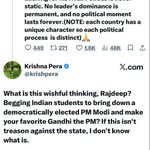
Rajdeep Sardesai’s latest sermon on India’s need for an ‘Abdul El-Sayed moment’ is a perfect example of the intellectual dishonesty that passes for political commentary in this country.
First, he posts that India needs a politician whose faith doesn’t matter and whose politics is about building bridges between communities.
When challenged, he comes back with an explanation even more problematic, hollow and bereft of evidence.
He now argues that India needs Muslim politicians elected from Hindu-majority constituencies, claims the reverse is equally rare, complains about the absence of Muslim MPs in the BJP and a Muslim Union Cabinet minister, and insists that India needs an American-style cross-community electoral coalition.
A few inconvenient realities for him.
In the 2024 Lok Sabha elections, 24 Muslim MPs were elected. Around 10 of them won from constituencies where Muslims were not the majority. Afzal Ansari won from Ghazipur, where Muslims constitute roughly 10% of the population. Navaskani, from the so-called Indian Union Muslim League, won from Ramanathapuram, where Muslims account for just 11.84% of the population. Think about this for a moment. A party that chooses to carry the Muslim League name, despite the League’s violent role in the Partition of India, can contest an election in this country and even win from a constituency where nearly 88% of the population is non-Muslim. This reflects a degree of electoral accommodation that only Hindus can demonstrate.
Now look at the other side.
The 2024 Lok Sabha had 14 constituencies with a Muslim population of at least 50%. Muslim candidates won all 14. Not a single Hindu MP was elected from a Muslim-majority constituency.
So, yes, Hindu-majority electorates have repeatedly elected Muslim representatives. BUT MUSLIMS HAVE NOT.
This is precisely the question Rajdeep would rather brush aside with a vague assertion that the reverse is also true.
Second, why is the absence of Muslim BJP MPs being presented as proof of India’s failure?
Rajdeep points out that the BJP has no Muslim MP and the Union Cabinet has no Muslim minister. But how many Muslim politicians are willing to contest on a BJP ticket without risking being branded a kafir by their own community? And how many would be willing to openly associate themselves with the party without facing that kind of religious denunciation?
These are questions he conveniently leaves out.
And even if a Muslim candidate were to win on a BJP ticket from a Hindu-majority constituency, would people like Rajdeep accept that as genuine cross-community electoral accommodation? Or would they question whether that candidate was elected or selected?
Third, comparing India to America while discussing religious representation is perhaps the most fundamental flaw in his argument.
India is not America. Our histories are entirely different.
India was partitioned following a violent Islamist separatist movement rooted in the Two-Nation Theory. The demand was not simply that Hindus and Muslims were separate nations. It was that Indian Muslims needed a separate political homeland because they could not accept being governed by a Hindu-majority electorate.
That history cannot be erased from any serious discussion of religion and politics in the subcontinent.
So we must discuss the electoral behaviour and political realities of subcontinental Muslims across India, Pakistan and Bangladesh. Nobody is suggesting that India should emulate either country. But our shared history and religious politics make these comparisons very relevant.
In Pakistan, the discrimination goes even beyond electoral behaviour. Its Constitution explicitly bars non-Muslims from becoming President or Prime Minister. Speaks volumes about the mindset of subcontinental Muslims.
Why is Hindu willingness to elect Muslims routinely celebrated as evidence of secularism, while the reluctance of Muslim-majority electorates to elect Hindus is hardly discussed?


Krishna Pera retweeted

Let me ask you…
If India’s Metro network had continued expanding at the pace it did before 2014, how long would the wait be for cities like Pune to have a metro?
YEARS….no…DECADES perhaps.
And that was UNACCEPTABLE.
In 2014, India had just 248 km of Metro lines across 5 cities.
Today, we have nearly 1,200 km across 26 cities.
Over 1 crore people travel by Metro every day.
The impact goes beyond statistics or numbers.
It means less time in traffic, more family time, greater productivity and better opportunities.
This is the transformation we are working towards for urban India!

What makes Pune Metro's new Pink Line so special?
23 km connecting Hinjewadi's IT hub with Shivajinagar.
Operated by women.
Almost a third of the electricity needs planned from solar energy.
Tomorrow, this Rs. 8,300 crore infra enhancement will be inaugurated!
A significant boost to 'Ease of Living' for Pune!
pib.gov.in/PressReleaseDetai…


Krishna Pera retweeted

Simply incredible!
One advantage of being of my vintage is having witnessed the dramatic transformation of our economy over the decades.
In 2023, I shared my sense of wonder at seeing India’s steel production surge ahead of Japan’s. For me, that alone was an almost unbelievable milestone.
And now, India is producing more steel than the US and Japan COMBINED!
I need a moment to catch my breath…
Somewhere in a parallel universe, my grandfather, J.C. Mahindra, who was appointed India’s first Iron & Steel Controller during the Second World War, must be celebrating.
My gratitude to Tata Steel, SAIL, JSW, & all the other companies and people who have driven this extraordinary transformation of one of our most fundamental industries.
What a journey. And what a foundation for the future!


I started my career in the Steel industry in the ‘80’s. (Mahindra Ugine Steel—alloy steel rather than mild steel, of course) At that time, the Japanese were like Gods in the Steel world. Untouchable in terms of scale or quality. It’s hard for me to express the sense of awe & gratification I feel to see this ranking. I’m glad I lived long enough to see this.
Krishna Pera retweeted

In 2014, India made less steel than Japan.
In 2025, India made more steel than the US and Japan put together.
Read that again.
87 million tonnes in 2014.
165 million tonnes in 2025.
Almost doubled in one decade. In the same decade, Japan fell 27%. The US fell 7%.
India is now the world's #2 steel producer. Only China is ahead.
And steel is not a services story / an app story. It is what a nation builds with railways, bridges, factories, ships, guns. The countries that ruled the 20th century were the countries that made the most steel.
The strange part? Nobody is talking about this. Just one quiet line in a World Steel Association release.
Bharat is rising. 🙏🙏
Source: World Steel Association, calendar-year crude steel production data. Graph made by me.

Krishna Pera retweeted
Lesson worth remembering:
1. Modi is not Trump…
2. Congress record on Livelihood issues was abysmal for 60 years. &
3. Your friend Rahul Gandhi is a divisive politician - ‘Jitna Abadi Utna Haq’ is exactly that.
Krishna Pera retweeted
Texas going blue was unthinkable 3 years ago. Trump is ensuring no Republican will win for the next decade.
But voters are stuck with a brutal dilemma: the Democrats aren't what they used to be - they’ve basically become the American Communist Party. May be Lenin & Stalin finally won over America.
Krishna Pera retweeted

Decisive vote! teapaw.org/i/election/10472548274…

Krishna Pera retweeted

I am touched by @PreetiChoudhry 's "independent" journalistic efforts to support "Anarchic dissent" of #RahulGandhi. I have an idea. Why don't @sardesairajdeep & she start a new "independent" channel? They can give employment to many "independent" youtubers. There is a huge anti BJP & anti Hindutva market ready to be tapped.😊🌹

About yesterday - #RamlilaMaidanRally
- Ramlila Maidan was packed to the rafters
- Clear endorsement of Rahul Gandhi’s leadership of the INDIA alliance.
- Unlike in the past, Congress was on the offensive,owning its attacks on the government.
- Good rally management, Seva Dal deserving special mention.
- Impressive cadre mobilisation across alliance partners.
- Unseen iter-party cadre camaraderie
- Launch of the Uttar Pradesh campaign.
- A more united, cohesive and organised Opposition.
Biggest achievement: not just mobilising, but energising and motivating the cadre for the battles ahead.