

PhD Economics @CamEcon @Cambridge_Uni | Postdoc @CambridgeJBS | Graduate Economics @IHEID | YIF @AshokaUniv | CS @surathkal_nitk
Cambridge, England
Joined July 2018
- Tweets28
- Following101
- Followers483
- Likes4.4K
Kishen Shastry retweeted

In the latest episode of the 2026 Ideas of India job market series, Shruti Rajagopalan (@srajagopalan) speaks with Kishen Shastry (@kskishen) of @Cambridge_Uni about the role of Hindu monastic institutions (mutts) in Karnataka, how their autonomy shapes educational opportunities and economic development, their impact on nonfarm employment following India's 1991 reforms, and their influence on political competition.
Check out the full conversation: mercatus.org/ideasofindia/ki…

Temple freedom is often discussed as important for the organisation of Hindu society. Yet there is little research to inform this debate, largely because few such institutions in India can be studied at scale.
I took this up in my PhD in Economics at the University of Cambridge. I examined how Hindu mutts, among the few Hindu institutions to have retained significant institutional autonomy at scale, have contributed to human capital formation and driven positive structural transformation in the communities they serve.
In this podcast, I discuss my research with @srajagopalan of the Mercatus Center at George Mason University on @IdeasofIndia. Thank you, Shruti, for being a fantastic host and for a wonderful conversation.
We also discuss interesting examples of autonomous religious institutions around the world. I share how Hindu mutts, being outside state control, have served as engines of social and economic progress.

The latest episode of the job market series of @IdeasofIndia @mercatus features @kskishen Shastry
@Cambridge_Uni. We talked about the the role of long standing monastic institutions in India and their impact on education, structural transformation, and political competition in India, and much more.

Kishen Shastry retweeted

In August 2025, a venture capitalist wrote an open letter to PM Modi. He called it "the brutal truth." His argument: most Indian products and services are simply not good enough to compete globally. He named specific failures: a broken credit system, outdated labour laws, bureaucratic hurdles in land acquisition.
That same man has backed Agnikul Cosmos, Ather Energy, and GalaxEye with his own fund.
His name is Rajeev Mantri.
Rajeev studied materials science and engineering at Northwestern University, then did his MBA at Columbia Business School, then went to work at Lux Capital in New York, one of the most respected deep technology investment firms in the world. He came back to India and co-founded Vyome Therapeutics, a biopharma startup he served as president for four years. Then he built Navam Capital, a venture capital firm based in Kolkata, with a simple idea: back Indian founders who are building things the world will actually need.
In January 2026, Navam closed its first fund at Rs 315 crore, oversubscribed from its original target of Rs 250 crore. The portfolio includes rockets (Agnikul Cosmos), multi-sensor satellites (GalaxEye), commercial drones (Aereo), drone delivery (TechEagle), quantum-safe cybersecurity hardware, swarm robotics, and advanced cancer therapeutics.
Tarun Mehta, the co-founder of Ather Energy, one of Navam's early bets that became a listed company, is now a Venture Advisor at the fund. The founder Rajeev backed early has come back to help him back the next generation.
He has also been writing about India's problems for longer than most people have been paying attention to them. Not on social media. In The Wall Street Journal, The Financial Times, The New York Times, and MIT Technology Review. He is a Raisina Young Fellow and a Chevening Fellow from King's College London. In 2020, he co-authored "A New Idea of India" with Harsh Madhusudan, a book about what India needs to believe about itself to become what its people deserve.
The man who tells India the brutal truth about itself also writes the largest cheques for the people trying to fix it.

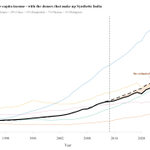
This paper doing the rounds is claiming that real per-capita income of India is roughly $1,000 less than what would have been without Modi government. After replicating the results, and extending the analysis, here are some serious issues I find with the work:
1. The gap between India and the counterfactual synthetic India is overwhelmingly explained by growth in Bangladesh and Ethiopia. But Bangladesh and Ethiopia both have questionable GDP numbers and without them the remaining pool cannot produce a credible counterfactual. Bangladesh's own government concluded that its growth figures had been overstated, worsening after FY2012-13, which is roughly when this study's treatment period begins. Meanwhile Ethiopia went through a civil war, inflation above 20 percent for several years, severe foreign exchange stress and a sovereign default.
While the authors spend time worrying about whether Indian economic data can be trusted, they raise no such concerns about the countries they are comparing India to. (1/7)
rgrier88.github.io/modi-prom…

Anyway, I dropped Bangladesh from the pool and their estimated gap falls to around $550, so removing a single country takes more than 40 percent off the headline number. When Ethiopia is dropped instead, Bangladesh's weight jumps from 25% to 76%. This makes the dependence on questionable Bangladesh data even starker.
So does the model still work without both of them? No, and not by a small margin.
Before 2014 the published model tracks India's actual income closely, with a typical yearly miss of about $60. Take those two countries out and the best the remaining twelve can manage is a miss of $684, more than ten times worse. I checked every possible weighting and there is no better answer available. (6/7)
None of this is surprising once you look at the countries closely. India in 1984 was poor and then grew fast, so to rebuild that path you need donors that start poor and then move quickly. Ethiopia is the only country in the pool that starts poorer than India, Bangladesh is the only one that starts level, and everything else begins richer, some of them many times over.
That is what creates a dependecy on these two countries. China grew far too fast to pass for India on its own, so the blend needs something poor and slow to hold the average down, and Ethiopia and Bangladesh are the only candidates available. Take them out and the best blend the method can build starts 1984 at $1,831 against India's $1,317 and widens over the next decades. So without these two, a counterfactual Synthetic India is not meanigful anymore.
tl;dr - The $1,000 figure is not robust enough to be taken seriously. (7/7)
Govt’s method to evaluate rich states has gaps. Take tax devolution down to district level theprint.in/opinion/govts-me… via @theprintindia

Bengaluru language war isn’t north v south. It’s about those who disrespect local culture theprint.in/opinion/bengalur… via @theprintindia

Kishen Shastry retweeted

'A mental health crisis is brewing among Indian youth. Religion can be a lifeline'
Kishen Shastry @kskishen, PhD scholar, University of Cambridge writes
#ThePrintOpinion
theprint.in/opinion/a-mental…
Why don’t we see big state-level reforms in India anymore?
E.g: Power, land, cities, and farm markets. Many subjects that would shape the next stage of growth are state subjects. Yet very few CMs seem eager to spend political capital on them.
Everything is now optimised for welfare transfers, and the state machinery follows. It gets better at lists and payments. But where do new reform ideas come from?
A US president gets thousands of political appointees. An Indian PM/CM mostly inherits a permanent bureaucracy.
That matters because India may not be able to grow around weak states forever.
If the next phase of growth depends on power, land, cities and farms, then state capacity is no longer a side issue. It is the main issue.
My fuller argument in ThePrint:
theprint.in/opinion/welfare-…

Kishen Shastry retweeted

New working paper: Religion, Covid-19 and Mental health, with @GirishBahal @kskishen and Sriya Iyer
econ.cam.ac.uk/research-file…
We ask if and how religiosity mediates the effect of Covid-19 on mental health in the US, using online survey data from Feb-Mar 2021
Details in 🧵..