

Professor of Economics at @UCSanDiego @GPS_UCSD. Trail runner, gravel biker, news reader, international economist, tweets on all of the above.
San Diego, California
Joined March 2018
- Tweets3.5K
- Following793
- Followers2.3K
- Likes6.8K






Kyle Handley retweeted

The U.S. trade war strained businesses before Iran conflict. GPS Prof. @KyleLHandley urges Congress to restore predictable trade policy. Read this new commentary: cato.org/blog/trade-war-was-…
#UCSanDiego #GPSFaculty #TradePolicy #PublicPolicy

ALT Aerial view of colorful shipping containers at a busy port illustrating global trade issues discussed in economic commentary.
Amazing, way back when I was a post doc at Stanford we used to hit up @howies_pizza. So it’s near the hotel for @nberpubs Fall trade meeting and I need some quick dinner. Turns out Howie himself is there serving up “off menu” Stromboli at the bar for a special event. He gives me a piece and then we end up having this extended conversation about globalization, Trump tariffs, and income inequality. Great pizza, smart business owner.
7
481


Voters just want the trade war to stop, @oren_cass. You can cherry pick all the short run six 6 month comparisons you want, but manufacturing jobs are barely up since Jan. 2025 and factory construction is down. None of your charts shows tariffs caused a boom. You helped sell this mess to your camp, Chief. Time to own it.


More here
teapaw.org/scottlincicome/status/…

"The Trade War Was a Problem Before Iran—Congress Can End It" via @KyleLHandley cato.org/blog/trade-war-was-…

Kyle Handley retweeted

New Stata commands fereg and feppml fit regressions with many fixed effects. In simulations, they were 5–62 and 5–87 times faster than reghdfe and ppmlhdfe, from @JFSchmieder nber.org/papers/w36017

Kyle Handley retweeted

"The Trade War Was a Problem Before Iran—Congress Can End It" via @KyleLHandley cato.org/blog/trade-war-was-…
Twilight is killing it tonight in SD. If we were still on daylight savings I would be making dinner and miss it all. These photos are 19 minutes apart


9
369
Reading the comments to this made me realize these Hitler Downfall memes are new to some folks. But this basically used to be the internet, even before Facebook was widespread. There was a whole Hitler Learns Topology meme shared among Econ grad students (and surely math majors as well) 20 years ago that is still out there reddit.com/r/mathmemes/comme…


1
3
550
Kyle Handley retweeted
"Yet the finding that [the China Shock] caused one in four manufacturing jobs lost from 1990 to 2007 has not aged well. Neither has the populist turn against free trade that began around the time of the original research" 🔥 economist.com/finance-and-ec…

Kyle Handley retweeted
Multilateral controls on dual-use goods reduce leakage and adversaries’ real military spending. Acting alone, even with an embargo, cannot match the security impact, from Jingting Fan, @kylelhandley, and Nuno Limão nber.org/papers/w35898

🚨New Paper Alert🚨: Export controls aim to limit adversaries' access to military-relevant inputs. But firms, supply chains, and incomes adjust. The countries imposing controls pay a price too. Using new data, we quantify when and how they can be effective and thus whether the trade-offs are worth it. 🧵 1/
New @nberpubs: "Export Controls and the Economics of National Security" nber.org/papers/w35898#fromr… viia @KyleLHandley

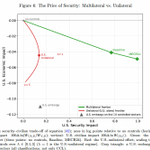
One might be tempted to do better by going it alone, but US-only controls can backfire. Beyond a point, lost export revenue and production scale REDUCE the relative security gain even as civilian costs rise.
Even a US embargo in the 10 controlled sectors can't match coordination. Using the model we can sketch out the civilian cost, to security benefit trade-off (the red-line below is a unilateral U.S. counterfactual, it bends back on itself because the own US losses outweight the effects on adversaries.) 9/

1
57
So the question isn't just "how much trade gets blocked?" That's not a measure of success on its own, especially if leakage rates are very high.
We need to know what relative security gain export controls buy, and at what civilian economic cost.
Our "price of security" can be extended to compares those trade-offs across coalitions (see Fig 7) and sectors (see Fig 8).
Thanks for reading. 10/10
1
57