Part of PitchBook, LCD is news, data and analysis on leveraged loans/private credit, high-yield bonds, distressed debt. Check out free news & analysis below.
Seattle, London, NYC, SF, SG
Joined April 2009
- Tweets68.5K
- Following981
- Followers22.1K
- Likes950
The US syndicated loan loan market lost 0.22% in October, its first monthly decline since February, as unease about AI and rate volatility deepens across the asset class. Non-Software loans drove the decline, led by cyclical and consumer names, with the weighted average bid on non-Software credits sliding 84 bps, to a three-year low of 95.90. Further evidence of the market's more risk-averse stance: Triple-C loans, comprising 7% of the $1.59 trillion market, plunged 2.87% in October, bringing the YTD return for that bucket to negative 8.68%. PitchBook LCD's Marina Lukatsky has more analysis in her 3Q US syndicated loan market wrap:
pitchbook.com/news/articles/…
#credit #risk #defaults #AI #software

After doubling so far in 2026, the amount of US syndicated loans trading at distressed levels has climbed to its highest point in six years. That headline stat is sure to raise eyebrows, though it might not be the most alarming part of the story. While the 2020 price plunge during the pandemic was indeed heart-stopping, it swept up scores of fundamentally healthy borrowers that were largely able to navigate the rocky economic terrain. This time around, the swollen ranks of distressed loans are concentrated among objectively riskier borrowers that face a relatively steep debt maturity wall and the specter of higher rates. Together, these factors point to a rising risk of defaults and, critically, weaker creditor recoveries on those loans, if and when they default. More analysis on this spike in lower-rated distressed loans is available here, courtesy @PitchBook LCD's Marina Lukatsky
pitchbook.com/news/articles/…
#credit #defaults #loans

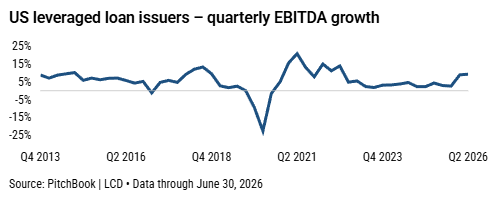
Credit investors are getting a big boost from an unlikely source. Software loans, which have been a huge drag on the syndicated loan segment throughout much of 2026, rebounded sharply in August, leading the asset class to a 0.93% return.
Why the turnaround? First, software loans took such a beating when AI-disruption fears kicked in early this year that there has been ample room for them to recover from what some called oversold levels (indeed, seven of the 10 largest contributors to loan gains in August were software issues, suggesting the rebound is more broad-based than just a handful of outliers moving). More broadly, there have been encouraging numbers on the software earnings front, punctuated by a late-July expectations beat by Microsoft. According to Morningstar, software companies are starting to see efficiencies and revenue from their own AI product offerings (as opposed to being devoured by AI). Also, many software companies are now more focused on profitability, and that’s showing up in the margins. “Probably the most important thing, though, is that the narrative around AI killing software is just not happening,” Morningstar says. Other headline software numbers from PitchBook LCD’s August US syndicated loan market wrap-up:
pitchbook.com/news/articles/…
#software #credit #privatecredit @PitchBook

The private credit new-issue malaise, exacerbated by a stubborn LBO drought, continues to hit BDC portfolios. Repayments and sales of loans at the 12 largest publicly traded BDCs topped origination of new credits in 2Q26, the third straight quarter this asset-sapping dynamic has taken hold. Overall, these 12 BDCs — a crucial source of private credit and BSL loan demand — originated $5.1 billion in gross fundings in Q2, down somewhat from the previous quarter and down sharply from the year-ago period. Also hindering BDCs is a drop-off in refinancings, which can comprise up to 75% of activity during a given quarter. Much more from PitchBook LCD here:
pitchbook.com/news/articles/…
@PitchBook #credit #PrivateCredit #PrivateEquity

Not all Software loans are created equal, indeed.
Leveraged loan investors have spent much of 2026 scrutinizing borrowers in the #Software segment, worried about how the AI boom might disrupt business at those companies. Over the past few months, however, investors have been delineating more between Software borrowers seen as especially vulnerable to AI disruption (application software concerns) and those viewed as better-positioned to withstand a boom (those focusing on software infrastructure & data, as well as cybersecurity).
The result has been a clear gap between the two cohorts, with loans backing application software concerns trading at a 3-4 point discount to the rest of the sector. PitchBook LCD’s Marina Lukatsky has more on this bifurcation, within an already bifurcated US syndicated loan market, in new research which is available here:
pitchbook.com/news/articles/…
#credit #PrivateEquity

The US economy continues apace, with equity markets testing records and leveraged loan default rates stubbornly benign. So why are distressed debt investors optimistic?
The broadest reason is that, five years into a higher-for-longer rate environment, companies that haven’t yet refinanced debt must continue to spend dollars on interest expense, instead of growth, potentially putting them in a precarious position. In his 2H 2026 Distressed Debt Outlook, PitchBook LCD’s Jack Hersch talks to a host of distressed players about where they see opportunities and pitfalls going forward, with emphasis on private credit, the housing sector and, of course, Software.
pitchbook.com/news/articles/…
@PitchBook #credit #PrivateEquity

The risk-sensitive stance that shaped the Wall Street banking segment in the second quarter was even more pronounced in US private credit, where deal activity dropped significantly. @PitchBook LCD recorded just $33 billion of direct lending deals across 149 transactions in the quarter, well short of the $74.1 billion/217 transactions in the first quarter, which was the busiest quarter in two years.
Direct lending activity was down by every measure. Of particular note: Those mega-buyouts that private credit had become accustomed to stealing from the BSL market have disappeared. PitchBook LCD has not tracked a single LBO financing of $2 billion or more in the private credit segment since early March.
There's much more on the 2Q direct lending segment in LCD's Quarterly Private Credit Wrap:
pitchbook.com/news/articles/…
#credit #PrivateCredit #PrivateEquity


The anticipated resurgence of M&A deals ran smack into AI/Software disruption and geopolitical uncertainty in 2026's first quarter. Despite a handful of headline LBOs, overall US syndicated loan activity dipped 34% from the pace seen last year. The market remains open, but at a cost, with single-B borrowing spreads increasing some 100 bps.
There's much more analysis of what has been a tumultuous first three months of the year in PitchBook LCD's 1Q26 US Leveraged Loan Market Volume Wrap:
pitchbook.com/news/articles/…
@PitchBook #credit #leveragedloans #SaaS #software #AI

Trading market prices on syndicated loans in Europe have hit their lowest point since June 2023, according to the Morningstar LSTA European Leveraged Loan Index. It will come as no surprise that the hardest-hit sectors so far in 2026 are IT Services and Software, which have been battered by fallout from AI disruption fears.
Full analysis: pitchbook.com/news/articles/…
@PitchBook #credit #leveragedloan #AI

Webinar: Q1 2026 European Leveraged Finance Analysis and Outlook
Date: 18 March 2026
Time: 2 p.m. GMT (10 a.m. ET)
Duration: 60 mins
Complimentary Registration link: pitchbook.com/webinars/Q1-20…
The European leveraged finance market opened the year on a record pace, with steady primary issuance and a wave of opportunistic repricings. That momentum has since broken, as an AI-driven sell-off across technology credits has effectively brought repricing activity to a halt and made investors markedly more cautious. Primary markets remain open, but visibility on the outlook for software credits is limited.
Join PitchBook LCD’s credit experts for a timely discussion on leveraged loans, high-yield bonds and CLOs, as they examine how these dynamics are reshaping issuance, pricing and restructuring activity into the second half of the year, informed by Q1 data.
Key topics
- The impact of the AI-related market sell-off on leveraged finance markets
- The outlook for M&A and other financing activity in 2026
- Whether the CLO market is heading toward another record year
Featuring, from PitchBook LCD
David Cox, Managing Editor (Europe)
Taron Wade, Head of Credit Research (EMEA)
Rachelle Kakouris, Director – EMEA Credit Research
Michael Rae, Sr. Editor, CLOs
Thomas Beeton, Sr. Reporter, HY Bonds
#credit #software #AI #leveragedloans #privatecredit #privateequity @PitchBook

The AI-inspired hit to Software companies has dragged performance in the US syndicated loan market to its worst start in 10 years, with the asset class sliding 1.4% so far in 2026, according to the Morningstar LSTA Leveraged Loan Index. Software loans, on their own, have plunged more than 7% so far this year, the worst-performing industry subset in the Index. This is especially notable considering Software’s considerable share of the market.
Other headline numbers, from February and for the YTD:
· The 0.78% decline for US leveraged loans in February was its worst monthly showing since September 2022
· The share of outstanding loans priced at distressed levels rose to its highest reading since May 2023
· Borrowing costs in the new-issue loan market rose sharply, partly reversing a trend seen during all of 2025
PitchBook LCD’s Marina Lukatsky has much more in the LCD’s February Market Wrap: pitchbook.com/news/articles/…
@PitchBook #credit #AI #Software

The slump on Software names extends beyond stocks. The sector has an outsize presence in the corporate-debt market, owing to a wave of private-equity buyouts that stretched from the late 2010s into the early 2020s. Trading prices of leveraged loans backing Software concerns have been especially hard hit.
wsj.com/finance/stocks/the-1…
@PitchBook @WSJ @jackpitcher20 @xavierjohnm
#AI #Software #credit #leveragedloans