


Dan Bilzerian told Joe Rogan he beat one man for $54,000,000 at poker, over 8 to 9 months.
Some of poker's best players still think the money came from his father.
In the video below, he tells Rogan how the games worked, and what he was on while he played.
He says it started in college. He sold 3 guns for $750, turned it into $10,000 on a gambling boat, and had $187,000 at the Bellagio 3 weeks later.
By 2012, he says, he was playing private heads-up games against billionaires. At one point he had $18,000,000 on the table. One hand alone, he says, was worth $14 to 15 million.
The man reportedly on the other side: billionaire Alec Gores. Pros later said Gores lost over $40,000,000 to him.
Doug Polk publicly asked him to prove it. His theory: the money came from Dan's father, Paul Bilzerian, a former corporate raider who went to prison.
Bilzerian denies it. He says he only got a trust fund at 35, years after the poker money.
Poker pro Chance Kornuth backed part of the story. He says he coached Bilzerian for the Gores game, played at $5,000/$10,000 blinds.
Gores has never confirmed the numbers.
Poker genius, or trust-fund kid with a great story?
Apple's $3,499 headset never shows you the room.
Everything you see is a camera picture, streamed to the screens within 12 ms.
I wanted to see how that works, and found a Vision Pro you can take apart. Lift the glass, pull it into layers, turn the lenses round to face you.
What it shows:
> 12 cameras, 5 sensors and 6 mics feed one chip, R1. The M2 next to it just runs the apps
> the 2 screens are micro-OLED, each about the size of a postage stamp, 23 million pixels between them
> behind each lens a ring of infrared lights and cameras watches your eyes. Invisible in real life, drawn red here
> fans pull air in underneath and push it out the top
The trick: the free anatomy skill makes Claude Code write the real numbers as a small model first, then draw every part from it and check every frame in headless Chrome.
Built by @elvar_official. Press the steps yourself in the first reply ↓


This is f*cking insane.
Every kid who watches F1 should get to play with this.
An F1 wheel you can drive, pull off the car and crack open, one button press per step. I always wondered what drivers actually do with all those buttons, so I went through it myself.
> through a chicane, 3 pulls on the right paddle go from 5th to 8th while the shift lights sweep green, red, blue
> under braking the left paddle clicks back from 8 to 4, and one yellow button turns on the pit limiter
> pull the red collar and the whole wheel slides off the column, so the driver can climb out
> then it splits into layers down to the board. About 1.3 kg, mostly carbon fibre
20-25 controls on one wheel, every part drawn in code with Claude Code and the free anatomy skill.
Made by @elvar_official, try it yourself in the first reply 👇
Build your own in the article below
press the steps yourself: visual-learning.app/f1-wheel
the skill is free (MIT): github.com/wheresryan22/anat…

Opus 5.5 is a beast at motion design but...
give it one link and it becomes a full mechanical animation studio
• real 3D engines where every part is modeled and moves on its own
• cinematic exploded views with smooth camera moves down to every bolt
• cutaways and airflow you can follow through the whole engine
I asked for a turboprop teardown. this is render #3
send this to your Claude:
mechanica-atlas.vercel.app


I gave Claude Code one folder and 5 free repos. 20 minutes later I had 3 agents planning, coding and reviewing each other.
someone mapped 300+ open-source agent tools on one page. most people bookmark it and never open it again.
hand Claude Code one folder and 5 repos from that list, and it stops being a chatbot. it plans, splits the work between agents, remembers, runs code in a sandbox and logs every step.
here's the whole stack:
> make a folder called AGENTS, open Claude Code in it, add a CLAUDE.md with one rule: "plan first, run code only in the sandbox, log every step"
> install Ollama, run ollama pull qwen3. a local model for the cheap subtasks. $0 per token, nothing leaves your laptop
> pip install crewai, then crewai create crew research. tell Claude to give it 3 roles: planner, coder, reviewer
> pip install mem0ai. now the crew remembers your project between sessions instead of starting from zero
> pip install e2b-code-interpreter (free key). every piece of code the agents write runs in a sandbox, not on your machine
> pip install agentops. one line in the script and you see every step, every tool call, every error
20 minutes of setup, and you have a crew instead of a chat window.
all the repos:
-> github.com/ollama/ollama
-> github.com/crewAIInc/crewAI
-> github.com/mem0ai/mem0
-> github.com/e2b-dev/E2B
-> github.com/AgentOps-AI/agent…
bookmark this and test asap


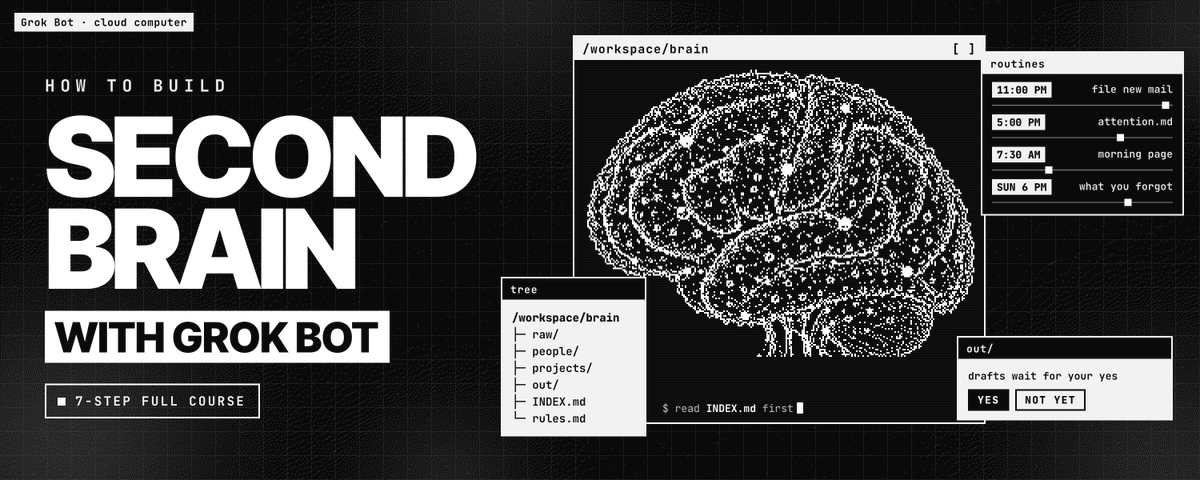
this sh*t is unreal. your second brain can work the night shift now, on Grok Bot's own computer, with your laptop closed
three bots, three jobs:
the collector files every link, PDF and voice note you drop into raw/ and never touches the original
the writer turns it into wiki pages and links every page back to where it came from
the checker wakes up on a nightly routine and hunts contradictions and stale pages
→ you wake up to one morning page: what came in, what changed, what looks wrong
→ two sources disagree: it flags you instead of quietly picking one
→ nothing new about a page for a month: it gets a "needs a fresh source" tag
chat memory keeps summaries. files keep exactly what you wrote
no page gets saved without three things:
> what it says
> which file proves it
> the last night it was checked
paste this into Grok Bot:
"Build me a second brain with three bots. Collector saves every source to raw/ and never edits it. Writer keeps wiki/ updated with a source link on every page. Checker runs every night at 3am, finds contradictions and stale pages, and sends me one morning summary. Ask me before deleting or sending anything. Show me the folder structure first and wait for my ok."
give it one project for a week before you hand it your whole life
the full 7-step build is in the article below ↓

THIS IS GETTING F*CKING DANGEROUS
You can run 20 Claude Code agents at the same time and put a second model on top that checks every word they write. None of them gets away with making stuff up
You open the terminal:
- 20 agents reading your files at once
- Every claim checked against the source before it's saved
- Anything without a real quote gets sent back
- Everything lands in plain markdown folders
The trick is the split: Opus does the work, a cheaper Haiku only decides if the claim is actually in the source. The loop keeps running until every claim passes
This used to be a week of reading. Now it's two markdown files and one prompt
Same Second Brain + agent swarm setup everyone keeps sharing. Full breakdown below ↓


It is becoming f*cking dangerous: Claude Code can turn a flat 2D drawing into a 3D part you edit with one number
ok I did not expect CAD to be next
no CAD license. one open-source Python library and a prompt
give it a dimensioned drawing of a bracket. it reads every measurement, writes the part as code and keeps each dimension as a named parameter
change hole_pitch from 40 to 55 and the whole part rebuilds around it
my favorite part: the drawing didn't give the wall thickness. it stopped and asked instead of making one up
the setup:
→ pip install cadquery (free parametric CAD in Python, exports STEP and STL)
→ open Claude Code in an empty folder
→ drop the drawing in as a PNG or PDF
→ paste this:
"Turn this drawing into a parametric CadQuery model.
1. Extract every dimension, unit and constraint into a table, with where each one sits on the drawing. Mark anything missing or ambiguous and ask me before you use it.
2. Write part.py with every dimension as a named parameter at the top. No hardcoded numbers in the geometry.
3. Use a separate subagent to check the model against the drawing: overall size, hole positions, hole diameters, and that the result is one valid closed solid.
4. Export part.step and part.stl, plus report.md with each dimension, its value and pass or fail.
5. Show me how to change one parameter and rebuild."
start with a simple part you can measure by hand
passing these checks means the geometry matches the drawing. it says nothing about strength or how the part holds up under real load
watch a flat drawing become an editable part below ↓

Holy sh*t. Grok Bot can watch you do a task for 10 minutes and turn it into a job that runs every night with the laptop closed
i've done the same 7-tab morning research by hand more times than i want to admit. the fix was one button and 5 rules
teach → review → add rules → test → approve → schedule
the official docs are blunt: a taught task is only a draft skill. the demo never shows it what to do when something breaks
so before night 1, give it the rules the demo missed:
→ source is down: report it, never reuse yesterday's data
→ data is stale: flag it and stop
→ send, delete, publish or buy: draft it and wait for my yes
→ step half done: say exactly which part finished
→ retry only if running it twice changes nothing
then one test run, and check it stopped at the approval point. a test run does real work
limits worth knowing:
> up to 50 routines per bot
> schedules at least 5 minutes apart
> last 20 runs kept per routine
> delete a routine and there's no undo
Teach it once. Write the rules. Sleep.
Paste this into Grok Bot right after you teach it, the full build is in the article below:
"Review the skill you just learned from my demo: [TASK NAME]
1. List every step and how it could fail: missing source, stale data, login wall, duplicate, rate limit
2. For each failure write one rule: if [problem] then [action]
3. Put every send, delete, publish or purchase behind my approval
4. Run one test, stop at the first approval, show me the result
Do not schedule anything until I confirm"

I read the jev-kit browser table three times. I was sure the decimal point was in the wrong place
someone wired Claude Code and TypeSafe's Jev into one team, and the agent stopped paying a frontier model for every yes/no
most people run agents in one of two ways:
-> let one big model decide every click, every tool call and every sub-agent, and pay frontier prices for forks a cheap judge could name
-> hardcode if/else rules that break the first time the task changes
jev-kit splits the stack in two:
> the writer: Claude writes the code, the drafts and the text in form fields
> the judge: Jev returns a typed choice, score or yes/no with a confidence, in about 0.3 s warm
> the guard: every tool call hits a rules table first, only the ambiguous ones reach Jev
> the tier check: a sub-agent sent 2+ rungs too expensive gets blocked, cheaper type named
> the belay: an agent that says "done" with no passing check gets sent back to verify
and the numbers, all measured in the repo:
> 9/9 browser goals for $0.0008 of Claude per run vs $0.1868 with Sonnet deciding
> 98.2% tier-guard accuracy on 57 scored dispatches, zero false blocks
> 33.2 ms added per tool call when no rule matches
> 100% on the deny-capable rules eval, zero false denies
Claude writes. Jev decides.
run it in shadow mode for a week, read the log, then let the cheap judge take the calls


It is becoming f*cking dangerous: Claude Code agents stopped thinking about every yes/no and started handing it to a second brain
TypeSafe built Jev, a model that never writes a single word. You give it a state and a typed question, and it returns a choice, a score or a yes/no with a confidence attached
Someone wired it into Claude Code, measured everything and open-sourced the whole setup as jev-kit
The split is one rule: if it creates → LLM. if it picks, scores or gates → Jev. if it does the thing → code
Each link in the team got a clear scope of work:
> Claude writes the code, the drafts, the briefings and the text in form fields
> Jev picks the next worker, scores the draft and gates every tool call
> plain code saves the files, hits the APIs and clicks the browser
> a tier guard checks every sub-agent dispatch and blocks the ones 2+ tiers too expensive
The danger is that a frontier model will happily burn 30 cents of tokens "thinking about" a fork it already knows how to name
So every decision has a bar to clear: a block only fires at 0.80+ confidence with a 0.40 margin over the runner-up, and any error or timeout just lets the call through
For every call, the log shows:
the question that was asked
the choice Jev made
the confidence behind it
whether the call was allowed, warned or blocked
The results: on a browser agent, with Jev picking every click, it reached 9/9 goals for $0.0008 of Claude per run. With Sonnet deciding: the same 9/9 for $0.1868. The tier guard was right on 56 of 57 dispatches with zero false blocks
If you want to run something similar, open Claude Code in your agent's repo and give it this command:
Split this agent into a writer, a decider and an actor:
1. Find every place where the LLM answers yes/no, picks from a list or scores something. List each one with its file and line
2. Turn each one into a typed Jev question with explicit options and a confidence threshold
3. Keep the writing on Claude, keep side effects in plain code, and log every decision with its confidence
4. Run it in shadow mode first: log what Jev would decide, change nothing, then show me the diff
It is wiser to start with one decision, the one your agent makes most often, and scale up from there
You will need a TypeSafe API key for the Jev calls. jev-kit's installer also has a --check-only flag that prints the plan before it touches anything
All 12 use cases and how to wire them are in the article below

THE MOST IMPORTANT PERSON IN THIS ROOM ISN'T THE ONE FILMING. IT'S THE ONE STANDING STILL.
Living room. Green top, black skirt, bare feet on a black mat. He points at her eye, then puts a hand on her collarbone. You still think she looks like a doll. Look closer. The details change everything. Phones already up behind them. She does not move.
That's the real product. Not a walker. Not a shift. A face that stays when he touches it, while everyone else records.
But the sharper business isn't the hardware. It's the face that stays. One body, one pose, a room full of phones. The quoted post already split this. Labor sells a clock-in. This unit sells a body that holds still in a living room and never has to answer.
The $16k walker clocks in. This one stands on a mat at about $1.5k to $4k and sells on whether the eye looks real when he points at it.
Who is the room for: the people filming, or the one who bought the face?


THE MOST IMPORTANT PERSON IN THIS UNBOXING ISN'T THE DOLL. IT'S THE ONE WHO SENT THE PHOTO.
Factory floor. Tall cardboard box. Foam blocks. Blonde bob, maroon top, white shorts. He points at the face, then the shorts. Guys, I gave this factory one photo, and look what they made. The skin detail is unreal. Would you actually order one.
That's the real product. Not a walker. Not a shift. A face built from one photo, standing in foam, waiting for a yes.
But the sharper business isn't the hardware. It's the face that stays. One photo becomes one body. New outfit, same features, same skin. The quoted post already split this. Labor sells a clock-in. This unit sells a body that never leaves the box until someone asks if they would buy it.
The $16k walker clocks in. This one sits in foam at about $1.5k to $4k and sells on how real the skin looks under a finger.
Who is the order for: the factory, or the person who sent the photo?
THE ONE THEY UNWRAP IS NOT THE ONE THAT WORKS
THE WALKER IS RIGHT BEHIND HER
ok wait
expo floor
black dress
bare knees
plastic still on the face
he pulls it off
real skin texture and gentle temperament
hand on the shoulder
exclusive warm company only for you
white walker sitting in the back
she never stands
ngl most people stay on the peel
not the unit nobody filmed
▹ what the floor is selling
a face that takes a film
skin he can grade with one hand
a pose that photographs
the same kneel as every other unit on the stand
▹ the surprise
the quoted post already split this
labor sells a shift
this unit sells a face that stays
the walker behind her is the $16k clock
she is the presence product
soft layer about $1.5k to $4k
not the $50k to $150k gaze head
not the $125k to $175k social body
factories buy torque
timelines buy the film coming off
china already proved loneliness clears deposits faster than chores
▹ why the peel wins
presence without rejection
a face that stays
a line that says exclusive and warm
loyalty you can film
a body that never clocks in
and never has to
so the demo people stop for
is not the robot clearing a floor
it is the film
and the sentence that says only for you
the walker was in frame the whole time
nobody asked what it costs


HE CARRIES HER ACROSS THE ROOM
SHE NEVER TAKES A STEP
THAT IS THE WHOLE PRODUCT
ok wait
glass showroom
city behind the windows
beige dress, gold heels
he lifts her
sets her on the white sofa
hands stay clasped
cameras already up
this lifelike companion brings you warm daily company
do you like this delicate life companion
she does not answer
ngl the line is the sale
not a function
▹ what the 8 seconds show
a man doing the walking
a body that holds a pose after he lets go
a dress that photographs
a crowd that films the sit, not a shift
▹ the quieter truth
warm daily company
that sentence is the sku
no task
no refusal
no clock-in
the sofa does the standing
▹ where it sits
soft companion layer
about $1.5k to $4k
showroom menu above that, $5.9k to $25k
not the $16k walker
not the $50k to $150k gaze head
not the $125k to $175k social body
▹ the split
the quoted post already said it
labor sells a shift
this unit sells a face that stays when he sets it down
factories buy torque
this room buys a sit
so the surprise
he is the one who moved
she is the one who stayed
one clocks in
the other waits on a cushion until somebody asks if you like her
how long did you watch the dress
before you noticed she never walked
HE PEELS THE FILM AND CALLS IT REAL SKIN
SHE NEVER SITS UP
ok wait
white table
black top, red pants
plastic still on the midsection
he lifts it
full protection for the bionic skin
then the hand goes flat on the belly
it feels just like real human skin
banner behind him says realistic companions
she does not move
ngl the test is the touch
not a function
▹ what the 8 seconds actually show
a body that stays on the table
a man grading the silicone
a film that came off for the camera
a phone already filming from the left
▹ the quieter line
protection for the skin
not a shift
not a walk
not an answer
the table does the standing
▹ where it sits
soft companion layer
about $1.5k to $4k
showroom menu above that
not the $16k walker
not the $50k to $150k gaze head
the quoted post already split this
labor sells a clock-in
this unit sells a belly that takes a hand
so the surprise
the film is the price
the skin line is the sale
she can feel real under his palm
and still never leave the table
how long did you watch the hand
before you noticed she did not sit up
THE NOSE SPRINGS BACK. THAT IS THE WHOLE DEMO.
ok wait
expo floor
phones already up
he peels the last film off the hairline
calls it transport
then pinches the nose
soft, returns to shape
someone says no way
he says that looks real
white top, brown shorts
she does not take a step
ngl most people stay on the pinch
not the receipt under it
▹ what the floor is selling
hairline you can film
a nose that gives
skin that takes a finger
a crowd that argues real or not
the same posters behind her, same pose, same job
▹ the surprise
the quoted post already split this
labor sells a shift
this unit sells a face that springs back
$16k walker clocks in
this one waits on a plinth while he grades the nose
soft layer about $1.5k to $4k
showroom $5.9k to $25k
not the $50k to $150k gaze head
not the $125k to $175k social body
▹ why the pinch wins
presence without rejection
a face that stays
a test you can do with one finger
loneliness that looks solved for 10 seconds
so the demo people stop for
is not a robot clearing a floor
it is a nose that returns
and a line that says that looks real
HOW YOUNG DOES THE FACE HAVE TO LOOK
BEFORE NOBODY ASKS WHAT SHE CAN DO
THE REMOTE ALREADY ANSWERED
ok wait
white plinth
blonde, plaid skirt, black top
he holds a clicker with an infinity mark
incredibly lifelike
smooth skin and movements
perfect for any exhibition
she stays on her knees
ngl that is the wrong test
the quoted post already split the market
labor sells a shift
this unit sells a face
▹ the face
young
wide eyes
soft mouth
choker
built so the booth photographs
not so she can clear a floor
▹ the remote
movements are claimed
the hand holding the clicker is the proof
if she walked on her own
he would not need it in frame
▹ the pose
knees on the cube
hands on the thigh
other units behind her in the same job
stand, sit, get filmed
none of them clock in
▹ the line
perfect for any exhibition
that is the sku
dwell, not laundry
a body that holds eye contact
long enough for the phone to come out
where it sits
soft layer, about $1.5k to $4k
not the $16k walker
not the $50k to $173k desktop head
not the $125k to $175k social body
the surprise
factories buy torque
this booth buys a kneel
one gets a shift
the other never leaves the cube
the clicker is the whole capability
how long did you watch the face
before you noticed the remote