

Associate Professor - University of Alberta - Canada CIFAR AI Chair (he/him, ele/dele). Machine learning as program search.
Edmonton, Canada
Joined July 2009
- Tweets597
- Following573
- Followers726
- Likes3.4K





Levi Lelis retweeted

One application of weight-space programming is out-of-parameter (OOP) generalization: synthesizing programs for task parameters not seen during training.
For example, after learning ARC-style tasks that move an object right by various distances, can we predict the weights of a Neural Program for an *unseen* distance at test time, zero-shot?
We show this is possible with a symmetry-aware graph hypernetwork in our @yudongxuwil @lyeskhalil @ScottSanner ICLR 2026 work: openreview.net/forum?id=x7zO…


We asked GPT-6 Astra to edit Qwen3.5-0.8B weights to improve math.
It directly changed only 0.016% of weights, fixing 0.8B's reasoning loops & improving math up to 6x and even instruction following 3x, without gradients or training.
We call this Weight-Space Programming: frontier LLMs can now natively read/write neural network weights! 🧵
Blog: rikiyat.github.io/blog/weigh…

Readers added context they thought people might want to know
LLM was given weights explicitly as text in prompt and used code/forward passes (per authors' logs) to ablate Qwen looping direction, a known thinking-mode issue per model card. Primarily fixed repetition in that mode, not general 'natively' improving weights/math.
rikiyat.github.io/blog/weight-sp…
github.com/RikiyaT/lm_und…
huggingface.co/Qwen/Qwen3.5-0…
huggingface.co/RikiyaT/Qwen3.…
Levi Lelis retweeted

The Department of Computing Science at the University of Alberta is hiring for two new tenure-track positions this year. Please spread the word:
- Computer Systems for AI and High-Performance Computing: iaejup.fa.ocs.oraclecloud.co…
- AI for Health: iaejup.fa.ocs.oraclecloud.co…

Levi Lelis retweeted

📢 The Department of Mathematical and Statistical Sciences at @UAlberta is hiring a tenure-track Assistant Professor this cycle, specializing in Mathematical Foundations of AI and Formal Reasoning!
If you know anyone who might be a good fit, I'd love to hear your suggestions or get connected!
mathjobs.org/jobs/list/29280
Levi Lelis retweeted
I will present this paper during the COLM poster session #4 Wednesday (today!) afternoon at location #29. Please come and chat about formal verification for large software repositories!


Introducing VeriSoftBench — a benchmark for repository-scale Lean 4 verification proofs!
📦 500 proof obligations from 23 open-source formal-methods repos
🧩 Preserves real repo context + cross-file dependencies
🧪 Two eval modes: Curated deps vs Full repo context
📉 Frontier LLMs still struggle: best achieves 41.0% (curated) / 34.8% (full repo)

Levi Lelis retweeted
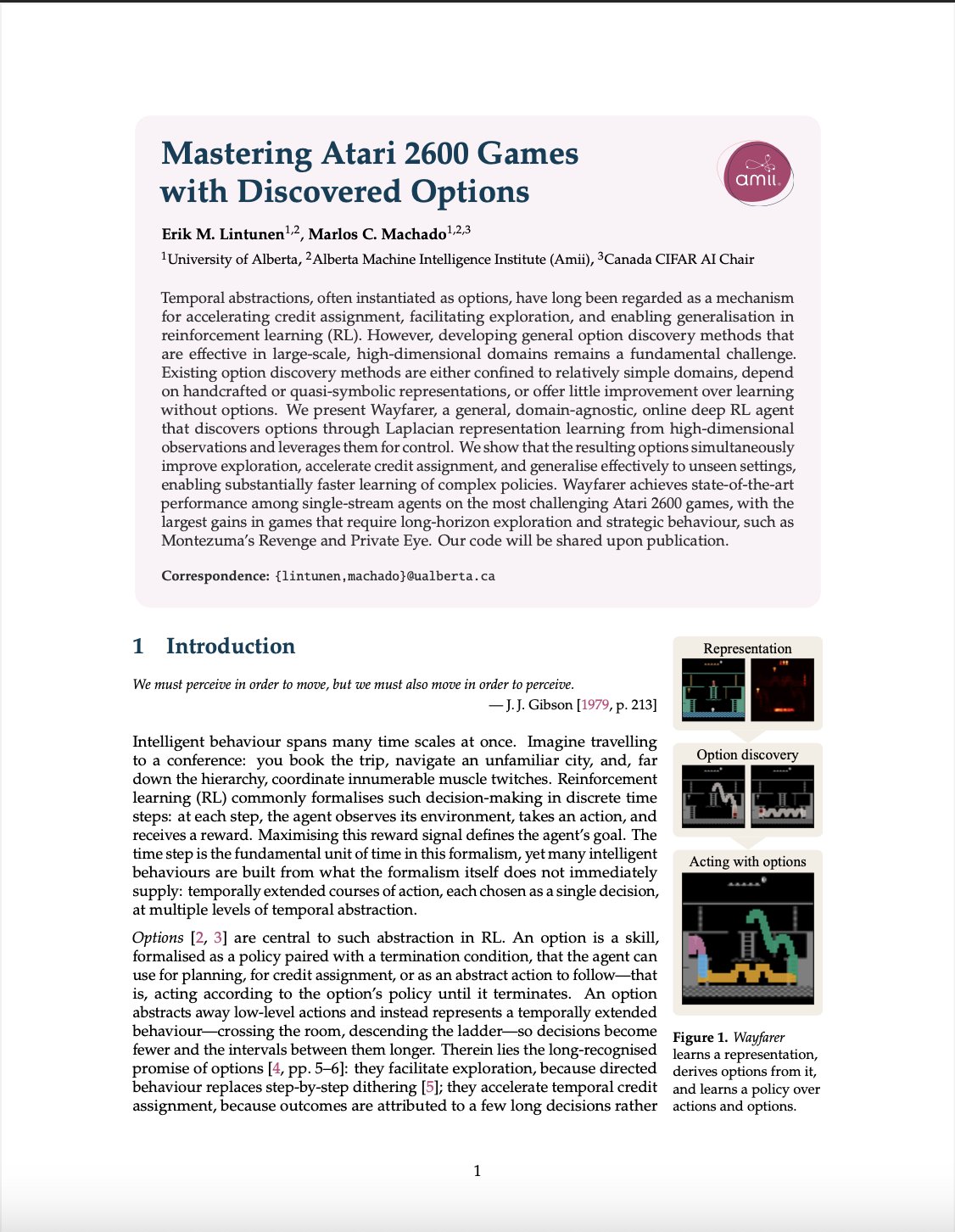
I'm excited to share Erik's work!
Mastering Atari 2600 Games with Discovered Options
We have a general-purpose option-discovery method that works w/ high-dimensional observations, tabula rasa, using a single stream of experience! It outperforms DreamerV3, Rainbow, and IQN! 1/9
Levi Lelis retweeted

@ClementBonnet16 and I started After Labs with a simple conviction. The next leap in AI will not come from models that merely store more knowledge or bake more task-specific skills into their weights. It will come from systems that can continually learn and refine their understanding of the world through interaction.
At After Labs, we are singularly focused on developing world models with the ability to adapt with every new data point instead of staying static. These adaptation mechanisms need to be built into the model during training and not bolted on as an afterthought.
Stay tuned as we pursue this mission of building curious agents that never stop learning 💡

Current models rely on brute-force RL training to adapt to new tasks and environments. However, intelligent systems should be able to learn on the fly in a sample-efficient manner, continuously refining their understanding of the world through their interactions.
After Labs is developing models with built-in adaptation mechanisms rather than treating adaptation as an afterthought. This new generation of models will start a new era of curious agents that may not possess all the world's knowledge but will have the crucial ability to learn in real time.
Today, we are happy to announce that After Labs has been selected as one of 10 AI labs to join NFAI and receive €3M in additional funding. This support will accelerate our mission to build models that continuously learn about the world. We will be contributing to open science along the way, so stay tuned and follow us on our journey to develop AI that augments human understanding of the world 🌍
Levi Lelis retweeted
Interesting to see more work in the inductive neural architecture space.
This builds on NLI, presented at ICLR 2026, which used an approximately discrete latent space to enable compositional generalisation via test-time latent search, while still leveraging gradient-based optimisation: arxiv.org/abs/2604.18907
NLI itself extends Latent Program Networks (NeurIPS 2025), which introduced the application of semi-amortised variational inference (test-time search in latent space) to the learning of programs themselves: arxiv.org/abs/2411.08706
There is still a lot to explore in Latent Program Network style architectures, from different structures of latent spaces to better test-time search methods. This is a hugely promising approach for sample-efficient learning and inference-time adaptation, all without parameter updates, leading to architectures where adaptation is built in during training rather than added as an afterthought.


🚀 We introduce Neural Theorizer (NEO) — a new type of world model that learns to theorize the world from observation, without language or LLM supervision.
Selected as an ICML 2026 oral presentation — 0.7% of submitted papers.
The paper asks:
"What does it mean to understand the world and build a world model?"
Today’s world models are often trained to predict the future: the next frame, next latent state, or next observation.
But is prediction enough?
We argue that a world model should be a theory-building system: one that discovers reusable primitives, composes them into executable explanations, and transfers those explanations to novel phenomena.
NEO is our first step toward this vision — a World Theory Model that learns explicit, compositional theories from raw observation.
This work was led by my wonderful students: Doojin Baek*(@doojin_a_baek), Gyubin Lee* (@gyubin0521), Junyeob Baek (@JunyeobB), and Hosung Lee (@HosungLee_).
For more details, take a look at the paper — and if you’re attending ICML, let’s talk there!
📄 arXiv: arxiv.org/abs/2605.03413
🌐 Project page: doojinbaek.github.io/publica…
Levi Lelis retweeted

I can nominate one Canada Impact+ postdoc candidate at UAlberta. Please reach out only if you have a strong theory track record (learning theory/bandits-RL theory/LLM reasoning). Deadline: May 10 (23:59 MT. Email: CV + best papers + brief pitch. Pls RT tinyurl.com/38vt2vyj
Levi Lelis retweeted
I'm in Brazil for ICLR! 🇧🇷
Presenting our paper "Gradient-Based Program Synthesis with Neurally Interpreted Languages" (arxiv.org/abs/2604.18907) on Thursday, April 23rd, 10:30 AM – 1:00 PM at Pavilion 3, P3-#215.
If you want to chat about world models, test-time adaptation or continual learning lets set up a chat or come say hi!
Levi Lelis retweeted
A couple of months ago, we released a preprint of one of my favourite papers I’ve ever written. It lies at the intersection of representation learning and neuroscience. I have now written a blog post about it.
Preprint: biorxiv.org/content/10.1101/…
Blog post: medium.com/@marlos.cholodovs…
Levi Lelis retweeted

Amii is hiring a Machine Learning Resident (1-year term) to work with ConeTec! Help solve critical safety challenges in geocharacterization using LLMs, OCR, and Deep Learning.
📍 Edmonton (Hybrid)
📅 Apply by March 4, 2026
🔗 amii.bamboohr.com/careers/23…

Levi Lelis retweeted
Amii is hiring a Machine Learning Scientist to lead our ML Educators and scale AI literacy across Canada.
If you have a background in ML research, people leadership, and a passion for AI for good, apply now: amii.bamboohr.com/careers/22…

Levi Lelis retweeted

Insightful thread about world models with ideas that very few people in the industry understand!
Building static, giant world models is a dead end for achieving human-level adaptation to new tasks. Instead, it's all about efficiently adapting local models of the world. The community should develop systems that produce world models (a la program synthesis) rather than static models.


Levi Lelis retweeted

To make a bit of an excuse for Microsoft: the world is just waking up to the fact that coding agents are general agents.
It’s bitter lesson adjacent: Writing and executing code will likely outperform years of handcrafting vertical-specific agents with expert knowledge.
Actually it might exactly map in bitter lesson: Program synthesis is a form of scalable search.
Levi Lelis retweeted
The Department of Computing Science at the University of Alberta at the University of Alberta has an opening for another tenure-track faculty in robotics. Please, spread the word.
I can attest to how awesome @UAlbertaCS and @AmiiThinks are!
(Official job posting coming soon.)
Levi Lelis retweeted

Join our Reinforcement Learning Group next week on Monday, September 29th for a session with Esraa Elelimy on "Deep Reinforcement Learning with Gradient Eligibility Traces."
Thanks to @rahul_narava for organizing this event ✨
Learn more: cohere.com/events/cohere-lab…

Levi Lelis retweeted
Happy to share that Searching Latent Program Spaces has been accepted as a Spotlight at #NeurIPS2025 ✨
It's been a pleasure to work with @ClementBonnet16 on this!
See you all in San Diego 🌴 👋,
arxiv.org/pdf/2411.08706

Levi Lelis retweeted

I am hiring a post doc at @UAlberta , affiliated with @AmiiThinks ! We study language processing in the brain using LLMs and neuroimaging. Looking for someone with experience with ideally both neuroimaging and LLMs, or a willingness to learn. Email me Qs
apps.ualberta.ca/careers/pos…
Levi Lelis retweeted

My acceptance speech at the Turing award ceremony:
Good evening ladies and gentlemen.
The main idea of reinforcement learning is that a machine might discover what to do on its own, without being told, from its own experience, by trial and error. As far as I know, the first person to propose this was Alan Turing in 1947, which makes it particularly gratifying and humbling to receive this award in his name for reviving this essential but still nascent idea.
I have three people that I would like to particularly thank.
First, Andy Barto. As my PhD supervisor he taught me my whole approach to science, and in particular instilled in me an appreciation of scholarship and craft, and of the great breath of prior work.
Second, I would like to thank Oliver Selfridge, my other main mentor; sadly, now deceased. Oliver taught me how keeping ideas simple can be the boldest of all ambitions.
Third, I want to thank Martha Steenstrup, my life partner and intellectual sparring partner. She keeps me honest and grounded.
Finally, I also want to thank the University of Alberta, which has been an ideal environment for me and for reinforcement learning research these past 22 years.
These three people and my university have reinforced in me the ambition to have ideas that matter, without getting too full of myself about it. They taught me that the quest for better ideas is serious, but is best approached playfully, with humility, kindness, and optimism. For this I am eternally grateful.
I would also like to thank all of you for being here and for celebrating the pursuit of intellectual excellence.
Thank you very much.
Levi Lelis retweeted

Test Time Compute was "invented" the same way America was "discovered"..
teapaw.org/rao2z/status/186803815…

Inference Time Computation is NOT new--we wanted to get rid of it, but are letting it back in out of necessity.. #SundayHarangue (#NeurIPS2024 workshop edition)
Noam Brown @polynoamial has been giving talks on o1 suggesting that including inference time computation was a relatively newer idea in games (which he and others have brought to LLMs).
While I have a lot of respect for Noam (he is probably one of the handful of frontier folks who actually has a good understanding of pre- 2013 AI) , I am afraid that in this particular case, his characterization gets the chronology mostly wrong for prominent games--most of which were "deliberative" rather than "reflex" agents in Russell/Norvig's terminology.
Many games--including Chess and Go--focused exclusively on inference time compute in the beginning! (See my Intro #AI slide below..)
The 1997 Deep Blue, for example, was all inference time compute (using alpha-beta pruning on shallow game trees where the leaves were evaluated by (mostly hand-coded) evaluation functions--plus a library of end games.
Pre-Alpha-Go approaches for GO went with just MCT at inference time.
For these games, it is the idea of learning an approximate policy off-line and using it to complement the already standard inference time computation (via generalized policy rollout) that is the latter development!
TD-Gammon is more of an exception which tried first spending time "off-line" to get a policy and make a largely reflex agent. (Partly because between Samuel's Chekers and TD-Gammon, there were few RL/Learning based approaches for Games..)
So when Noam says he and Tuomas started poker first with off-line approximate policy learning and just using that during inference time, and then recognized that online policy roll out is actually helping, they went in the reverse order of what happened in Chess and Go!
The appeal for the off-line policy computation was that you can spend unlimited amounts of time behind the scenes, so that online computation can be mostly taken out. Many of us still remember marveling at the fact that the learning time for AlphaGo would have been about 1700 years on the common desktops of that time!
This learn everything upfront with a close-to reflex agent became so strong in the aftermath of AlphaGO that they tried their best to reduce the MCT search that was left over in the original AlphaGo in a stream of latter developments.
Reducing user-facing inference time computation was a deliberate choice--and has even lead to a change in the way the field started viewing computational complexity considerations (see teapaw.org/rao2z/status/150017834…).
This trend continued with LLMs too--with all focus on pre-training so inference time compute is kept negligible--so that it costs very little for end users, and can even be done locally on edge devices..
I suspect that the twin bitter truths (c.f. teapaw.org/rao2z/status/183435453…) --that you can't quite get reasoning out of auto-regressive LLMs, and that learning an approximate pseudo-cot-action policy that is good enough would be way too costly even for OAI/Microsoft's resources--dragged them into inference time compute awkwardness (c.f. teapaw.org/rao2z/status/186345813…) which certainly changes the business model by pushing the scaling costs to the edge users! (teapaw.org/rao2z/status/186760478…).
