

Lizard Island Reef Research Foundation: funding science at the Australian Museum's Lizard Island Research Station and elsewhere on the Great Barrier Reef.
Lizard Island, Queensland
Joined May 2014
- Tweets1.1K
- Following832
- Followers1.2K
- Likes475



With your support, scientists can continue their vital work at Lizard Island Research Station. Any amount you give will be greatly appreciated and put to good use.
Donate now: lirrf.org/donate/

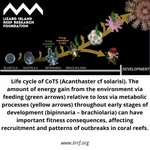
The energy gain from the environment via feeding relative to loss via metabolic processes throughout early stages of development can have important fitness consequences, affecting recruitment and patterns of outbreaks in coral reefs.
Learn more: rpb.li/6Nv5XH

Four different species previously identified as Acropora hyacinthus on the reefs of Lizard Island. Only one of these species is likely to be A. hyacinthus. The other species are either undescribed or in synonym = A pectinata
Learn more: lirrf.org/shedding-light-on-…

LIRS has four self-contained houses for visiting researchers and student groups. The houses are named for people and organisations who have been important in the station’s history.
Learn more: lirrf.org/our-programs/resea…

Sixteen students from across NSW and two teachers were lucky to be selected to spend a week on Lizard Island studying Coral Reef ecology and marine biology.
Here are some video highlights of the study tour by Dr Andy Lewishttps://rpb.li/5uAhPf
Without policies in place to protect marine environments, the recovery process could be set back significantly.
Learn more: lirrf.org/teachers-study-tou…

Lizard Island Research Station - Update post Cyclone Narelle - mailchi.mp/0176c1dae88b/mar-…

Reef corals at Lizard Island have been mapped since the early 2000s using traditional techniques and were at a historically low abundance and diversity following a sequence of disturbances from 2014 to 2017.
Learn more: rpb.li/ucrtd5

Drs Vincent Raoul (Griffith Uni), Karen Joyce & Stephanie Duce (James Cook Uni), George Roff (CSIRO) and Prof Jane Williamson (Macquarie Uni) were awarded a Critical Research Grant for Drone-based monitoring of Lizard Island bleaching recovery
Read More: rpb.li/Wm9

Fellowships Awarded 2025
Dr Christopher Hemingson
2025 Charles Warman Foundation Fellowship
The University of Texas at Austin, USA
Understanding the drivers of diverse coloration on coral reefs and their susceptibility to environmental change
Learn more: lirrf.org/2025-fellowships/

The Lizard Island Research Station’s 2024 Report is available here and includes:
2024 in Review
Fellowships & Grants
Projects and Equipment
Foundation
Visitors in 2024
Publications
Donor
Learn more: lirrf.org/2024-lizard-island…

Dr Chris Goatley and Dr Simon Brandl were surprised to find smaller numbers of cryptos in our censuses, recording two and a half times fewer fish in 2022 than in previous surveys.
Learn more - bit.ly/3txG4Jb
#lizardisland #lirrf #smallfish #research #fellowship

During coral spawning huge numbers of planktonic shrimps and worms congregate in the snorkellers’ torch beam, making it difficult to see beyond them
Learn more - bit.ly/3EAum6O

Water is the medium in which fishes move, feed, reproduce, and live their lives. Because it is all around them, it must play a critical role in shaping how fishes live.
Learn more: lirrf.org/fellowships-awarde…

Coral reefs are one of the world’s most biodiverse ecosystems. Unfortunately, coral reefs are under threat due to a variety of factors such as climate change, disease, and declining water quality.
Learn more: rpb.li/d5x0 lirrf.org/effects-of-habitat…


Sea spiders are the closest relative of all arachnids without being an arachnid. There are 1,300 species of sea spiders distributed from tropical to polar waters, from intertidal pools to the deep sea.
Learn more: lirrf.org/exploring-the-sea-…

In 2023 Dr Anne Hoggett AM and Dr Lyle Vail AM were awarded the 2023 Australian Museum Research Institute Lifetime Achievement Award in recognition of their tireless work in advancing our understanding of coral reef biology.
Learn more: rpb.li/mG7L

We can now use eDNA to detect the presence of COTS in an area from water samples, even when they are at low densities.
Learn more: rpb.li/fuGmt

The young researchers who win our fellowships are intelligent, enthusiastic and hard-working. They seek to answer interesting and important questions and many go on to become leaders in their fields.
Learn more: lirrf.org/our-programs/fello…
