


Hao Li retweeted

🖥️ Two years after we introduced OSWorld, frontier models have rapidly advanced in computer use, completing real workflows across the digital world.
🖥️ 🔜 🤖: Physical interaction is the next frontier, where foundation models expand into robot-use agents in the physical world while retaining their general intelligence. Agents like Claude Fable 5.2 already score 65% on RoboDojo. Problem already largely solved?
Not even close.
🚀 Today we introduce RoboWild: Can Frontier Models Generalize to Robot Use in the Wild?
🏠 38 furnished realistic scenes, from homes and stores to workshops and labs
🛠️ 4,480 objects, with operable doors, dials, drawers, and more
🤖 341 diverse tasks across four robot embodiments
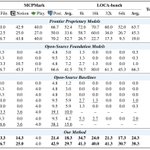
📊 Best results: Claude Fable 5.2 reaches the highest accuracy at 13.3% on RoboWild, while GPT-6 Astra is far more token-efficient yet plateaus at 11.6%. No model is close to solving real robot use yet!
🏠 Homepage: robowild.xlang.ai
📄 Paper: huggingface.co/datasets/xlan…
📽️ Slides docs.google.com/presentation…
💻 Code: github.com/xlang-ai/RoboWild
🤗 Dataset: huggingface.co/datasets/xlan…
🧵 [1/8]


What if the best way to train tool-using agents is to make them write code?
Introducing ProgAgent: a framework for training LLM agents through Programmatic Tool Calling (PTC).
Our key finding: PTC training consistently outperforms direct tool calling (DTC) training, and the gains even transfer back to DTC.
📄 Paper: arxiv.org/abs/2610.14774
💻 GitHub: github.com/hkust-nlp/ProgAge…
🤖 HF: huggingface.co/collections/L…
A closer look below 🧵

The benefits of PTC training extend beyond PTC itself. Even when evaluated with DTC, PTC-trained models outperform their DTC-trained counterparts, suggesting that programmatic training improves tool orchestration beyond the training interface.

1
1
33
Huge thanks to everyone that contributed to ProgAgent: @yuzhenh17 @ltzheng01 @lockonlvange @AndrewZeng17
1
48
Hao Li retweeted

‼️The Bitter Lesson for context management: Giving LMs unrestricted control over their context beats human-designed SOTA!
Introducing 🩵Context Language Models (CLMs)🩵
- Natively manage their own context
- Treat context as a file
- Learn policies in CLM weights, no harness

Hao Li retweeted

Introducing an interesting project- Mine Odyssey, a benchmark for measuring spatial agentic intelligence in the wild!
TL;DR: We leverage a wide variety of Minecraft maps created by the amazing community (yes, games are great lol) and challenge models to navigate through them by reading maps, finding paths, opening doors, going up and down stairs, climbing ladders, and more.
Thanks to the incredible Minecraft modding community, we can also introduce a wide range of variations for ablation studies, including weather conditions, different HUDs, first-person vs. third-person views, and reference route lines, to investigate how these factors affect model performance.
When we first launched this project, we honestly didn't think any model would be able to solve these challenges smoothly. But now, GPT-6 Astra and GPT-6.1 Sol can make it all the way to the destination remarkably quickly, with significantly fewer turns! 😨 Meanwhile, other models, even when they manage to reach the destination, often take unnecessary detours or get lost along the way.
Our benchmark is fully open-source and Harbor-compatible!
Kudos to @SArt_Maxine @llleo0612
@junxian_he
More details: mine-odyssey.github.io/


Hao Li retweeted

SMELT: Scaling Laws for Compute-Matched MoE Looped Transformers
"We study looping on Mixture-of-Experts Transformers while closely matching per-token FLOPs, total non-embedding parameters, and KV cache. Through a series of ablations, we arrive at a recipe we call SMELT (Sparse MoE Transformer, middle layers Loop Twice), which loops the middle half of layers twice while matching the unlooped Baseline on all three budgets. We scale SMELT across four sizes up to 54B non-embedding parameters and fit a separate Chinchilla-style scaling law for each architecture. SMELT’s loss drops faster with compute, saving 6.8–18.0% of training FLOPs on the compute-optimal frontier."
paper link: arxiv.org/abs/2609.01343

Hao Li retweeted

We revisit GRPO, SC and BPO through coordinate transformations and local approximations to policy improvement. This view helps explain how clipping can distort updates under training–inference mismatch, and leads to Decoupled Score Centering.
Blog: gelatinous-expert-612.notion…
1/9

Hao Li retweeted

Am I bothered about the news today, am I fuck. Cheated or not cheated I’ve had an absolute blast seeing my @ManCity climb to heights I never even dreamt of. I’ve seen us lift every trophy and felt every emotion. Been to places to watch us play that I never thought of. If I never see it again I am blessed. #mancity #115charges

Hao Li retweeted

Introducing ACM: Agentic Context Management for Long-Horizon Tasks.
ACM teaches agents when and how to manage context on its own — no forced compression, no loss of discarded details. It keeps short-term working memory clean and long-term external memory stable.
[1/9]

Hao Li retweeted

Introducing Speculative Programmatic Tool Calling (sPTC)!
A general class of technique for speculating on tool calls during code generation in a harness and queuing them early to overlap with token generation + REPL execution time.
Blog: alexzhang13.github.io/blog/2…

Hao Li retweeted

RL is expensive, so every step should count. ~1 yr ago, we showed xent SFT isn’t the best way to prepare for RL (arxiv.org/abs/2510.15020). Now, we propose TailSFT (arxiv.org/abs/2608.25756), a lightweight + principled way to directly improve coverage and get better post-RL perf.


