






Oh boy…

Big news: Kimi-K3 by @Kimi_Moonshot is now #1 in the Frontend Code Arena with 1679 pts, surpassing Claude Fable 5.
This is a 17-place jump from Kimi-k2.6 (#18 -> #1).
In Frontend, Kimi-K3 ranked #1 in 6 of 7 domains: Brand & Marketing, Reference-Based Design, Data & Analytics, Consumer Product, Simulations, and Content Creation Tools, landing #2 only in Gaming behind Fable 5.
The full model weights will be released by July 27.
Congrats to the @Kimi_Moonshot team on this major milestone!


Been exploring datasets.bot lately, it's full of rich open datasets. I fine-tuned RF-DETR to track a robot's gripper and the object it's grasping, then pointed it at DROID, which has 76k+ real teleoperation episodes spanning hundreds of scenes and a dozen labs. Same model everywhere, no retraining, and honestly it held up better than I expected.
My friend is a Pokémon card vendor who buys/sells in person. A card graded a 10 can be worth hundreds more than the same card graded a 9, and it comes down to small details: centering, corners, creases, scratches. He judges it all by eye. So I built a tool that scans a card and breaks it down 👇
It spots the card in the video, flattens it to a straight-on view, measures the border on all four sides, and compares left vs right and top vs bottom (same centering ratios PSA grades on). The worse side sets the score.

For the damage detection I fine-tuned an object-detection model on my own cards. The honest shortcomings:
• misses defects: caught a crease on the front, missed it on the back
• can't gauge severity: flat photos have no depth, so a crease and a print line look the same
• too little data: trained on a handful of my own cards
The real bottleneck is data, as it always is.
Ruku retweeted

a few things that make this exciting
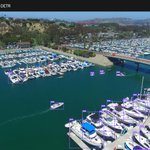
- 7 images to get a custom model means nobody is constrained by data or compute to train, cost is not a barrier
- the tiny boats way off in the distance it catches
- it is not confused by the cars
doing poorly with the part of the marina beyond the bridge/road, density might be too much for the model to see distinct boats there
so cool


8 seconds is enough time for a Polymarket degen to get a real edge in live sports betting

We’re teaming up @Palmeiras, the first football club to meaningfully build upon TacticAI: our AI system that can help simulate field scenarios and predict open play dynamics up to 8 seconds in advance. ⚽
Adding ball-speed metrics. The ball is tracked, its flight fit to a ballistic arc, and each shot's pace clocked at the bounce. Shown as a blue-to-red meter for relative pace rather than a hard mph.
I ran 2D pose estimation on a pickleball rally, with skeletons on all four players through the entire point:
- Keypoint R-CNN (torchvision) detects the 17 body joints for each player
- PyTorch runs the model inference
- OpenCV connects the joints and draws the skeleton overlay onto the frames
For each frame, I detect every player and map their feet from pixel space onto real court coordinates using the court homography, then tag each position with the correct player identity. You can accumulate all of a given player's positions into a two-dimensional grid laid over the court and color each cell by how often that player stood there, so that denser areas represent more time spent and the result is a per-player occupancy heatmap.

Every cut, wide to side or a replay, forces the tracker to re-initialize, so identities have to be re-assigned from scratch. I assigned by court position: near-left is player X. That works when players are spread out, and breaks when they're bunched together.


