

co-founder @herd_eco, Solana/NEAR eco veteran, prev @Dune @Clutter @Video_Amp
🇺🇸
Joined December 2008
- Tweets8.2K
- Following2.3K
- Followers1.2K
- Likes30.5K







Pinned Tweet
Our years of background in crypto data informed the design of Trails
Bottom up, from contract primitives (functions, events, constants, etc) to our Explorer (search, understand) to Trails (app layer)

So bullish on @andrewhong5297 and @herd_eco.
Starting from an LLM, without building the primitives / structures to understand where the LLM is failing, is futile.
@herd_eco trails solve for this gap as do @glider__'s building blocks
Ahead of the curve. There's a reason we're both building this way.
Can confirm that maximally truth seeking @grok is spot on about @Garretthughes

Edward retweeted

It has been 16 hours since I was able to update my deployments on Railway 🙃


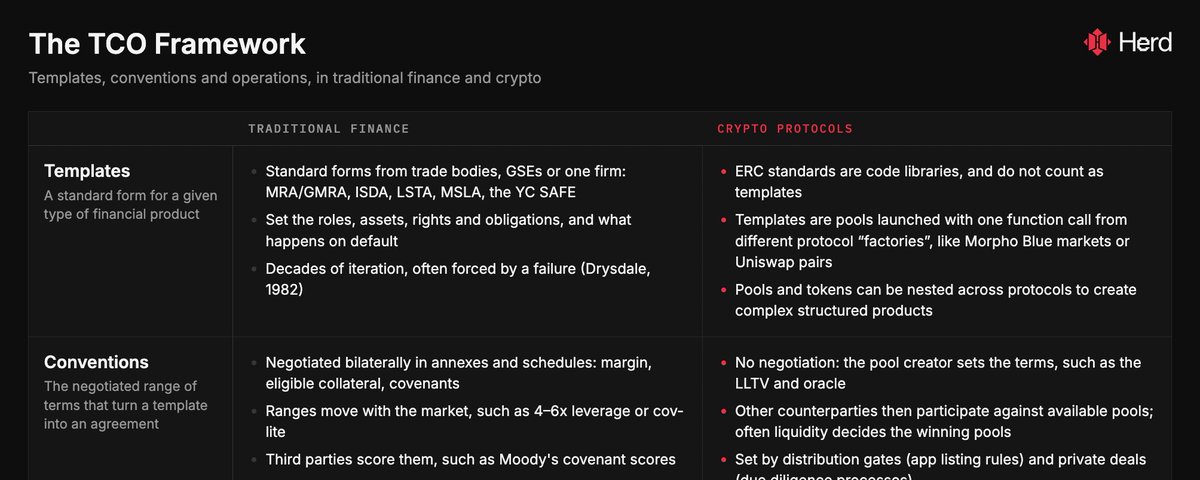
Edward retweeted

if you had told me a year ago I'd be using slack to develop and linear to read code I'd have called you crazy
Edward retweeted
I firmly believe 99% of the remaining crypto institutional adoption problems sit within accounting, legal recognition, and tying/modernizing these methodologies to execution onchain
good example dive in here!


Super cool to see, we adopted Tanstack Start @herd_eco when it was still very early and has been great to work with 🙂

TanStack Start 1.0 is officially stable! 🎉
A full-stack web framework for React and Solid, already used to build millions of apps, from Fortune 500 companies to your favorite tools and weekend projects.
tanstack.com/start
Edward retweeted

mise is really good. i switched from homebrew on my work machine and have had a wonderful experience so far

new in mise: tools that keep themselves up to date.
set auto_update on a global tool and mise upgrades it right before it runs. optionally run a daemon to do upgrades in the background.
mise.jdx.dev/dev-tools/#auto…

While I'm sure this is a great outcome for the team, I am pretty disappointed that they will end active Deno runtime development next year
There is now basically no JS server runtime competition to Node besides Bun

We are excited to announce that Deno is joining Cloudflare!
deno.com/blog/cloudflare

Edward retweeted

A perpetual problem: the more visible activity there is, the more impressive the work looks. Ten years ago people were building unnecessary distributed systems, with >1:1 microservice:dev ratio, that could've been simple monoliths. The same thing is happening with "factories".
Edward retweeted

The more time I spend working with coding agents, the more convinced I am that they make software engineering even harder
We can do amazing things with them, but unlocking their full potential requires extraordinary discipline and knowledge

Bury your head in the ground at your own risk. I aim to not jump on any hype trains, but since Opus 4.6 and GPT-5.2 + the harnesses it was clear that these things can write code nearly as good as I can in my best language; better in other languages.
But we won't see non-devs push production code for a long time; possibly forever, if you ask me. Software still needs to be built in robust ways, and it's our profession to do this well, and use the new tools we have, which create new and interesting (+tough!) challenges
Edward retweeted

JavaScript was never designed for the server. If that doesn't change soon, JavaScript on the server will be replaced by Rust.
The fix needs to happen in the engine. Sound types. Ahead-of-time compilation. Threads with shared objects.

"I love Rust! Rust is amazing ...if you never, ever, EVER have to look at it yourself." — @dhh
Edward retweeted

Herd is covering the Monad ecosystem!
The Herd team is doing a nice job of automatically disentangling chained dependencies across DeFi. I believe that with better information, we can all make better decisions. Now on Monad

Edward retweeted

a big blackpill moment for me was when I saw the senior staff eng that used to block my prs for poorly named functions start to directly merge claude outputs into master

I am done with this shit. It is over. The state of engineering right now is horrible. It has been half a month since I started a new role at a big company. Nobody knows anything here. The specs, code, tests, PRDs, tickets, resolution of those tickets, reports, etc., everything is made by Claude Code. Nobody on my team likes this. They are being forced to ship as much as they can. I have heard multiple times from higher management that pushing code is not a bottleneck, so why are we slow? People are working 12 to 13 hours a day just to press enter. Nobody is reading anything. Humans in corporate are doing nothing on their own. Everyone, literally everyone, from an L1 to an L7 engineer here is doing the same thing. Talk to Claude. There is no sense of victory. Nobody is resolving bugs. In reality, nobody is thinking anymore. Everything is done by LLMs. It is so soul-sucking. I would not mind it, to be honest, if we were at least given the time to check out the code and see what is going where. But no, the goal is to just ship. No matter what happens.


Edward retweeted

Did anyone actually read the SEC Exemptive Relief letter for Tokenized Securities?
I read the 60 pages today, and the carveout is incredibly limited. Considering the celebrations on X, I thought it would contain something useful, but imo there isn't demand for the model proposed / nor is any incumbant already meeting the requirements as written.
I haven't seen anyone properly breakdown what it actually says, so here are the most important parts with my commentary:
1. Permissioned Participants Only.
Tokenized Security Venues (TSVs) can "facilitate the permissioned trading of tokenized NMS stock using innovative automated market makers."
The key word is "permissioned." It's mentioned multiple times throughout the letter. Permissioned means whitelists, whereby both the LPs and traders are known, KYC'ed and KYB'ed.
Onchain stock AMM liquidity/execution is already terrible, and that's without limiting to permissioned entities. Who is actually going to provide liquidity into these permissioned venues?
It's not market makers. Market makers prefer CLOBs because they are more capitally efficient. Market makers also prefer bilateral trading via single dealer platforms (or as the cryptonatives call them propAMMs).
There is limited supply side liquidity for permissioned AMMs. It's either permisionless AMMs or permissioned structures other than AMMs.
2. What is a Tokenized Security Venues (TSV)?
A TSV "brings together buyers and sellers of Tokenized NMS Stock by: (1) providing one or more AMM Liquidity Pool(s) for permissioned participants to interact and agree to terms of a trade and (2) setting standards for persons to access trading on such AMM Liquidity."
By this definition, Hyperliquid's CLOB model would not count for exemptive relief. Hyperliquid Spot (not perps) does ~50% the daily volume of Uniswap. But, to put things in perspective, Hyperliquid only has 70 spot pairs(!!).
It's obvious, there will be tighter execution and better discovery on CLOB models like that of Hyperliquid.
We need permissioned CLOB or propAMM structures included in the definition. In fact, as I'll get to below, the SEC even calls out the fact that AMMs lack best execution protections... whcih could easily be implemeted in CLOB structures!
3. What counts as a Tokenized NMS Stock?
First, a Tokenized NMS Stock must be registered with the SEC. Second, a Tokenized NMS Stock "does not include securities where a third party issues a crypto asset representing its own security that provides synthetic exposure to an underlying security, such as a tokenized linked security or a tokenized security-based swap."
To be clear, none of the permissionless representations of stocks today are SEC-registered securities @RobinhoodCrypto @coinbase @binance @Ondo @xStocksFi etc. The fact that they are not, means nothing in this letter pertains to them. To be clear, it does NOT mean that these models are inferior (in fact I would argue the opposite, but that's outside this scope.)
Lastly, a Tokenized NMS Stock can only trade against "another Tokenized NMS Stock, a non-security crypto asset (e.g., a payment stablecoin issued by a permitted payment stablecoin issuer), or a tokenized money market fund."
The phrasing is vague here to me, does "non-security crypto asset" include memecoins???
4. Lack of Consumer Protections and Risks with AMMs
In the US, investors are given best execution protections. Without these protections, market makers can provider inferior execution and manipulate spreads at investors expense. These protections are part of Reg NMS.
Alarmingly, the SEC says consumers will NOT have these protections in TSVs: "A TSV could not comply with the requirements of Regulation NMS without significant modifications to its trading model, which may adversely impact TSV Participants."
Why are we going down the AMM path? Without these protections, who is going to participate on the demand side? As mentioned above, we have severely limited the supply side, now we are effectively saying to consumers, "Spreads will be wide, good luck."
You know what can easily abide by Reg NMS? CLOBs like that of Hyperliquid.
With both supply and demand sides hamstrung, we're setting ourselves up for failure. But on a positive note....
5. The SEC recognizes the benefits of Blockchains!
TSVs "offer the potential to benefit investors by enabling investor self-custody, around-the-clock trading, fractional ownership of shares, and near instantaneous settlement.... The use of such technology may also lower operating, recordkeeping, and transaction costs, and improve efficiencies."
6. Long list of Requirements to become a TSV
Pages 36-46 are a long list of requirements TSVs must make publicly, including things like, "a TSV must consent to examinations of its books and records by the Commission staff at any time" and "at least 30 calendar days before operating, a TSV must publish a copy of a notice (“Notice”) prominently on its publicly available website."
7. Issuer Protections, Remember AMC / Robinhood?!
We all remember the AMC debacle. The SEC is giving AMC exactly what they asked for: required issuer permission for the tokenized security to exist.
"If [AMC] provides... written notice to the TSV that it objects to a Tokenized NMS Stock... the TSV cannot make such Tokenized NMS Stock available for trading on the TSV."
This line reads almost directly from the AMC incident: "An issuer of the underlying NMS stock may be concerned about the risk of maintaining its shareholder register related to onchain transfers or the potential price dislocation or adverse effects on the price of the underlying NMS stock, particularly given that prices disseminated by an AMM Liquidity Pool are most likely based only on the ratio of the quantities of assets in that liquidity pool."
Yet another reason to prefer CLOBs where the prices are not directly linked to a single pool which could be mispriced.
8. Tokenized Stocks must have the Same Benefits
Tokenized stocks must have "a right to receive the same dividends... a right to exercise the same voting rights... and a right to receive the same share of the residual assets of the company upon liquidation."
Great stuff! Investors in tokenized representations should get everything (and more!) than they would in the traditional form.
9. Extremely High Volume Limits and Other Controls
The limits the SEC has set for volume are sky high. The "volume of Tokenized NMS Stock Traded... cannot exceed 0.25 percent of the average daily share volume during the prior month in the relevant NMS stock as reported by an effective transaction reporting plan". The TSV must pause trading"
For reference, even the permissionless versions of these tokenized equities are doing less than 0.001% of the volume.
Remember today, there are only $3 bn in tokenized equities. The market is $70 trillion.
----------------------------------------------------
Expect a formal comment letter submitted to the @SECGov from myself and @glider__ soon.
Edward retweeted
love brian but ATPs are not an apples-to-apples comparison to vaults. while its good rage bait, it is just making everyone more confused
everything in defi comes down to "strategy" and "custody". a strategy is a managed set of allocations across contracts, and custody sits both above and below the strategy (how do you "hold" a position in the strategy, and how does the strategy "hold" positions across other contracts).
The primary ATP strategy today (an ETF) is safer than a variety of strategies run by vaults. My mental comparison of glider today is against my metamask or coinbase account, not against some steakhouse vault. When glider gets to openly creating and managing strategies that ATPs can allocated into, then we are getting closer to an apples comparison. I believe the complexity of contracts/oracles is unavoidable, you can abstract it with an API sure but it is still there and institutions will still want to audit down through every layer (they aren't going to just sign off on your api). It's not a problem you can just run away from.
I also know I tweet large token graphs often, but more contracts != more risk always. For example, centrifuge has like 30+ contracts just to manage bridging of an asset because they want fallbacks/gates/agreement across different bridges (chainlink, layerzero, and axelar). And if you want to allow different strategies, you have to segment what operations are allowed by what operators (this is the bulk of contracts for any protocol/vault). Privy wallets give glider full authorization to do anything they want on behalf of the user, but eventually that will have to become more segmented like a policied weiroll solution which a few other teams are close to launching (like makinax).
I'm seeing enough confusion on the timeline that it's probably worth me writing an article about the layers of strategy, custody, and operations in defi today.
