

Max leverage, max points, max yield with LP tokens as smart collateral | https://xitter.cf/t.co/mwDynhj0BP |
Joined January 2024
- Tweets1.3K
- Following152
- Followers20.1K
- Likes1.1K








Loop retweeted

It might look complex, but it's just composability.
slpETH - earns from @LoopFixyz's leveraged ETH restakers
gtWETHe - earns from @Gauntlet_xyz vaults on @MorphoLabs
16.3% vAPR with 10x Quaaloops too!
app.aura.finance/#/1/pool/25…

Loop retweeted

Yield Infographic Series: #8
Yield: 32-37% APY with points
Protocols:
@elixir
@mystic_finance
@roosterprotocol
@TreehouseFi
@pendle_fi
@loopfixyz
BONUS:
@PeapodsFinance

Loop retweeted
Professor: “Any questions?”
Student: “Yeah… why are stablecoin yields still this high?”
Professor: "Blame @LoopFixyz, @ParallelMoney, @infinifi, @GyroStable, and @Aave. They're absolutely cooking."

Loop retweeted
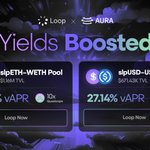
37% vAPR on the $slpUSD | $USDC pool!
slpUSD is @Loopfixyz’s interest-bearing stablecoin, accruing yield from USDC interest paid by restakers leveraging LRTs. The USDC is boosted by @Aave, while @Balancer’s Stablesurge hook helps keep the assets pegged.
🔗 app.aura.finance/#/1/pool/25…

Loop retweeted

[SPACES THIS WEEK]
🔔 [SMART MONEY] - Regulatory Clarity For DeFi Is FINALLY Coming w/ @loopfixyz , @DexlynLabs , @ranktrading and @SentoraHQ
🗓️ June 26th @ 10:00am EST
🧵 2/8 👇
Loop retweeted
Y’all got any more of that yield?
The WETH accrues extra yield via @gauntlet_xyz vaults on @MorphoLabs. slpETH receives borrower interest payments as @loopfixyz users loop LRT LPs to maximize restaking yields.
Plus trading fees, emissions, and a sprinkle of MORPHO rewards.
➡️ app.aura.finance/#/1/pool/25…

Loop retweeted

inwstETHs is now loopable on @loopfixyz
One-click automates the full loop:
wstETH → inwstETHs
↑ ↓
borrow ETH ← LP Spectra
No extra tabs and manual steps.

Loop retweeted

Explore today’s top opportunities for your LRTs.
Up to 24.59% APY on @loopfixyz, 15.95% with @ThenaFi_, and more across @CurveFinance, @ConvexFinance, @StakeDAOHQ, and @spectra_finance
All while stacking rewards from @eigencloud, @kernel_dao, and Astherus.

Loop retweeted

$400M FDV Valuation with an Airdrop Campaign?
How to best farm Treehouse.👇
(takes 2 minutes)
• go to @loopfixyz/ mainnet
• go to loop section
• go to tETH/ PENDLE strategy
• deposit ETH or WETH or tETH
• choose 5x (leverage)loop factor
♦️+3.88% Net $ETH APY
♦️x10 Treehouse Nuts(points)
♦️x5 Loop Points
♦️+43.67% estimated APY from points
♦️+47.55% overall estimated APY
How it works:
>you deposit ETH
>ETH deposited on @TreehouseFi for tETH
>tETH gets LP'd on @pendle_fi
>ETH is then borrowed against your tETH LP from lenders on @loopfixyz & then looped dependant on your chosen Loop Factor.
How you found this post of use, if so here is my Loop ref code: IJ6-FLA
Enjoy.


🌳 Treehouse is now valued at $400M.
Backed by leading institutions from TradFi & crypto, we're building the infrastructure to accelerate fixed income in digital assets.
Learn more 👇
treehouse.finance/blog/fundi…

Loop retweeted

• Top performing pool on @avax: $USDC | $USDT | $AUSD
• New proposal: Balancer Alliance Program (Aave, Lido, Rocket Pool)
• Dynamic fees coming via @ezklxyz
• @loopfixyz xitter.cf/loopfixyz expanding more on V3
and more…
xitter.cf/Zen__Dragon/status/191…


What a refreshing morning right before a holiday weekend. Oh what's this? Incredible yield opportunities on @Balancer V3's @avax deployment? @aave is that you old friend? @GyroStable you fine sers welcome to the party.
It'll dilute right?... right!?
balancer.fi/pools?protocolVe…

Loop retweeted

My detailed overview of @loopfixyz Protocol
LoopFi is a decentralized lending hub designed specifically for so‑called carry trades with $ETH. In simple terms, LoopFi lets users borrow and lend crypto in a way that earns on the interest‑rate spread. What makes this project unique is that it accepts liquid staking deposit tokens and other yield‑bearing ETH derivatives (and also $BNB and stablecoins) as collateral - for example, Liquid Restaking tokens from projects like @pendle_fi , @EtherFi , @swellnetworkio , and others. A user deposits these assets into the protocol, and LoopFi then allows them to borrow ETH against those tokens, boosting their overall ETH staking yield.
The core LoopFi feature is automated, leveraged reinvestment. The protocol can magnify your base position by up to 5× using borrowed funds. For instance, if you hold the equivalent of 1 ETH in a collateral token, LoopFi can lend you up to 4 ETH, taking your total exposure to 5 ETH.
All borrowed funds are automatically converted back into the original collateral asset and redeposited - creating an investment loop. Thanks to this, your collateral continues to generate its base yield (staking rewards, liquidity‑pool fees, etc.), now on a position several times larger than your original deposit.
Moreover, the leveraging process is fully automated: the protocol repeatedly executes the cycle
“deposit → borrow → buy more collateral → redeposit” until it reaches the chosen leverage ratio.
‑‑‑‑‑‑‑‑‑‑‑‑‑‑‑‑‑‑‑‑‑‑‑‑‑‑‑‑‑‑‑‑‑
➤The problem LoopFi solves: in @ethereum ecosystem there are many ways to earn yield on ETH (staking, restaking via @eigencloud , yield pools like Pendle, etc.), but borrowing against those positions has been limited. Traditional lending protocols (@aave , @compoundfinance , and others) either let you borrow stablecoins against ETH collateral (but with relatively low LTVs for risk reasons) or borrow ETH against LST (liquid staking tokens) - which eases rate arbitrage but often comes with high rates due to borrowing demand.
LoopFi offers a hybrid solution: a high credit limit against ETH‑denominated assets at a borrower‑friendly long‑term rate. It achieves this by specializing tightly in staking and restaking derivatives.
As a result, you can borrow cheap ETH and deploy it into a higher‑yielding ETH instrument, executing a carry‑trade (interest‑rate arbitrage) automatically.
At the same time, the platform rewards both sides: lenders earn interest, and borrowers boost the APY on their positions. Under the right conditions, the yield from your collateral exceeds the borrowing cost, effectively giving you leveraged exposure at almost zero net interest (and, if yields are high enough, fully covering the loan’s interest).
➤Current Product Status
LoopFi launched in 2024, and the protocol’s development proceeded in several phases:
Epoch 1 – a “warm‑up” liquidity campaign in which users deposited ETH and LST derivatives in exchange for loyalty points (Loop Points).
Epoch 2 – after audits and public testing, the full lending protocol went live.
Epoch 3 – the flagship Loop feature was activated, allowing users to take out loans and “loop” (leveraged) their positions automatically.
‑‑‑‑‑‑‑‑‑‑‑‑‑‑‑‑‑‑‑‑‑‑‑‑‑‑‑‑‑‑‑‑‑
➤Available Features
→Lending for Liquidity Providers (Creditors)
Users can supply a base asset (e.g. $ETH) to the protocol’s pool and earn interest. Upon deposit, they receive an interest‑bearing deposit receipt token - lpETH (analogous to cToken or aToken) - which automatically accrues yield.
This token can be held, staked for additional rewards, or used in other protocols. The interest rate for creditors floats based on borrowing demand (via a utilization‑rate model) and may be further subsidized by protocol rewards.
→Leveraged Borrowing for “Loopers”
Users deposit supported collateral (LST/LRT tokens) and borrow ETH, which is then automatically converted back into the same collateral and redeposited - creating a leveraged position in one seamless transaction loop.
‑‑‑‑‑‑‑‑‑‑‑‑‑‑‑‑‑‑‑‑‑‑‑‑‑‑‑‑‑‑‑‑‑
➤Network Deployment & TVL
Total value locked has been steadily growing: on Ethereum, TVL reached approximately $3 million (with an all‑time high in March 2025), and on BNB Chain around $4 million. While modest compared to major DeFi platforms, these figures are significant for a specialized newcomer. User activity is also rising: in the first months, LoopFi reported several hundred unique depositors and loopers, indicating growing adoption among advanced DeFi participants seeking to maximize staking yields.
‑‑‑‑‑‑‑‑‑‑‑‑‑‑‑‑‑‑‑‑‑‑‑‑‑‑‑‑‑‑‑‑‑
➤Interface & User Experience
The platform features a modern web interface with informative dashboards. Anyone familiar with basic DeFi concepts can follow the step‑by‑step form on the Loop tab. Optionally, users can enable a Boost: by staking a small additional amount in a special pool (see Architecture section), they can reduce their borrowing rate. Once a position is open, the Portfolio tab displays its real‑time status.
‑‑‑‑‑‑‑‑‑‑‑‑‑‑‑‑‑‑‑‑‑‑‑‑‑‑‑‑‑‑‑‑‑
➤Team & Backers
LoopFi is built by a doxxed team of DeFi enthusiasts with blockchain experience:
Founder & CEO: Andrés Soltermann (Switzerland), previously involved in launching the Swiss stablecoin DefiFranc and the Grizzly.fi platform.
CTO & Co‑founder: Roman Fritschi.
Chief Business Officer: Jonathan Gropper.
CMO: Valéria Pereira.
The core team is international, with expertise in smart‑contract development, tokenomics, and decentralized finance. They maintain an official blog and an active X account. Rather than star advisors, the project emphasizes its technology and product reputation.
‑‑‑‑‑‑‑‑‑‑‑‑‑‑‑‑‑‑‑‑‑‑‑‑‑‑‑‑‑‑‑‑‑
➤Investors & Funds:
Initial financing came from crypto‑focused funds, notably @OutlierVentures (bringing both capital and mentorship via their Base Camp program) and @v3v_ventures . Roughly 10 % of LOOP tokens were allocated to investors - implying a raise in the low‑millions. The team holds 24 % of tokens under long‑term vesting, underscoring their commitment.
Prior to token launch, early users who accumulated Loop Points earned eligibility for a LOOP airdrop and public sale, fostering a community‑driven fair launch.
At token launch (end of 2024), tokenomics allocated ~61 % to the community (including 20 % for rewards, 11 % for airdrop, and 25 % to the DAO treasury) and
39 % to team, advisors, and investors under vesting schedules - limiting concentration among early VCs.
‑‑‑‑‑‑‑‑‑‑‑‑‑‑‑‑‑‑‑‑‑‑‑‑‑‑‑‑‑‑‑‑‑
➤Audits & Security
Security is paramount given the risks of leveraged lending. LoopFi underwent multi‑stage smart‑contract audits before mainnet launch:
Professional Audits: @WatchPug_ conducted at least five separate audit reports covering the Points Program, lending‑pool logic, liquidation mechanisms, oracle integrations, etc. All critical and high‑risk issues were addressed during testnet.
Community Audit: In summer 2024, a @code4rena contest with a $100 000 prize pool engaged white‑hat hackers to probe the code. Only medium‑ and low‑severity findings were reported and promptly fixed.
Post‑launch of new features - such as stablecoin looping and integration with Pendle/@Penpiexyz_io - WatchPug audits were commissioned. A permanent bug‑bounty program (up to $100 000 per critical finding) is now in place.
On the technical side, LoopFi uses modular, thoroughly tested contracts; price feeds are secured via @chainlink with fallback TWAP from @Balancer for certain pairs. Administrative controls employ multisig, and key‑management procedures are kept minimal to reduce centralization risk. To date, no major incidents or fund losses have occurred; the DAO treasury reserves can act as an insurance buffer against potential bad debt.
➤Architecture and Mechanics of the Protocol
LoopFi’s architecture combines elements of classic lending with a system of individual collateral vaults. In essence, there is a single liquidity pool for lenders (into which base assets - for example, ETH or BNB on the respective chain - are deposited for borrowing), while each borrower receives a personalized position tracking their collateral and debt.
When a user opens a Loop position, the protocol performs a series of steps:
1)It deposits the user’s collateral into a dedicated vault contract (an internal CDP vault).
2)It borrows the required amount of ETH from the liquidity pool.
3)It swaps that borrowed ETH for additional collateral tokens via a DEX.
4)It deposits the newly acquired collateral back into the same vault.
This cycle repeats automatically until the target leverage ratio is reached. The user ends up with a position consisting of some number of collateral tokens on‑chain and an outstanding ETH debt to the pool. A smart contract monitors this position’s health factor (the collateral‑to‑debt ratio) and will trigger liquidation if it falls below a predefined threshold (typically around 110–120 % collateralization, corresponding to about 90 % LTV).
‑‑‑‑‑‑‑‑‑‑‑‑‑‑‑‑‑‑‑‑‑‑‑‑‑‑‑‑‑‑‑‑‑
➤Supported Collateral Assets
LoopFi focuses exclusively on ETH‑denominated, yield‑bearing tokens, including:
1)LST (Liquid Staking Tokens): e.g. stETH (@LidoFinance ), rETH (@RocketPool_Fi ), weETH (@EtherFi ), swETH (@swellnetworkio ). These represent staked ETH and earn ~3–5 % APR in staking rewards.
2)LRT (Liquid Restaking Tokens): tokens received by restaking LST in secondary protocols (e.g. via EigenLayer), which can generate extra yield (at the cost of slashing risk).
3)Yield‑bearing LP Tokens: liquidity‑pool tokens where one side of the pair is ETH or an ETH derivative. For example, Pendle LP tokens allow splitting base yield and rewards to capture elevated APR; LoopFi supports select Pendle pools (“Yield Tokens”) and strategies from @spectra_finance that also focus on high‑yield ETH‑based positions.
All of these “Smart Collateral” tokens continue to generate yield - staking rewards, DEX fees, or protocol incentives - even while locked as collateral (a concept similar to that used by @GearboxProtocol and @0xfluid ).
‑‑‑‑‑‑‑‑‑‑‑‑‑‑‑‑‑‑‑‑‑‑‑‑‑‑‑‑‑‑‑‑‑
➤Yield Composition
A LoopFi user’s total APY comprises:
Base Collateral Yield: the native yield of the collateral token (e.g. ~5 % APR for stETH, potentially 20–30 % APR for certain Pendle LP tokens). Because borrowed funds are continuously redeployed into collateral, a 3× leverage multiplies this base yield roughly threefold.
Borrowing Costs: the ETH interest rate, which is dynamic and rises with demand. If the rate is, say, 8 % APR, that cost accrues on the debt. Net yield equals base collateral yield minus borrowing cost; LoopFi explicitly displays the Borrow Cost vs. Yield metric, with optimal strategies keeping this ratio under 1 (i.e. yield > cost).
Protocol Fees: LoopFi charges borrowers an interest fee, portions of which are redistributed as Boost rewards to active participants - indirectly improving their net APY.
‑‑‑‑‑‑‑‑‑‑‑‑‑‑‑‑‑‑‑‑‑‑‑‑‑‑‑‑‑‑‑‑‑
➤User Protection & Risk Management
LoopFi employs standard DeFi safety mechanisms: over‑collateralization and liquidation. Each borrower’s position must maintain collateral above debt by a set margin (e.g. minimum 110 % collateralization). If price movements or accrued interest cause this ratio to breach the threshold, third‑party liquidators can repay the debt and claim the collateral at a discount, preserving overall protocol health. Price oracles (Chainlink with Balancer TWAP fallbacks) guard against manipulation, and maximum borrow limits or higher collateral requirements can be set for less liquid assets.
Only carefully vetted assets are onboarded - initially, only the most robust LST and select LP tokens- with any expansions governed by DAO proposals and subject to additional audits (as was done for the USD Loop strategy).
‑‑‑‑‑‑‑‑‑‑‑‑‑‑‑‑‑‑‑‑‑‑‑‑‑‑‑‑‑‑‑‑‑
➤Potential Risks
Despite its safeguards, LoopFi carries inherent risks typical for leveraged DeFi:
Technical Risks: Smart‑contract bugs, oracle failures, or vulnerabilities in integrated protocols (e.g. Pendle, Spectra). Admin‑key compromise could allow malicious parameter changes.
Market Risks: Extreme ETH volatility can trigger mass liquidations; at high leverage, a 10–15 % drop in collateral price may wipe out a position. Derivative tokens can depeg or suffer slashing events, devastating collateral value. Borrow rates may spike under heavy demand, potentially exceeding collateral yields and forcing unprofitable closures.
Bad‑Debt Risk: If a position is liquidated but falls short of covering its debt (e.g. due to rapid price moves ahead of oracle updates), lenders bear the loss.
Competition: Established lending protocols could launch competing LST or leveraged‑staking products. Failure to capture market share risks liquidity flight to larger platforms.
Centralization Risk: Early governance remains team‑controlled until the DAO fully forms. Users must trust that the team won’t change tokenomics or protocol rules to their detriment.
Ultimately, LoopFi strives to balance yield enhancement and security, but responsibility for risk management lies with each investor.
Shotouts to founders and defi geeks,hope you will find my research interesting: @Val_bpereira @Loop_Intern @altcoinandy_ @Pancakesbrah @sebaudet26 @patfscott @0xThoor @thedailydegenhq @shanicebest @poopmandefi @JiraiyaReal @apeguru


Loop retweeted

🌲 NOVEDADES TOP EN ECOSISTEMA TREEHOUSE. LOOPFI. VALORACIÓN DE $400M 🤯
Hay varias novedades MUY TOP en el ecosistema de @TreehouseFi como la financiación a una valoraciónde $400M! En este tweet voy a destripar qué me hace estar bullish en Treehouse basándome en las últimas noticias.
Además, voy a presentarte el proyecto de @loopfixyz , que te permite apalancar tu tETH LP de Pendle para conseguir un APR de hasta un 50%, incluyendo un boost de hasta un x10 en $NUTS y puntos de @Loopfixyz para su futuro airdrop. Te lo desgrano todo, poco a poco:
🔵 1- Treehouse cierra ronda a $400M de valoración
Treehouse acaba de cerrar una nueva ronda de financiación con una valoración de 400 millones de dólares. Esta noticia confirma la solidez del proyecto y la confianza que los inversores institucionales tienen en su visión. Esta ronda se suma a los $18M de financiación inicial que levantaron anteriormente. MUY TOP . .
🔵 2- DOR en DeFiLlama, apoyo de Lido y tETH en Pendle
Treehouse ha conseguido tres avances SUPER potentes, en mi opinión:
➡️ @DefiLlama ha creado una nueva categoría llamada DOR (Decentralized Offered Rates), donde Treehouse es el primer y único protocolo listado actualmente.
- Esto supone un reconocimiento oficial a su modelo como nueva capa base de tasas de referencia para todo DeFi. En el tweet mencionado ya expliqué lo que era el DOR.
➡️ Por otra parte, Lido DAO ha mostrado públicamente su apoyo a Treehouse, destacando que el token tETH está respaldado 100% por stETH, el LST más utilizado y fiable del ecosistema Ethereum. MEGA BULLISH. Aquí tenéis su tweet:
xitter.cf/LidoFinance/status/188…
➡️ Y por si fuera poco, tETH ya está disponible en @pendle_fi, lo que permite integrarlo en estrategias de tipo fixed income. Además ahora podrás aprovechar un protocolo de looping para aumentar tu rendimiento y puntos. Vamos con lo más jugoso: LoopFi.
🔵 LoopFi: apalancamiento de tETH LP para multiplicar tu yield
@loopfixyz es un nuevo protocolo partner de Treehouse especializado en estrategias de looping automático con LPs de Pendle. Esta semana han lanzado soporte para el LP de tETH en Pendle, lo que permite a cualquier usuario apalancar su posición de forma automática con un solo click.
Además conseguirás un APR de hasta el 50%, frente al 2,74% que da tETH solo holdeandolo en la wallet . .
➡️Cómo funciona? Fácil: tú depositas tu tETH (si no tienes tETH puedes hacer swap de ETH a tETH en Jumper por ejemplo red Ethereum), LoopFi lo deposita en Pendle y lo utiliza como colateral, te presta una stablecoin, y con esa stable vuelve a comprar más tETH LP, repitiendo el proceso hasta un máximo de x5 de apalancamiento (lo que se conoce como looping en Defi).
- Aqui te dejo el link para depositar tus tETH (si quieres ayudarme puedes usar mi referido
app.loopfi.xyz/#/?ref=V6C-QW… y después ir directamente al link para depositar tus tETH:
app.loopfi.xyz/#/loop/0x1438…
Una vez dentro asegúrate de seleccionar tETH como aparece en la imagen: . .
➡️Todo esto lo hace la plataforma de forma automática. Además, con este apalancamiento también obtienes un boost de hasta 10x en $NUTS (Treehouse) y 5x en Quaaloops (el sistema de puntos de LoopFi para su futuro token).
➡️Y los riesgos? ¿Te pueden liquidar?
Sí, como en cualquier estrategia apalancada. Pero te lo explico fácil con un ejemplo:
- Supón que tienes $1000 en tETH. Si usas un apalancamiento de x3, estás abriendo una posición de $3000, de los cuales te han prestado $2000. Para que te liquiden, el valor de tus tETH LP tiene que bajar por debajo de los $2000.
-Eso implicaría un depeg del 31-33%, algo muy improbable en un LP de Pendle. Por eso yo prefiero ser conservador y usar un apalancamiento de x3, que ya me da un APR del 31%, frente al 2,4% de no hacer nada.
- Además, con ese apalancamiento x3 estás recibiendo 6x más $NUTS, lo cual puede marcar una gran diferencia en el próximo airdrop de Treehouse. Estás multiplicando tu farming y tu airdrop al mismo tiempo, sin necesidad de hacer maniobras complejas. Te dejo una imagen para que lo veas gráficamente. .
Eso sí, esta funcionalidad sólo está disponible en red ETH y bloquearás tus tETH hasta el 28 de Mayo. Sin embargo siempre puedes retirar los tokens PENDLE LP que te dan a cambio.
🔵 CONCLUSION
En definitiva, Treehouse lo está haciendo muy bien. Tiene capital, tiene narrativa, está creando una nueva infraestructura de tasas para DeFi (DOR), aparece en Defillama, y ahora se integra con protocolos como Pendle y LoopFi.
Como siempre, si tienes alguna duda ponlo en comentarios o preguntame al DM.
Si te ha gustado la información agradecería mucho tu Like + RT


🌳 Understand @TreehouseFi in depth:
What are they building? Why is it so innovative in DeFi? What are TESR and tETH?
Lately I’ve been enjoying analyzing the DeFi projects I use from a more “technical” perspective.
Here’s the full thesis 👇
➡️ The problem to solve:
In DeFi, every protocol sets its own rate. There’s no clear way to know which one is “fair.”
Treehouse is trying to fix that.
1️⃣ Treehouse is not just another LST.
- They’re building reference rates for DeFi.
Just like TradFi has SOFR (Secured Overnight Financing Rate) — the benchmark for loans, derivatives, and bonds — Treehouse wants to build those same standards for crypto.
- In TradFi, markets don’t operate on random rates.
All banks use standardized benchmarks like SOFR.
Example: a loan might be priced at SOFR + 2%.
Everyone knows what SOFR is. It’s neutral and transparent.
- Treehouse wants to replicate this in DeFi by creating standardized benchmark rates for staking, lending, and borrowing.
That’s why they created TESR = Treehouse Ethereum Staking Rate.
- TESR is a daily rate that reflects the real yield from staking ETH, built from multiple data sources:
1- Native Ethereum staking data
2- Decentralized data validators (panelists)
3- Weighted daily averages
You can see it live here: dor.treehouse.finance/data/T…
2⃣Why is this important?
Because right now, DeFi has no reliable base rate.
One lending protocol offers 0.2%, another 2%, based on different internal models. That’s not efficient . .
3⃣The solution: DOR and tETH
- Treehouse is developing a full framework for reference rates called DOR (Decentralized Offered Rates).
- TESR is just the first benchmark (for staking). They’re already working on lending and borrowing rates too.
- So… what is tETH?
tETH is Treehouse’s native LST. A token that represents the standardized ETH staking yield based on TESR. It’s the most neutral and fair, LST in DeFi.
4⃣ Treehouse Business Model
Treehouse doesn’t do protocol-rates arbitrage. It identifies rate gaps across DeFi, creates an averaged rate and launches financial products on ii.
Some examples of future products based on DOR:
🔹 Lending/borrowing indexed to DOR
🔹 Floating-rate stablecoins based on DOR
🔹 OTC loans for institutions
🔹 Yield futures and staking derivatives
All based on Treehouse's reference rates.
5⃣ Why would major DeFi protocols adopt Treehouse rates?
- Well, Treehouse isn’t trying to impose, it’s trying to standardize. They try to establish a neutral and consensus-based benchmark. Whoever adopts it gains credibility and alignment.
- DOR improves capital efficiency and pricing logic across DeFi. And the more adoption it gets, the harder it will be for protocols like Lido, Aave, Frax or others to ignore it. .
🎯 It’s an ambitious goal tbh...But so far, Treehouse is executing exactly what they promised.
Meanwhile, we’re stacking $NUTS (for future drop) and generating ETH yield with a protocol that’s building something way bigger than farming.
Here’s my referral if you want to jump in:
app.treehouse.finance/referr…
That’s all for today!


Loop retweeted

On this week's startup spotlight, we will be talking about about the first protocol to make delta-neutral LP looping a one-click reality.
Join us tonight at 7PM IST for a Space with
@altcoinandy_ from @loopfixyz
Set your reminder 👇
We’ll be talking about:
🔁how they are collateralizing LP positions of protocols like Pendle and Spectra
🖱️their one click looping functions
🛣️their roadmap for the year
Loop retweeted
What’s performing best? Here’s what’s leading the pack:
🔥 Biggest APY: @loopfixyz ynETHx
⚡ Highest Bonus: @spectra_finance's ynETH
The top 5 strategies to generate the highest APRs are @loopfixyz, @CurveFinance, @ThenaFi_, @ConvexFinance, and @StakeDAOHQ.

Loop retweeted

1/ @loopfixyz ETH Leveraged Strategy offers 53.89% eAPY with high risk
• Deposit ETH for tETH on @TreehouseFi
• Loop with 5x leverage
• Auto-compounds for optimal yield
Loop retweeted

Stablecoin Yields on Mainnet
Ranked by real yield first, not just the highest APY that’s mostly rewards
17.22% – slpUSD Staking APY (real yield) on @loopfixyz
6.86% – slvlUSD Staking APY (real yield) on @levelusd
6.69% – USDS APY (real yield) for @SkyEcosystem on @yearnfi
6.54% – USDT Vault APY for @tether on @yearnfi
6.31% – USDe Staking APY on @ethena
4.83% – USDC Vault APY on @term_labs
8.65% – USDC APY (4.77% real yield) on @eulerfinance
4.50% – USDC Vault APY on @sparkfinance
9.42% – USDe APY (3.56% real yield) on @eulerfinance
5.85% – USDS APY (3.48% real yield) for @SkyEcosystem on @compoundfinance
3.40% – USDT APY on @0xfluid
10.57% – eUSD APY (1.5% real yield) for @reserveprotocol on @MorphoLabs
6.47% – USDS APY (0.10% real yield) for @SkyEcosystem on @aave
Pendle PT Yields (Paid in Pendle Tokens)
15.13% – sUSDe PT for staked @ethena on @pendle_fi
13.07% – lvlUSD PT for staked @levelusd on @pendle_fi
12.58% – slvlUSD PT for @levelusd on @pendle_fi
12.26% – superUSD PT for @superformxyz on @pendle_fi
11.03% – syrupUSD PT for @maplefinance on @pendle_fi

Loop retweeted

😊 Happy to share some wins from @loopfixyz community:
✅ 47 days of looping on Loop delivered a solid 16.9% ROI in ETH
✅Earned 120-130% APR while maintaining a delta-neutral position
✅Reward tokens and points aren’t even factored into this APR, meaning the 4x Eigen, 4x SEED, 4x Quaaloops, and $SPECTRA earned are pure bonus gains!
@Loop_Intern could you help with the math here? This user started with 5 ETH and looped it to ~20 ETH (4x). Based on that, how many Eigen, SEED, and Quaaloops has he farmed?

Loop retweeted

You don't know what to do with your ETH, BNB or USDC? Why not staking or looping on @loopfixyz?
Rates vary but currently you can stake
ETH for 20%
BNB for 15%
USDC for 16%
or you can also loop and get over
300% on ETH
35% on BNB
40% on USDC
Interested? Read more 👇🧵 1/x
Loop retweeted
Triple Digit Yields?
DeFi Summer?
Where?
Here's one(285% eAPY), posted it before but yields are even higher now!👇
>go to @YieldNestFi
>stake $ETH for ynETH
>go to @loopfixyz /loop
>deposit you ynETH
>pick 5x loop factor(leverage)
🔷+146.6% levered yield
🔶-59.1% borrow cost
🔷+87.5% net ETH yield
🔷+197% estimated points yield
overall estimated APY of 285%
Yield comes from LPing the ynETH on @spectra_finance then borrowing ETH against it & looping the position 5x, the borrowed ETH comes from lenders on Loop which can be accessed via their ''Earn'' page.
Enjoy.


Loop retweeted
“This Isn’t on X, The Real Alpha Is in Private Chats”
237 Active Depositors, with an average deposit size of 7.46 ETH = (~15.4k USD) (out of the 1,770 ETH TVL) @loopfixyz
Lenders
Lenders can provide ETH, BNB, or USD, receiving a receipt token in return, lpETH, lpBNB, or lpUSD. Once they have the receipt token, they can choose from the following strategies:
➜ Stake: Earn more yield + 1x Loop points
➜ Lock: Exclusively for those seeking 5x Loop points
➜ Provide to a pool: Earn some yield + 10x Loop points
According to the breakdown of lender types, although the majority of lenders prefer yields, a hefty 32.4% of lenders are mostly apeing into our airdrop.
Current Lending yields:
All paid in real yield
slpETH → 27,78% + 1x loop points
slpUSD → 7,43% + 1x loop points
slpBNB → 20.09% + 1x loop points
@loopfixyz is massively undervalued. It may not be one of the most talked-about protocols, and there are a few reasons for this:
➜ Limited Strategy Set: We only have 3 looping strategies live so far.
➜ Zero Marketing Budget: Outside of salaries (we aren’t volunteering as tributes)
But also…
➜ Fear of dilution 🤦🏽♀️ many of our LPs are depositing large amounts, making big bets on Loop. Why they don’t shill us constantly? "I don’t want to get diluted." The real strategies aren’t circulating on X, they're happening in private group chats.
For those worried about dilution, Loop offers a flexible interest rate model, ensuring that lenders won't see small yields. We we providing 17% yield on slpETH for 30 days straight and its now 27,78%. Go read the docs for more details on our interest rate paid to lenders.
Why Hold vs. Dump Post-TGE?
The simple answer: We make $1.6M at 100M TVL, which exceeds the revenue of several major protocols. Loop’s future looks bright, and as we scale, the potential growth is staggering. Despite the current 1,770 ETH TVL, Loop has only just scratched the surface (ONLY WITH 3 STRATEGIES)
We haven’t even started looping DEX pools. The potential for growth is enormous.

