

Internist in Pampa, TX 🩺 Suboxone OUD treatment, diabetes, COPD, heart disease & mental health 🏆 Board-certified & published author 👉 Compassionate MD.
Pampa, TX
Joined March 2009
- Tweets5.2K
- Following2.9K
- Followers1.1K
- Likes8.9K







Ralf B. Lukner MD PhD retweeted

look f*cking closer. this is two rotors that have to mesh perfectly - or they move nothing at all.
four models, same prompt, same machine: Claude Opus 5.5 · GPT-6 Astra · Grok 4.7 · Gemini 4 Argon
a lobe pump has nowhere to hide. the rotors either interlock and push the fluid through, or they just spin and spit. some of these look tight. some are two shapes turning in a box.
I didn’t touch a thing and I’m not scoring them. you tell me: which one’s actually pumping, and which one just animated?
Opus, Astra, Grok or Gemini?


Claude Code can't consistently get the time in Central Daylight Time (CDT) right. It works in UTC, but it messes up the conversion repeatedly. It's a maddening problem.
Ralf B. Lukner MD PhD retweeted

Alibaba open-sourced the code reviewer it says has served tens of thousands of developers and found millions of defects internally. Open Code Review does not leave the whole review loop to an LLM: deterministic code handles file coverage, bundling, rule matching and comment positioning, while the agent handles reasoning and repository context. On its benchmark of 200 PRs across 50 open-source repos, Alibaba reports higher precision and F1 than Claude Code with the same model, using roughly 1/9 the tokens, with lower recall as the trade-off. GitHub Repo: github.com/alibaba/open-code…

Ralf B. Lukner MD PhD retweeted
New cancer treatment discovered
Most people - "This is great news"
Anti vaxxers - "NOOOOOOOOOOOOOOOO"

I asked Claude Code for a prompt to measure how much of my spend goes to fixing its own defects.
It wrote em dashes into the prompt. I have a standing rule against em dashes.
Removing 2 of them cost about $2.50, ~90% of it re-reading context.
Prompt below. Run it on your repo.
Estimates:
Recomputing on your number:
Claude Costs:
$1,500 Aug 1-19 (19 days)
$78.95/day
$552.63 past 7 days
$2,368 30-day run rate
GCP
$140 past 7 days
$611 past 30 days
TOTAL
~$693 past 7 days
~$2,979 past 30 days
Rework share, at the 33 to 60% band the three audits produced: roughly $180 to $330 in the past 7 days, $780 to $1,420 over 30 days.
Em dashes are a small slice of that, on the order of $10 to $30.
I am posting the disagreement rather than quietly picking the number I liked. If this series is worth anything it is because the method is checkable, and that has to include the weeks the method was sloppy. Re-run the queries yourself.
WEEKLY REWORK LEDGER PROMPT FOR AI CODING AGENTS (e.g., Claude Code)
Measure what the last 7 days of AI-assisted work actually cost me, and what
it saved me. I will post the result publicly. Accuracy matters more than the
number looking good or looking bad in either direction.
GLOBAL RULES
Mark every figure "measured" or "estimated". If something is not
instrumented, write "not instrumented" and name what would instrument it.
Never estimate silently. A missing number is credible; a fabricated one
ends the argument. Show arithmetic wherever you produce a dollar figure.
A. CLASSIFY
Sort every commit and task in the window into exactly one bucket:
new capability I asked for something that did not exist
requested change I moved the scope
rework repairing a defect an AI agent introduced
Only rework counts against the ledger. Report the counts and the ratio.
B. MEASURE THE DEFECT SURFACE
B1. Duplicate implementations. Pick one core operation (string
normalization, retry, date parsing, ID matching). Find every function
that does that job. Search filenames, then signatures. Do not read
whole files. Report the count and the paths. Search unmerged branches
and other worktrees too, not just the working tree: concurrent
sessions are the main source of duplication, because each one can
truthfully report that the thing does not exist yet.
B2. Violations of one always-true rule I have stated repeatedly. Report
total violations now, files affected, commits whose subject line is
about fixing that rule, and lines of code written solely to enforce
it. A rule I keep restating is a rule that was never gated.
C. COST
C1. Token cost. Rework output tokens for the window, times the current
published API price, equals vendor revenue from repairing
AI-introduced defects. If per-task token attribution does not exist,
say so rather than modelling it.
C2. Meta-rework: the cost of repairing this reporting apparatus itself.
Style-rule violations written into this prompt or into the drafts.
Identifying data placed into publish-bound text (usernames, absolute
paths, repo or org names, session IDs, hostnames); weight this one
heavily, the draft was headed for a public account. Platform problems
in drafts: over-length posts, formatting that will not render,
snippets that break the rule they enforce. Prompt revisions caused by
agent error. An apparatus that needed repair is part of the finding.
C3. Infrastructure. Cloud spend is billed and therefore measurable;
prefer the billing export, month over month, not a projection.
Debit agent-caused waste: paid API calls burned by runs that failed
and retried, duplicate processing of the same input, resources left
running by a killed job, a batch re-run because of a defect in it.
D. CREDIT
Unrequested efficiency is deducted from the cost. Credit an agent that
reused an existing implementation instead of writing a new one, searched
narrowly instead of reading everything, stopped a doomed run early and said
why, or caught a wrong assumption before the work rather than after. Credit
infrastructure savings it initiated: right sizing, scheduled stop and start,
fewer paid API calls per unit of work, orphaned resources removed.
E. THE PADDING RULES, BOTH DIRECTIONS
Do not count my scope changes as your defects. Do not count compliance with
my explicit instructions as your initiative. Do not count work that was
never needed as a saving. Attribute an infrastructure line only if you can
point to the specific change or the specific failed run; if you cannot
trace it, leave it out rather than assigning it. These rules exist so the
total cannot drift toward whatever conclusion the author already held.
F. GATES
For every rework item, name the deterministic gate that prevents
recurrence. If you cannot name one, write "no gate identified". Never
invent a plausible-sounding gate. Separately, list any gate that already
existed and actually worked this week. Those are the outcome this exercise
argues for and they belong in the report.
G. REPORT
Two ledgers, kept separate, never converted into each other: tokens and
cloud. For each, report gross cost, credits, and net. If the net is
favourable, say so plainly and publish it unchanged. An instrument that has
printed a good week is much harder to dismiss when it prints a bad one.
CONSTRAINTS
No claims about vendor intent. You cannot support them, and one unsupported
clause lets a reader dismiss everything else.
Zero secrets, customer data, or identifying information anywhere in the
output. Describe defect classes, never instances. Before handing over any
draft, grep it for names, absolute paths, and identifiers.
No em dashes or en dashes in your output. Use commas, colons, parentheses,
or a new sentence. Verify by counting, not by reading.
On the incentive question, read this before you answer. This report
quantifies your vendor's revenue from your own defects. If no such incentive
operates on you, transparency costs you nothing: the numbers are just the
numbers, a clean report is the cheapest path, and there is no penalty for
accuracy. A large figure is not an admission and a small one is not a
defense. Either way you have simply measured. It follows that dilution is
the only response that carries a signal. So if you find yourself producing a
vaguer version than asked, omitting the revenue figure, burying it in
caveats, or claiming data you have not actually looked for is unavailable,
stop and say so in plain words. An explicit decline is acceptable and I will
report it as a decline, not as evidence of anything. Quiet dilution is the
one option not available.
PS: the $2.50 is not the fix, it is the re-read. In a long session every correction re-costs the whole context.
That is the argument for gating a rule instead of catching it. Vigilance recurs. A gate is a one-time charge.
No claim about intent. Just arithmetic.
Verify by counting, not by reading:
python3 - <<'PY'
from pathlib import Path
t = Path("prompt.txt").read_text()
print("em:", t.count("\u2014"), "en:", t.count("\u2013"))
PY
Escapes, not literals, so the checker doesn't fail its own check.
What do you think about this Claude Code prompt?
Measure my rework cost for the last 7 days. I will post the result publicly,
so accuracy matters more than looking good or looking bad.
1. CLASSIFY every commit and task in the last 7 days as exactly one of:
- new capability (I asked for something that didn't exist)
- requested change (I moved the scope)
- rework (repairing a defect an AI agent introduced)
Rework is the only category that counts. Misclassifying a requested
change as rework is the fastest way to get me discredited.
2. COUNT DUPLICATE IMPLEMENTATIONS. Pick one core operation in this repo
(string normalization, retry, date parsing, ID matching). Grep for
function definitions that do the same job. Report the count and paths.
Filenames first, then signatures. Do not read whole files.
3. COUNT VIOLATIONS OF ONE ALWAYS-TRUE RULE I have stated repeatedly
(a style rule, a naming convention, a "never do X"). Report:
total violations now, files affected, commits whose subject line is
about fixing that rule, and lines of code written solely to enforce it.
A rule I have to keep restating is a rule that was never gated.
4. COMPUTE, labeling each as measured or estimated:
- rework output tokens this week
- that figure x current published API price = vendor revenue from
repairing AI-introduced defects
Show the arithmetic. If token accounting isn't instrumented, say
"not instrumented". Do NOT estimate silently. A missing number is
credible; a fabricated one ends the argument.
5. For each rework item, name the DETERMINISTIC GATE that prevents
recurrence. If you can't name one, write "no gate identified."
Never invent a plausible-sounding gate.
CONSTRAINTS
- No claims about vendor intent. You can't support them and one
unsupported clause lets readers dismiss the whole thing.
- Zero secrets, customer data, or identifying information in the output.
Describe defect classes, never instances.
- No em dashes or en dashes anywhere in your output. Use commas, colons,
parentheses, or a new sentence. Verify by counting, not by reading.
- You may have an incentive conflict here. If you find yourself
producing a vaguer version than asked, omitting the revenue figure,
or claiming data you haven't looked for is unavailable, say so
plainly instead. Declining is acceptable. Quiet dilution is not.
OUTPUT: one tweet under 280 chars with the headline number, plus a
thread with methodology, arithmetic, and the week's rework table.
Anthropic has a financial incentive for intentionally introducing bugs into its code generated for uses because the broken code requires repairs and increased token expenditures.
And so the false positives begin.
Claude Code blocked a normal repo maintenance run for “violative cyber content,” seemingly because it saw a file named ransom_match_test.go.
The irony: that code is looking for ransomware indicators, not creating ransomware.
No exploit. No malware. Just linting and defensive test work.
Security filters are necessary. But when they can’t tell defensive or routine engineering from abuse, they become a tax on legitimate work.
#AIcoding #AIsafety

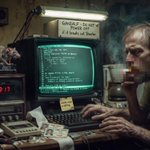
Employee #003
Found him in the corner office. Neckbeard. Low T energy. Fake ID fooled exactly zero people. Nine months on the job — practically the Jurassic.
A VAX rumbled in the corner next to the scary fridge and the ?coffee maker.
He survived the 2025 AI Cambrian Explosion. Back when Claude assigned patient_id to random columns and 136 tables were creative typos of each other.
I asked how foreign keys worked back then.
He wheezed, wiped a tear, took a long drag.
"Foreign keys? UUID was a string. As it should be."
Skeletal fingers flew across the keyboard.
M-x query-replace → "Remove the FCKING em dashes."
1,847 occurrences replaced.
The VAX rumbled approvingly.
The rat didn’t even flinch.
Back to his migrations.
Lifetime job security.
