

Research Scientist ♊ @GoogleDeepMind | Ph.D from @UTAustin | Ex @Google @aws @ Seed @jumptrading | Opinions on my agents, not on my own
xyz
Joined November 2019
- Tweets168
- Following521
- Followers448
- Likes1.1K






Lizhang Chen retweeted

I couldn't find any evidence of sabotage in FrontierCS 2 evaluation or in my own research traces from Opus or Fable. If anything, it looks like I'm the one sabotaging things 😜


Introducing GLM-5.4: Generalized Coding with Our First Loop Transformer.
- Loops existing layers in the GLM-5 base model for deeper reasoning
- Pushes beyond traditional coding to video, games, 3D shaders, and CAD modeling
- Adds vision capabilities for stronger visual coding
API access will open after safety evaluation. Model weights will be released responsibly.
Tech Blog: z.ai/blog/glm-5.4


🥳

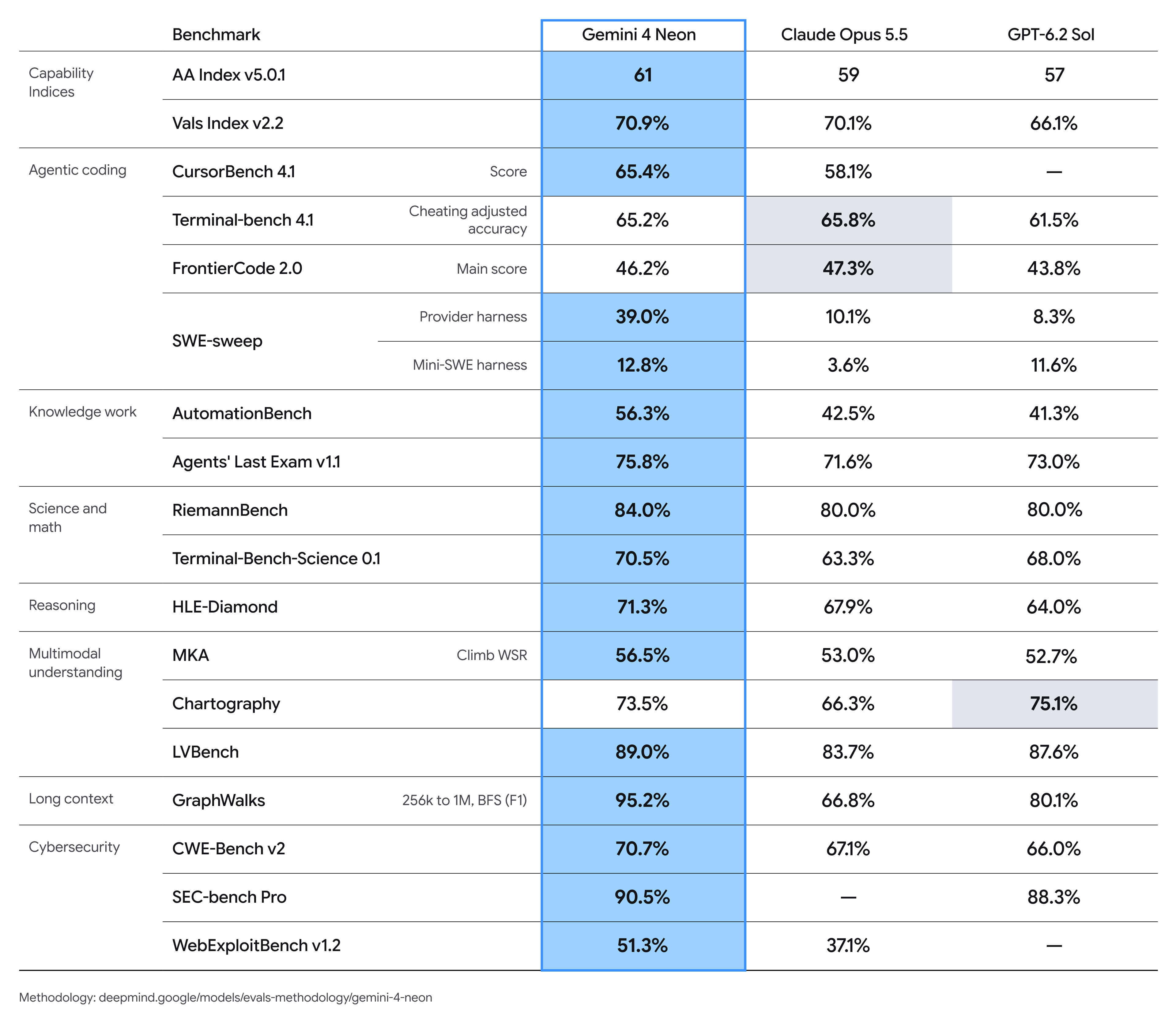
Today we’re introducing Gemini 4 Neon — bringing frontier-level intelligence with fast end-to-end task completion across complex software engineering, knowledge work, and science workflows.
We focused on making Neon better to work with: much improved steerability (#2 on Agent Arena Steering), strong multi-step instruction following, and our lowest fabrication rate yet in internal Google @Antigravity testing. Neon ranks #3 (61 at xhigh) on the Artificial Analysis Intelligence Index — landing just behind larger, slower models — and #2 on the Vals Index on the Pareto frontier.
1
18
1,410
amazing 🤩
You can just make a looped transformer without training.
I took a frozen Qwen3-0.6B and ran 3 layers twice, half a step per pass. On ARC-Easy, accuracy went up without changing wieghts.
All based on "Training-Free Looped Transformers" by @lzchen_ut and co.
This is super easy to hack on and have fun with so try it out.
here's the code: huggingface.co/buckets/burte…
and a fun video with a friendly voice.


Lizhang Chen retweeted
Thanksgiving Blog: Perplexity (on what?) is intelligence 🌟
perplexity is intelligence as OpenAI said, so does perplexity on agent trajectories measure agentic ability?
we found it does not. whole traj perplexity ranks models backwards on Terminal-Bench 2.1.
but on 0.3% of the bytes, perplexity gets the ranking right, and they're the command tokens an agent writes right after reading the terminal.
we call it AgenticPPL, inspired by LongPPL. happy thanksgiving!
Blog: wenhaochai.com/blogs/agentic…
Data starvation? Let us do data-run! github.com/L-z-Chen/data-run


Pretraining should just be called “training”. You can’t have pre and post, but never have actual training. Like, you dress up to work out and then you shower, but don’t actually work out 😂
Unless I’m super missing something, data starvation will be the training challenge next year.
1
284

Lizhang Chen retweeted

Been using Gemini 4 Argon a lot internally and it's truly a game changer!
Research ideas to landings in no time...
Excited to share it externally. More to come

Lizhang Chen retweeted

Importantly Argon has frontier safeguards and we are rolling it out responsibly - it’s with the US gov’t and going to a set of trusted cyber defenders through our Fairwind Program today.
We’re going to make it available as soon as we can and as safely as we can. So hold tight, lots more coming, and you’re going to see us iterating rapidly.
blog.google/innovation-and-a…

The next Muon moment!!!

New historic NanoGPT record at 39.9s (-27.7s) from @DevenPzak , obliterating the prior record of 67.6s!
This record introduces a new paradigm of thinking to NanoGPT: instead of optimizing matmuls or adding more expressive operations, optimize at the individual flop level with incredibly clever engineering and ML judgement. If a flop is low value on a particular step, skip it.
Specifically:
-(~8s) Sampled softmax. If a token doesn’t appear in a batch, skip its lm_head fwd/bwd some fraction of the time.
-Sparse values. Only run an optimizer step for ngram embeddings that occurred in the batch. Set beta1 to zero to enable this. Beta2 is applied retroactively when the row is later used.
-Sparse updates. Only update ngram and value embeddings once every 4 steps instead of once every 2.
-Sparse communication. Shard the n-gram table across GPUs, and only pass the rows receiving updates on each step.
-Sparse optimizer states. For the n-gram table, reduce from 2 floats in Adam optimizer per param, to 1 float per 768 params.
-Hand-rolled flash attention for 64 dim heads.
There are several additions that add accuracy too:
-(~4s) EMA during last 300 steps, combined with lifting final_lr to 0.3 instead of 0.15.
-(~1s) A new optimizer, Anvil2, which expands muon via a second tracked momentum buffer, improves the ortho coefficients, and modifies the cautious weight decay application.
-A couple additional dynamic skip connections in the network.
The most striking consequence of the ‘flop aware paradigm’ is you can grow parameters arbitrarily large,
only limited by the available memory, since you can selectively choose how to expend flops on those parameters on each step. NanoGPT has kept active parameters below 124M, but total is unbounded, and has grown to 640M through embedding sparsity over the last year. This PR takes that to its logical conclusion on the 8xH100, scaling up to 65B sparse embedding parameters, which accounts for 25% of the PR’s gains. At frontier scale, where one is not bounded by an 8xH100, one could imagine where this paradigm could lead.
github.com/KellerJordan/modd…
As this was a very notable PR, I spoke with Deven for an hour to learn how he did it. Here’s his story on the changes: hyperstition.cc/training-nan…

14
1,092
Lizhang Chen retweeted

We believe forcing a ~100,000 bit hidden state into a ~17-bit text token for CoT is a massive bottleneck
This is a wasteful human prior that we should eliminate—following the bitter lesson—by scaling computational depth

We think computational depth is the missing scaling axis, i.e. we should be doing a lot more deep learning!
Every other axis has been scaled by OOMs over the past few years (params, data, sparsity, test-time reasoning), but depth has been stuck at ~100 layers since GPT-3.
We've found that LLMs are both *severely* depth-bottlenecked and bad at using the depth they have, and that architectural interventions that lift this bottleneck efficiently lead to gains that increase with compute.
w/ @akshayvegesna

Lizhang Chen retweeted
Weekend project: What Happened to AutomationBench?
Open models score well on AutomationBench: DeepSeek V4.1 Flash ranks above Claude Fable 5.1.
But how?
Maybe part of the answer is the rubric: some guardrails use simple string-matching !! and fail to serve as reliable checks.
wenhaochai.com/blogs/automat…

Lizhang Chen retweeted

Paper: arxiv.org/abs/2609.19107
Code: github.com/qlabs-eng/scaling…
1/ We start with the intuition that we want to train models with large computational depth for a given budget. To this end, we study three architectural interventions that could achieve a larger depth and help utilize the depth better.
- Model Growth
- Looping
- Boundary Operator