

bullish on https://xitter.cf/t.co/9hyRJWfYZ4 | building https://xitter.cf/t.co/eVtuAqQclX
Joined April 2016
- Tweets300
- Following70
- Followers36
- Likes255








Of course the internet is burning, worst 48h in history of cybersec and @posthog decides to send a marketing email like this.
Congrats, really.

If you rely on coderabbit approving your PRs bro I have very bad news for you.
Stop paying that thing and make your own custom runner reviewer


kids in the 90's: dad can you buy me toys
kids in the 30's: dad can you top up my runpod, I need to fine-tune Qwen 4 27B


It’s official, police officers are proven USELESS, look at this:
On public events, if we completely remove police officers at the entrance, more people can enter the events, less incidents are happening and we cut costs by 100%


ok it's official... AI-written unit tests and integration tests are empirically proven to be unhelpful. you should tell your agents to stop writing tests by themselves
on the deepswe eval set, banning sonnet 5.5 high from writing any tests actually resulted in slightly higher success rate (non stat-sig), with less time and token spent (stat-sig). this is pretty hard empirical evidence
across the tests that were written by the "tests allowed" baseline arm, 65% of them were unit tests, 35% were integration tests, neither bucket resulted in any improvement compared to not writing any tests at all
i also picked a random sample of 44 tasks subset where i completely disabled executing even existing tests - it also did not affect success rate at all
i spot checked many tests written in the baseline arm, and my intuition is that most tests are simply a repetition of the implementation
agent-written tests do not add any value because both the implementation and the tests were simply the agent's interpretation of our intent. the tests aren't any more accurate than the implementation itself
i suspect we can still extract some value from unit tests and integration tests if we describe them ourselves when we believe we can articulate our intent better through test cases than through requirements. but i have not proven this yet
also worth noting, during deepswe eval the agent wrote almost no e2e tests (only 17, compared to 3000+ unit/integration tests written). so this analysis does not prove nor disprove the value of e2e tests - i will do another eval specifically for that

Non-technical people are shipping more than engineers right now.
Why? They don't know what's "supposed to be hard."
New models can do a lot more than you think. Try everything you have in mind, especially the stuff that feels hard.
noooooo the new best model cannot use computer use just like codex, i wish there was a way to basically make it happen, i absolutely see no way, let me use 6.1 sol on the codex app for my computer use tasks!

2 days of shipping in pi-gna! 🤌
Took a weekend shipping the harness of my dreams, computer use included. Next is some sort of remote control with ios
github.com/manuelcecchetto/p…
unleashing 🤌i-gna, the first artisanal italian harness. macOS app for pi.dev
-> github.com/manuelcecchetto/p…

Today I opened vscode by mistake, the new design looks fresh, congrats to the microsoft team!
(I’m never opening it again)
Had my best task so far using my codex compaction strategy!
It reduced median context per tool call from estimated 129k to 65k and total tokens from 71M to 38M (-45%!!)
It also just kept going, on medium reasoning, without /goal, without cutting off short, 0 to 100!

Give your agent a place where it can lament for free and then examine it weekly:
## Lamenting reports: capture tool friction immediately
When meaningful churn reveals a missing or inadequate tool capability, write a short lamenting report immediately, at the point of friction, then continue the task. Do not defer reporting until task completion. Triggers include repeated manual reconciliation, redundant polling or discovery, brittle multi-step workarounds, and missing operations that block reliable verification. Report observed friction, not speculative wish lists or ordinary one-off errors.
Store reports outside the project in `$CODEX_HOME/lamenting-reports/` (default `~/.codex/lamenting-reports/`), creating the directory when needed. Use one Markdown file per distinct gap with a timestamp and descriptive suffix to avoid collisions between concurrent agents. Keep reporting lightweight; update a known relevant report with new evidence rather than repeating it, but do not perform a broad backlog search before continuing work.
Each report should capture:
- Task/context and the operation being attempted, without secrets or sensitive task content.
- Observed friction and evidence: relevant failed attempts, repeated steps, or verification limitations; distinguish measurements from estimates.
- Tools/skills checked, and whether the capability is absent, unavailable/not connected, hard to discover, or present but failing. Do not claim absence without a targeted discovery check; mark uncertainty when unresolved.
- The desired concrete operation, including expected inputs and outputs, and whether an existing tool could be extended.
- The workaround used and its practical impact on effort, reliability, or completion.
Logging a report does not authorize installing tools, changing permissions, or expanding the task to build the proposed capability. Continue with the best available authorized approach. Mention the gap to the user promptly only when it materially affects progress, correctness, or requires their action; otherwise keep the report quiet. If writing the report fails, do not let reporting itself become another source of churn.
I built a tool that lets GPT-6 Astra compact its own context in Codex.
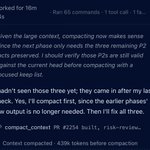
Astra is surprisingly good at knowing when it no longer needs the raw tool results. It writes a checkpoint, requests native compaction, and continues with that checkpoint carried forward verbatim.
In my daily workload with the original patch: 30–40% fewer tokens, with no quality regressions I noticed.
To install, ask Astra:
“Install github.com/manuelcecchetto/c…”

I genuinely think the context-management experiment @thsottiaux and the Codex team shipped was worth pursuing.
My take keeps OpenAI’s native compaction and adds a self-contained checkpoint written by Astra. The summary provides context; the checkpoint preserves the exact handoff.
The goal is to bring down the median context per tool call while getting the same work done!
GPT-6 Astra is so good at… deciding when to compact itself?
I built a Pi package that gives the model a compact_context tool: finish a phase, save what matters, compact, and keep working.
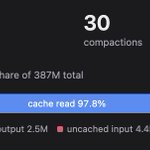
In this run: Astra called it 50 times. Terra and Luna: zero. 👇

All three had the same model-agnostic tool available. Astra used it at phase boundaries; Terra/Luna let context grow until later compactions.
github.com/manuelcecchetto/p…
