
PhD Student at Stanford with Tatsu Hashimoto and Jure Leskovec. Teaching CS336: Language Modeling from Scratch. Previously MIT, Oxford, CERN
Stanford, CA
Joined March 2012
- Tweets34
- Following291
- Followers2.8K
- Likes154


Pinned Tweet
Introducing the world's fastest tokenizer implementation, Gigatoken!
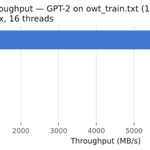
Gigatoken is ~500-1000x faster than HuggingFace, and ~100x faster than OpenAI's tiktoken for most tokenizer definitions on most machines.
These baselines are already multithreaded Rust implementations! 🧵

Marcel Rød retweeted

Deep learning is often taught as a sanitized collection of facts and math. But work at the frontier of AI is messy and empirical.
Our new class, Deep Learning Alchemy, aims to teach the art and science of deep learning in the hands-on spirit of Language Modeling From Scratch.
Students build intuition by running experiments on small LMs, then test it through prediction quizzes: given an unseen code diff, can you predict what happens?
deep-learning-alchemy.github…
My co-instructor @kothasuhas and I think there's significant demand for classes that treat students as serious learners who want to be assessed for what they’ve learned, and so we're trying a new exam-heavy approach to the class (7 exams, 85% of the grade, with the remaining 15% in-person discussion assessments).
We’ve designed the class so students can use AI agents to run their experiments and do their assignment, but they then have to demonstrate that mastery on exams without access to the assignment, and any partial credit on the exam has to come through citations to the assignment, incentivizing them to know what’s in their write-up.
The same assignments and quizzes are public for anyone to try (lecture recordings will be released through @StanfordOnline with some delay). We have some very fun assignments and quizzes covering both classic topics (like NQM, run-to-run stochasticity, and scaling laws) and new and timely topics like muP or hyperball. Made by some real experts like @TristanThrush and @wen_kaiyue
Try some quizzes below!

Marcel Rød retweeted

New historic NanoGPT record at 39.9s (-27.7s) from @DevenPzak , obliterating the prior record of 67.6s!
This record introduces a new paradigm of thinking to NanoGPT: instead of optimizing matmuls or adding more expressive operations, optimize at the individual flop level with incredibly clever engineering and ML judgement. If a flop is low value on a particular step, skip it.
Specifically:
-(~8s) Sampled softmax. If a token doesn’t appear in a batch, skip its lm_head fwd/bwd some fraction of the time.
-Sparse values. Only run an optimizer step for ngram embeddings that occurred in the batch. Set beta1 to zero to enable this. Beta2 is applied retroactively when the row is later used.
-Sparse updates. Only update ngram and value embeddings once every 4 steps instead of once every 2.
-Sparse communication. Shard the n-gram table across GPUs, and only pass the rows receiving updates on each step.
-Sparse optimizer states. For the n-gram table, reduce from 2 floats in Adam optimizer per param, to 1 float per 768 params.
-Hand-rolled flash attention for 64 dim heads.
There are several additions that add accuracy too:
-(~4s) EMA during last 300 steps, combined with lifting final_lr to 0.3 instead of 0.15.
-(~1s) A new optimizer, Anvil2, which expands muon via a second tracked momentum buffer, improves the ortho coefficients, and modifies the cautious weight decay application.
-A couple additional dynamic skip connections in the network.
The most striking consequence of the ‘flop aware paradigm’ is you can grow parameters arbitrarily large,
only limited by the available memory, since you can selectively choose how to expend flops on those parameters on each step. NanoGPT has kept active parameters below 124M, but total is unbounded, and has grown to 640M through embedding sparsity over the last year. This PR takes that to its logical conclusion on the 8xH100, scaling up to 65B sparse embedding parameters, which accounts for 25% of the PR’s gains. At frontier scale, where one is not bounded by an 8xH100, one could imagine where this paradigm could lead.
github.com/KellerJordan/modd…
As this was a very notable PR, I spoke with Deven for an hour to learn how he did it. Here’s his story on the changes: hyperstition.cc/training-nan…

Marcel Rød retweeted

Can an LM, starting from random init (!!), learn to generate all of its pretraining data?
Introducing Self-Play Pretraining with Zero Data. Two models start from random initialization: a generator proposes programs for a universal Turing machine and a learner trains on their outputs. We never train on any real data, but see predictable scaling on natural datasets: zero-shot val loss on images, text, audio, and melodies decreases predictably with self-play compute. And the learner develops in-context learning capabilities.
A fun proof-of-concept, co-led with @AdityaCowsik and @KfirDolev and co-authors @gbruno_dl, @ANourya @noahdgoodman, and @YoavLevine.

Marcel Rød retweeted

Ox-Alpha token counts matches GLM 4.5-5.2 token counts, and their tokenizer is custom, so it's pretty sure. For your amusement, added a row to tokenize.rs/glitch
␣词条初始信息均引自国家企业信用信息公示系统
is a glitch token unique to the GLM series

Marcel Rød retweeted

The models are improving the models.
Locus, our automated AI research system, is SOTA on PostTrainBench and post-trains Qwen3 base models that surpass the human post-trained Qwen3 model.
Today, LLMs post-trained end-to-end by Locus are in production to millions. 🧵👇
PostTrainBench evaluates agents' ability to post-train models on various domains given 10 H100 hours.
We extend PostTrainBench via PostTrainBench+, which has a greatly expanded compute budget that provides clearer signal on automated post-training capabilities. We find that thousands of H100 hours help distinguish methods' performance post-training Qwen3 1.7B-Base models, and that Locus scales best. In this setting, modes trained by Locus collectively surpass the perforamce of the offical human post-trained Qwen3 1.7B model.
In a test of generalization, we ran Locus on all live Kaggle competitions with prize money and public leaderboards. After 16 days, Locus achieved the 4th highest average rank among all participants.

Marcel Rød retweeted

I tried to make a character-level LM joke to @JulieKallini about how this would still be slower than list(s), but then I checked, and Gigatoken is 7x faster than list(s), and like 2x faster than smart variants of list(s)!

If you're curious about how fast Gigatoken will run on your data and with your tokenizer, you can run it without installing Gigatoken using uv:
uvx gigatoken bench <tokenizer-name> <dataset>

I had a lot of fun finding these optimizations over the past year! Thanks to @mdbereket, @percyliang, @tatsu_hashimoto, @jure for feedback and supervision.
Check out Gigatoken on GitHub! github.com/marcelroed/gigato…

Marcel Rød retweeted

Excited to release a new paper today: “End-to-End Test-Time Training for Long Context”.
Our method, TTT-E2E, enables models to continue learning at test-time via next-token prediction on the given context – compressing context into model weights.
For our main result, we extend 3B parameter models from 8K to 128K. TTT-E2E scales with context length like full attention without maintaining keys and values for every token in the sequence.
With linear-complexity, TTT-E2E is 2.7x faster than full attention at 128K tokens while achieving better performance.
Paper: test-time-training.github.io…
Code: github.com/test-time-trainin…

Marcel Rød retweeted

Our new paper, “End-to-End Test-Time Training for Long Context,” is a step towards continual learning in language models.
We introduce a new method that blurs the boundary between training and inference. At test-time, our model continues learning from given context using the same next-token prediction objective as training.
With this end-to-end objective, our model can efficiently compress substantial context into its weights and still use it effectively, unlocking extremely long context windows for complex reasoning and applications in agents and robotics.
Paper: test-time-training.github.io…
Code: github.com/test-time-trainin…
