

Research on the world’s strongest companies (NFA). Join 2,000+ investors:
Groningen, Nederland
Joined August 2024
- Tweets714
- Following328
- Followers1.1K
- Likes931




The best series ever made.
“Der Mensch kann tun, was er will, aber er kann nicht wollen, was er will.”

This week’s episode of Dark Matter was once again really good and complements the other recent episodes of this season, especially E5 and E8, which were also very strong in my view. Congrats to the production team at @SonyPictures / @AppleTV

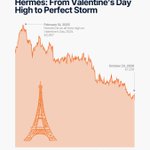
The Hermès thesis has turned into a perfect storm, with the stock down 42% year-to-date. Since Valentine’s Day 2025, the share price of Hermès International Société en commandite par actions has fallen from €2,957 to €1,239 as of today.
Getting back to its former all-time high would now mean a return of +139%. Right now, that level feels like a fading memory from a romantic night in Paris. Several developments are weighing on this negative sentiment. For one, revenue growth in regions like Asia-Pacific has softened in recent quarters (constant exchange rates):
- Q1'26: +2.2%
- Q2'26: +2.5%
- Q3'26: +0.0%
The French company’s total revenue growth over the past three quarters has been (constant exchange rates):
- Q1'26: +5.6%
- Q2'26: +6.7%
- Q3'26: +4.3%
Besides slowing sales growth in Asia-Pacific, recent developments in France are likely to play a role as well. In summary, Hermès is caught in a perfect storm.
The big question is whether and when Hermès can return to double-digit revenue growth and regain full strength. The company currently trades at 28x trailing twelve-month earnings, which is relatively low compared to its recent history. If Hermès reignites its growth engines, that multiple could rebound. However, if the current negative forces continue and intensify, the multiple could compress even further.
The key question we have to ask ourselves as investors is whether Hermès ranks among our best ideas. Accounting for opportunity cost is essential here: each dollar invested in Hermès is a dollar that could be deployed in a more attractive opportunity.
How do you guys view the future of Hermès? Is it among your top ideas? Why (not)? $RMS.PA

Andy Jassy, CEO of Amazon $AMZN, on the incredible demand for compute and the company’s $220B infrastructure investment:

The third season of Netflix’s The Gentlemen (IMDb: 8.1/10) is now in production $NFLX
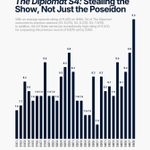
The cast is stealing the show in The Diplomat’s new season, not just the Poseidon.
$NFLX

I just published a new investment letter, including an overview of my current portfolio, my thoughts on three core themes for building a sound portfolio strategy, and why I favor a concentrated portfolio over a diversified one.
massivemoats.substack.com/p/…


This episode has video on Netflix.
An exclusive deal between two of my favorite companies @AcquiredFM & @netflix 🤝


Some thoughts on Hermès $RMS.PA.
If France’s current trajectory continues to deteriorate over the coming years, what could that mean for French companies like Hermès? Beyond the risk of higher taxing on successful companies, could political instability and social unrest gradually change how consumers worldwide perceive “Made in France”-brands like Hermès, as they do not want to be associated with France its decline?
Hermès’ French origins sit at the center of its brand identity and anchor its IP moat: Parisian elegance, craftsmanship, and heritage. So what happens if France continues to loses its prestige?
Can Hermès transcend its national context and stay insulated from a weaker image of its home country? Or would the brand’s status slowly erode as the nation loses its allure and, perhaps, even its culture?

I believe the market currently overestimates the value capture at the model layer and underestimates the value capture at the data center layer.
Jensen Huang (CEO of NVIDIA $NVDA) on why future AI usage will take a lot more inference than the LLMs we know today:

I run a concentrated portfolio. What is not visible from the outside is that I research new prospects almost every day. Lately, I have not found a new idea as strong as my top positions. This is the primary criterion, because I do not want to dilute the portfolio with mediocre ideas. I do not want to add positions merely for the perceived benefit of diversification; I only want top-tier, alpha-generating ideas.
One thing that might differentiate me from most professional investors is that I have a different perspective on risk and do not feel the urge to add new companies just “to feel important” or to chase the currently popular “momentum waves.”
I remain calm. My goal is to expand the portfolio to 6–8 positions in the long term. I believe the right ideas are worth waiting for. While I keep searching, I am curious which recent ideas you are allocating toward that you consider truly exceptional.

In a recent episode of The Modern Investor podcast, @BillAckman shared his perspective on concentration in portfolio management. Some thoughts:
- Concentration starts with the proper set of knowledge. The more you know about investing and the businesses on your radar, the more opportunities you have to be a concentrated investor.
- In addition to the knowledge you have about particular businesses, which forms the foundation for well-grounded conviction, the ranking of positions in a concentrated portfolio should be based on risk and return.
- There is only a small number of incredible businesses with a certain scale. On certain occasions, these businesses trade at a discount. When this happens, provided that you have built up the proper knowledge over the years, you can do a quick assessment and swiftly decide whether to seize the opportunity offered by the market.
- In Ackman’s view, there is a maximum number of stocks to hold to properly benefit from concentration. Beyond 12-15 positions, the incremental benefits are no longer meaningful. In other words, one should ask whether, in a properly constructed portfolio, allocating capital to a new idea (e.g., idea 16) truly pays off compared to the top ideas, Nos. 1-3.
- A certain degree of diversification is still important, however, since investing remains a game in which the unexpected can happen, as Ackman concludes.
Watch the full interview here: youtube.com/watch?v=2kTVSQS2…

Warren Buffett and Charlie Munger at the 1997 Berkshire Hathaway Annual Meeting on wonderful businesses, their fluctuating valuation, opportunity costs, and the self-reinforcing nature of rising prices:

I think few investors who only recently started their investing journey fully grasp how enormous the dot-com boom and bust really was. Between January 1, 1995, and March 10, 2000, when it hit its all-time closing high, the NASDAQ Composite Index soared 571.4%, climbing from $751.96 to $5,048.62. It then collapsed by 77.9%, bottoming out at $1,114.11 on October 9, 2002.
To put that in perspective: after a 77.9% drawdown, an investor needs a gain of 353.2% just to get back to even.

In a recent episode of The Modern Investor podcast, Bill Ackman explained why he expects more attractive investment opportunities in high-quality companies in the years ahead. Three key insights:
📈 Rising volatility from indexation. The volatility in markets is rising due to the rise of indexation, with bigger percentages of equity stakes held by large index funds, which shrinks the effective float. As a result, the marginal buyer and seller will have more impact on price.
⚡ Short-term capital amplifies volatility. Short-term oriented investment strategies, deployed by firms like Citadel and Millennium, tend to capitalize on short-term events like quarterly earnings. This further exacerbates the movement of stock prices, both positively and negatively.
🏛️ Permanent capital is a big edge. Investors with permanent capital have a strong advantage, since they can buy into severely punished stocks and hold them as long as they like, without the perceived pressure to sell these underperforming stocks at the end of the year. This sets up high returns in future years.
Watch the full interview here: youtube.com/watch?v=2kTVSQS2…
I highly recommend reading the latest quarterly letter from Bristlemoon. Some thoughts:
Albeit tracking a net return of -34.8% over the past 12 months and describing a difficult period for the fund, Bristlemoon remains positive and sees immense value in its portfolio companies. Bristlemoon’s top 5 positions as of 30 September were: AppLovin, ASML, PAR Technology, ServiceNow and Timee.
According to Bristlemoon, the sharp price declines across a large group of individual companies partly reflect broader market rotations, which have directed capital toward a limited group of market leaders. For example, ~70% of the S&P 500’s YTD return of ~12.7% (TR) comes from the top 10 contributors, 9 of which are in the semiconductor and AI infrastructure sectors.
According to Goldman Sachs data, ~45% of S&P 500 constituents now have a negative 3-month beta, significantly exceeding the previous peak of ~18% in 2001. Bristlemoon believes this has caused a substantial dislocation between the share prices of the fund’s portfolio companies and their underlying intrinsic values.
Bristlemoon defined a fund manager’s traditional edge as Investment Skill = Information Gathering + Analysis + Judgment. It sees that edge disappearing in the analysis of information and shifting toward the judgment process, supported in part by proprietary data and investigative journalism (e.g., scuttlebutt, with on-the-ground insights via interviews and site visits).
I wrote about this earlier this year as well: the human factor is becoming more important, both in terms of psychological and behavioral skills for investors themselves and in assessing the quality and integrity of company management.
I have also written about the amplification I see in market narratives due to AI, and its effect on share price movements. Bristlemoon sees this exacerbating too. It expects that more investors will be able to use AI to analyze and act on the same information quickly. I believe this, in turn, can intensify both sentiment and movement around stocks, both positively and negatively.
I currently find myself in a similar position to Bristlemoon. While the S&P 500 is up more than 12% YTD, I stand at -6.5% YTD as of 30 September (TR). This is largely driven by my largest position, 3i Group, which lost more than 25% of its market value this year. Like Bristlemoon, I see considerable value in these non-AI companies that are lagging and significantly underperforming a benchmark index which is largely driven by a handful of semiconductor companies.
I therefore share the thrust of Bristlemoon’s letter: be patient, focus on intrinsic value, and in the meantime keep working hard to challenge your assumptions and strengthen your investment process to foster long-term results. In the end, what matters is who goes the furthest, not who makes the fastest start.

We published our September 2026 quarterly letter, with the Bristlemoon Global Fund returning -8.4% for the September 2026 quarter, with a -5.9% return for the month of September 2026, net of fees. We are not happy with these results and they mark a very disappointing last 12 months for the Fund. While we remain excited and optimistic about the Fund's holdings, many of these stocks have continued to derate to depressed levels, despite robust fundamental performance those businesses. We look forward to a time when we can report better news.
In the letter we discuss the lack of market breadth, how AI is commoditizing analysis, and outline our theses on 4 shorts: $CPB, $REA AU, $MBC and $PII.
