

Founder of @vuln_u | Long Island elder emo surviving in ATX | AI and Cybersecurity news from an 18yr industry vet
Joined June 2008
- Tweets48K
- Following2K
- Followers47K
- Likes87K





Pinned Tweet
🚨 Exciting thing🚨 I'm getting back to my content creation roots.
I've missed blogging, podcasting, and community engagement from back before I worked for big companies with scary PR teams.
So... I'm launching a newsletter called Vulnerable U. vulnu.beehiiv.com

Yeah I think Kyle’s take here helped me solidify my own opinion.
Agree wholeheartedly.

I 100% agree that the embargo period for 0days should never be broken by a trusted party, but I think the security industry need to reevaluate how much time these embargo’s could realistically afford to wait now that cyber models exist.
During the KVM escape vuln a few weeks ago, @0x4D31 was able to independently discover the vulnerability within a few hours simply by giving a semi-redacted tweet from the security researcher to a cyber model.
xitter.cf/0x4d31/status/21107976…
We of course respected the embargo period and did not share details, but you can imagine if we were able to do it then anyone motivated enough can as well.
Ultimately I think embargo periods need to be measured in hours, not weeks or months. Vuln discoveries now travel as fast as rumors
Matt Johansen retweeted

When it rains it pours: blog.railway.com/p/security-…
> an unauthorized third party may have accessed encrypted environment variables and, for some of them, obtained the decrypted contents


Matt Johansen retweeted

phucking patch
php.net/archive/2026.php#202…
github.com/php/php-src/secur…
github.com/php/php-src/secur…


GitHub going down on PHPocalypse day is INSANE.

We are investigating reports of degraded performance for Actions, Pull Requests and Webhooks githubstatus.com/incidents/n…

Matt Johansen retweeted

PHP sites behind Cloudflare already have an initial set of WAF rules deployed for the known exploit vectors in these vulnerabilities. The rules are available to all customers, including free.
We are seeing early attacks emerging and are updating mitigations as new vectors show up.
This is a STOPGAP only. Patch as soon as @ThePHPF releases the update at 14:00 UTC today.

Matt Johansen retweeted

An unofficial stopgap is going around:
Set session.upload_progress.enabled = Off until you can upgrade
PHP hasn't confirmed it helps, but WordPress and Laravel don't use the feature
Trellis steps are in the thread along with Cloudflare rules
discourse.roots.io/t/upgradi…


PHP is shipping a security release tomorrow (Oct 21, 14:00 UTC) for two critical vulnerabilities
Re-provisioning Trellis won't upgrade PHP on its own. Here's how to upgrade once the PPA build is out:
discourse.roots.io/t/upgradi…
PHP's announcement: php.net/archive/2026.php#202…

Matt Johansen retweeted

Teamwork makes the dream work.
The team and I
@J4ck3LSyN @Archknight23
🚨 Heads-up for anyone running PHP: two critical RCE bugs, patch drops tomorrow.
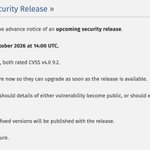
The PHP project has confirmed an emergency security release for two critical remote code execution vulnerabilities: CVE-2026-109618 and CVE-2026-109619, both rated CVSS v4.0 9.2.
📅 Patch lands Wednesday, Oct 21 at 14:00 UTC (9:00 AM Central). PHP has reserved the right to ship it earlier if details leak or exploitation shows up.
PHP runs about 75% of the web, including WordPress, Drupal, Joomla, Laravel, Magento, and countless custom apps. If you operate a PHP server, this is your weekend-ruiner unless you act.
Here's the part the big threat-intel shops aren't shouting about:
No official technical details are public yet. But based on my own source-code analysis of php-src, my best assessment (moderate confidence, NOT officially confirmed) is that the vulnerable path is PHP's session.upload_progress / multipart form-data (rfc1867) handling:
🔹 Present since PHP 5.4
🔹 Enabled by default (the compiled-in default is On; the sample php.ini ships it commented out, so stock installs have it live)
🔹 Processes uploaded request data before any of your application code runs, so it's reachable pre-authentication on a default config
That lines up exactly with the public breadcrumbs: "affects default installs," "every version since 5.x," "fires before user code." Treat it as a working hypothesis, not gospel. The official advisory supersedes all of this when it lands.
✅ What to do right now:
1. Inventory your PHP. Know every host and version (php -v). Anything on PHP 7.x or older won't get a fix, so plan to upgrade.
2. Apply the stopgap (best-intel, low-risk, reversible). In php.ini / .user.ini / .htaccess:
session.upload_progress.enabled = Off
Reload PHP-FPM or your web server. My analysis says this closes one of the two likely paths.
3. Clamp multipart uploads at the edge. The second likely path lives in the multipart parser itself, which runs for any multipart/form-data POST regardless of the setting above. If you've got a WAF or reverse proxy, tighten inspection or rate-limit multipart POSTs to endpoints that don't need uploads. This is the same network-layer mitigation the enterprise vendors are quietly deploying for their paying customers.
4. Patch the second it drops. Current stable: 8.5.11 / 8.4.26 / 8.3.35 / 8.2.34. If your hosting is managed, confirm your provider's timeline today.
Why I'm posting this for free:
A pre-patch mitigation shouldn't be a subscription perk. I'm a one man shop, and the orgs most likely to get burned in the gap between leak and patch are the small teams without an enterprise threat intel contract. The steps above cost nothing. Spend tonight reducing risk, not tomorrow doing incident response.
I'll follow up once the official advisory publishes and confirm whether my root cause read was right.
Stay patched. 🔒
#PHP #CyberSecurity #InfoSec #RCE #CVE #WordPress #Laravel #ThreatIntel #VulnerabilityManagement #AppSec
This quoted post is unavailable.

PHP and SSL CA's being broken in the same week...
It's like finding out all cement would fail this week without remediation.

This is gonna be a bloodbath if Andrew is warning people to go ahead and take any PHP offline until patch drops.

Full details of a remotely exploitable vulnerability in the core engine of *all* PHP versions will be released tomorrow, October 21st. If your organization has internet facing PHP applications then you need to be ready to patch the minute the update is released or *strongly* consider taking the application offline until you can:
php.net/index.php#2026-10-20…

Cat is getting further out of the bag. Here is some tools and tips to help prepare.

Since I heard about this #PHP #RCE last week, I've been preparing a tool for everyone who doesn't know what to do right now:
process-watcher shows you every program your PHP processes start, with full command lines, so you can spot suspicious activity
Until a patch is out, isolation (containers) and tight monitoring are your best bet to limit the damage. And I'm sure the LLMs already go "brrrr" and people are trying to reproduce the vulnerability.
From what I've heard, exploitation will probably show up as suspicious sub process spawns. That's exactly what this watches, using eBPF: one static binary for Linux (amd64, arm64), no dependencies, running in a few minutes. It can also kill the ones you name (dry run first), but it's a detection layer, not a patch, and it can't see anything that happens inside PHP without starting a process.
Quick start: github.com/Neo23x0/process-w…
Project: github.com/Neo23x0/process-w…


📣 There it is, official announcement from PHP. Critical patches coming out tomorrow
Gear up to roll these out ASAP.


Um yes hello… it’s spooky vuln month.
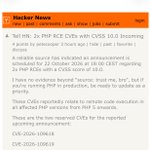
2 CVSS 10 PHP RCEs are dropping. Get ready to patch ASAP once more info drops because time to exploit is going to be measured in minutes not days.

