

Profesor de Periodismo en @UCMccinf | PhD @unicomplutense | Former visiting scholar at @Harvard | Journalism, AI, disinformation & crisis communication
Madrid, Comunidad de Madrid
Joined May 2010
- Tweets970
- Following1.4K
- Followers589
- Likes1.9K







Pinned Tweet
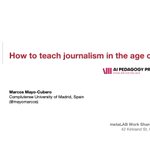
Thanks for sharing this incredible moment! It was an honor to share my work at @metalabharvard with brilliant minds and bold ideas. Truly grateful for the support of @Harvard community and excited to continue collaborating with the AI Pedagogy Project aipedagogy.org💡✨


🤖🪄🌊 Snapshots from August’s metaLAB Work Share & Mingle. AI & art-tech with Harvard summer visiting scholars @mayomarcos (prof & PhD at @unicomplutense) and Khalil Ismail (Innovation Design Engineering at @RCA and @imperialcollege) ⭐


Marcos Mayo-Cubero retweeted

Al lío, que me toca preparar todo bien.
Mil gracias a Pedro Sánchez por atreverse al final en un formato que no le va a ser fácil, y que se une a los otros tres valientes candidatos: Feijóo, Abascal y Colau.
Como ya dije, mi idea es publicarlas todas el día 13 de Noviembre, primer día de campaña.
Las charlas serán mucho más cortas que mi formato habitual: 60-90 minutos, por lo que NO podré abarcar todos los temas que existan, ya os aviso, tendré que concentrar bien y quedarán cosas fuera.
El estilo será incisivo, más de lo habitual en mí, iré a temas delicados y jodidos para ellos y repreguntaré siempre que sea necesario, pero con total respeto y cordialidad.
2 periodistas verificadores estarán en plató por si es necesaria su consulta, tanto si algún candidato me la quiere colar, como si yo meto la pata. No están a mi favor, sino a favor de lo veraz.
Descarto el gran debate a cuatro, y me centraré en hacer otro 1vs1 muy potente, con perfiles top. Ya os iré dando información por si puedo cerrarlo.
Marcos Mayo-Cubero retweeted

Lo que es bueno para el PIB no siempre es lo mejor para mi familia. Hoy salgo en El Mundo (¡mil gracias @rojas1977!) hablando sobre la decisión de aparcar el podcast. El modelo del coste de oportunidad (mirar la renuncia y no tanto lo que añado) es el más útil antes de decidir


Marcos Mayo-Cubero retweeted

Alright, alright. I bit. My latest on The Antidote: My two cents on recent scary tech predictions. The Future Doesn’t Get Predicted — It Gets Produced
carissaveliz.substack.com/p/…

Marcos Mayo-Cubero retweeted

This week I had the honor of speaking to Princeton’s entire incoming undergraduate class to address their AI anxieties. I had three messages for them — good news, bad news, and a note of optimism. Here’s a condensed version.
The good news
We have enough evidence now to conclude that the shrill predictions of rapid, massive job loss were misplaced. Even in a field like software engineering where AI has been rapidly adopted, its effect has been to shift, not replace the role of the human (see the “decide-execute-deliver” framework normaltech.ai/p/why-ai-hasnt…)
Similarly, the panic about what to major in is also misplaced. There will be enduring demand for computer science, philosophy, and just about everything else. (In fact, AI companies hiring philosophers has been a big recent trend.)
The bad news
AI seems to help senior people much more than juniors. I can use AI for coding because I spent 25 years learning how to code, which lets me supervise coding agents effectively. (See my post on the “growth cycle” vs the “dependence spiral” xitter.cf/random_walker/status/2…)
You are in a bind — you can’t offload your skill-building to AI, but you’ll graduate into a market where employers will expect you to get work done with AI. We never faced this dilemma. As a result we haven’t figured out how to revamp our classes to help you do both. You’ll have to help us figure it out. And you’ll need to somehow resist the constant temptation to turn to the shortcut machine.
The hope
My point is not that AI is bad for learning. It’s an incredibly flexible tool. Is the internet good or bad for learning? Depends — are you using it to find research papers or waste time scrolling? I use AI every day for learning. The key is to use it to increase, not decrease your cognitive load. To learn deeper, not faster. There is no learning without the cognitive sweat. I try to make sure I’m mentally exhausted at the end of the day. I do feel that AI lets me push myself harder than I ever could before, and I have a vision that as AI continues to advance it will enable human-AI “co-superintelligence“. (I talked about this at the end of my ICML keynote. normaltech.ai/p/what-will-be…)


There’s a big, under-appreciated reason why people may have very different experiences and opinions about using AI for work — are they using it for tasks they’re already an expert at, or tasks they can’t do themselves? The former leads to a *growth cycle* and the latter leads to a *dependence spiral*.
When I use AI to do something I’m an expert at, like coding, I treat it as a tool. I can build quickly, maintaining an understanding of the code, knowing that if necessary, I can fix the code myself. It feels empowering. It frees up my time to think about the complex, judgment-oriented parts of software engineering that I can’t or won’t delegate to AI. That means my own skills improve rapidly, and I get to climb the ladder of complexity and develop higher-level skills, much more so than when I write the code myself. I feel in control. I can lock in and achieve a flow state — when AI is working, I’m reviewing, building understanding, and planning the next steps. I never get the feeling that the tool is about to replace me. This is the growth cycle.
(Of course, the growth cycle is not automatic. I still need to exercise agency to use AI responsibly. But it’s the same challenge with any productivity-enhancing technology, and those who’ve navigated such transitions before are well-equipped to navigate it with AI as well.)
On the other hand, if I use it for tasks I don’t understand and haven’t learned to perform myself, I have no choice but to treat it as a superintelligence. If something breaks, the best I can do is ask AI to fix it and hope for the best. I generally can’t evaluate the quality of the output myself. The only way to find out if it's any good is if and when the work is ultimately reviewed by an actual expert. The experience is confusing, unsettling and disempowering. And forget about flow state. By over-relying on AI, I risk losing whatever skill I had at the task in the first place, even if it boosts productivity in the short term. This is the dependence spiral.
It’s no wonder that entry-level workers and students preparing to enter the workforce find themselves in a bind. To compete with the AI-enabled productivity of more seasoned workers, they must adopt AI themselves, but doing so risks the dependence spiral. I have some thoughts on solutions that I will share in later posts, but I think having a clear diagnosis of the problem is a useful first step.
Marcos Mayo-Cubero retweeted

Two new Stanford courses are free this fall — and applications close at the end of the month.
Probability for AI and Code in Place X are six-week programs designed for anyone who wants to understand how AI works, not just how to use it. No prerequisites, no experience needed:
pai.stanford.edu | codeinplace.stanford.edu
Marcos Mayo-Cubero retweeted
When it comes to AI, what are people paying too much, and not enough, attention to? What do universities have to offer in conversations about AI? What keeps you up at night about AI?
BKC Co-founder and Director @zittrain shared his thoughts on the state of artificial intelligence as part of BKC’s 3 Questions series.
Watch the full video here: youtube.com/watch?v=rOcglDNy…

Marcos Mayo-Cubero retweeted

Thrilled to see 3 Harvard affiliates leading workshops @ the Public AI Summit!
✨ Olivia Tai (alum/past metaLAB RA) on AI's social life
🔤 Dan Be Kim (@hgse) on finding new language for AI
✍️ Jane Rosenzweig (@HarvardExt) on writing in the AI era
Register publicaisummit.org


Marcos Mayo-Cubero retweeted

Google avisó del terremoto de Venezuela segundos antes del temblor: así convierte los móviles Android en sismógrafos de bolsillo elmundo.es/tecnologia/2026/0…

Marcos Mayo-Cubero retweeted

Hay una lucecita roja parpadeando en las facultades de Periodismo que avisa del agotamiento del modelo.
Porque el futuro del periodismo depende de la calidad humana de quienes lo enseñan y aprenden a ejercerlo.
O formamos periodistas con criterio… o correctores del algoritmo🧵
Marcos Mayo-Cubero retweeted

Periodista – Última Hora (El Confidencial)
Buscamos un periodista para nuestra mesa de Última Hora.
¿Qué pedimos?
* Capacidad de redacción bajo presión. Rapidez y rigor para transformar el flujo de actualidad en noticias con el sello de la casa.
* Uso de la IA. No queremos que nos digas qué es ChatGPT; queremos ver cómo lo usas para ser más eficiente y preciso.
* Experiencia. Se valorará paso previo por secciones de breaking news.
* Turno. El horario habitual será de lunes a viernes con rotación en fin de semana.
* Disponibilidad. Incorporación inmediata.
Si tienes el pulso de la noticia y sabes dominar las herramientas del periodismo actual, envíanos tu CV a [email protected] con el asunto Mesa.

Marcos Mayo-Cubero retweeted

“He llegado hasta aquí por haber empezado en esta facultad” nos cuenta Vicente Vallés en @espacios_dtuatu
Puedes seguirlo en directo aquí: youtube.com/live/PAcHIYnISgM…

Marcos Mayo-Cubero retweeted
Este curso he dejado de pedir trabajos por ordenador a los estudiantes.
Hacen prácticas a mano en clase, debates y exposiciones orales
El cambio ha sido radical
La IA no “mejora” cómo escriben los estudiantes. Al revés. Destruye su capacidad cognitiva
Te comparto mi experiencia🧵
Marcos Mayo-Cubero retweeted

En @A3Noticias buscamos redactores/as para este verano. Si te apasiona la información y tienes ganas de trabajar con nosotros, puedes mandarnos tu CV. Requisitos en el enlace 👇
talento.atresmedia.com/es/si…

Marcos Mayo-Cubero retweeted
Hablemos de salud mental, un tema tabú en las redacciones durante mucho tiempo.
El agotamiento, el estrés y la depresión son un problema real. Afecta al 65% de los periodistas.
Da igual si tienes 30, 40, o 60 años
Veamos cómo desconectar y cuidarnos
Nos jugamos mucho🧵
Marcos Mayo-Cubero retweeted

How to speak: When I was at MIT, everyone knew that this talk by my colleague, AI pioneer Patrick Winston, was one of the Institute's treasures.
unavailable
Marcos Mayo-Cubero retweeted
Nuestra Facultad se posiciona por octavo año consecutivo como la número 1 en España en estudios de Comunicación y Medios. La Complutense es la única universidad española en el Top 50 del mundo en esta materia en el ranking por materias Top Universities publicado ayer.
Por primera vez, la Facultad se sitúa en este grupo de cabeza, en concreto en la posición 45, mejorando la posición de años anteriores que nos situaba entre las 100 mejores del mundo. A nivel del continente europeo, es la 14ª mejor Facultad de Comunicación en 2026.
🔗Noticia completa: ccinformacion.ucm.es/noticia…

Marcos Mayo-Cubero retweeted

¡Odontología en #LaComplutense, el mejor grado de España y entre los 11 mejores del mundo en el @TopUnis by Subject 2026!
Pero eso no es todo:
🐾 Veterinaria, en el puesto 36 y
📢 Comunicación, en el 45, se sitúan entre las 50 mejores del mundo, reflejando el poder multidisciplinar de #LaComplutense
🌍 Además:
✔️ 15 materias entre las 100 mejores del mundo
✔️ 26 disciplinas en el top 3 nacional
✔️ 14 liderando su área en España
🚀 La Complutense no solo consolida su prestigio internacional, sino que proyecta su capacidad para formar profesionales altamente cualificados en ámbitos estratégicos como la salud, la ciencia y la comunicación
ℹ️ucm.es/ranking-qs-by-subject…
#ExcelenciaAcadémica #RankingQS #OrgulloComplutense #EducaciónDeCalidad

ALT La Complutense posiciona Odontología como el mejor grado de España y entre los 11 mejores del mundo en el QS World University Rankings by Subject 2026

Marcos Mayo-Cubero retweeted

El rugby tiene una cosa maravillosa. Cuando un “gordo” que lleva una hora bregando en melés sudorosas sin ver una mierda salvo para placar o chocar, pega una galopada que acaba en ensayo. Gloria bendita para él y los que lo ven pasar.
Marcos Mayo-Cubero retweeted
No hemos aprendido nada
De los creadores de:
Internet salvará el periodismo
Las redes sociales
Google Discover
El vídeo...
Ahora llega:
"La IA salvará el periodismo"
No nos engañemos: la automatización no va a solucionar nada
Sólo los periodistas enamorados salvarán la profesión.
