

Director of Research | AlphaSense | AI | Technology | Former Buy Side | Opinions are my own.
new york, ny
Joined March 2011
- Tweets642
- Following549
- Followers230
- Likes1.4K



michelle brophy retweeted

Interview with an industry expert exploring why closed-source AI models continue to see strong demand despite the rise of open-source alternatives ($ANT, $GOOGL, $MSFT):
- The expert highlights that, based on his experience, AI model usage has shifted significantly toward $ANT's Claude, while $GOOGL's Gemini has seen declining adoption. A year ago, his team initially split usage equally between Gemini and OpenAI's GPT models. However, Claude subsequently became the most widely used closed-source model, followed by GPT, with Gemini accounting for only a minimal share.
- At the same time, he emphasizes that open-source models offer lower operating costs and more flexibility to customize models for specific applications. Techniques such as quantization, distillation, and fine-tuning have further improved their efficiency, particularly for organizations with high AI usage volumes. According to him, combining open-source and closed-source models provides an effective balance between performance, cost, and flexibility.
- The expert believes that open-source models are particularly suitable for handling sensitive company data, as they can be deployed internally without sharing information with external providers. They are also more cost-effective for large-scale, repetitive tasks, especially when companies have their own infrastructure. In contrast, closed-source models generally offer stronger reasoning capabilities and are better suited for complex tasks where performance and accuracy are more important than cost.
- The expert highlights that the choice between major cloud platforms and specialized inference providers largely depends on the specific AI workload. Providers such as Fireworks AI generally offer faster inference and lower latency, making them better suited for real-time applications, although potentially at higher costs. Fireworks AI stands out for its broader selection of open-source models, faster support for newly released models, and stronger serverless inference capabilities. By comparison, major cloud platforms offer stronger data integration, enterprise security, and compliance capabilities.
- According to the expert, AI model usage continues to grow significantly across both open-source and closed-source models, although open-source adoption is increasing at a faster rate. Internally, he has observed open-source model usage growing approximately 1.5–2x faster than closed-source usage over the past year, reflecting increasing adoption of lower-cost alternatives. However, the expert expects closed-source models to maintain strong growth over the next two to three years, as many companies lack the technical expertise and infrastructure required to deploy and manage open-source solutions.
- The expert further emphasizes that despite their higher costs, closed-source models can deliver strong returns on investment when applied to suitable business use cases, supporting continued demand. While technically advanced organizations are increasingly adopting open-source alternatives, companies with limited engineering capabilities remain more dependent on proprietary solutions.


michelle brophy retweeted

What I’m currently building with AI: self-improving Read-through system
This is entirely focused on the Consumer sector – currently at a 55% hit rate (your read-through to ANT = positive – this will need the frontier for a long long time)
Every week, the system goes through the docs hitting our system and puts them through a funnel. From the initial docs, the relevant statements within them expand the set of impacted categories ~4x (ie a TGT probably opines on a handful of end markets being strong or weak).
From that 4x expansion, there’s a screen of what qualifies as a credible read – which brings it back to ~1x.
The system then leverages the very intricate supply chain mapping AlphaSense built to expand the list of companies impacted by the read roughly another 4x based on each category flowing through the criteria of a credible read.
We then run validation layers to make sure the company relationship passes through based on the specific comment (ie was there trade-down, eat at home vs. away, do the product lines overlap, etc) – getting us back down ~0.3x calls, with a strength of signal score.
Every week, it runs an eval of the results. Early on, a good chunk of them were just errors – you could have a share shift that hurts the target company but the initial read would have said positive because of a company level relationship. True logic errors are becoming less common (though that does not mean it got a stock movement right – that’s a much higher bar).
It builds ideas based on US Consumer companies >$3bn mkt cap, trading a full day after the read (not gaming the pre-market) – through the next 42 days (what the system determined to be covering the gap from read-through through target earnings. Not pressure tested)
Read-throughs → Sector supply chain map / relationships → Evals → Self-improvement
Within this, there is one particular strategy that is printing $$ – which is positive read-throughs on beaten down (>10% down) stocks. This part is hindsight though.
Do I expect this Sharpe to continue from just this – probably not.
Where I’m going next is chaining together my pieces:
Read-through system
Channel Check correlation system
Forecasting system which uses prior two as inputs
IC Memo System which uses forecasts and builds valuation analysis through r/r
The concept is that this goes to manual fundamental Hedge Fund depth, but at quantitative scale.
Any quants interested in collaborating, lmk.


michelle brophy retweeted

How does an always-on agent work 24/7 without its bill growing exponentially?
It's the system around the model that enables SuperAnalyst to stay on the frontier while working continuously on your behalf:
- High quality content (signal > noise)
- Search is core, not an afterthought
- Pre-computed context (most exciting new lever- give the agent 'experience' and 'intuition')
- Updates pushed in real time, so the agent acts only on change
- A frontier research sub-agent that brings context to the agent, instead of the other way around.
I'm most excited about SuperAnalyst as infrastructure - fleets of SAs, managed programmatically, monitoring markets, and executing orders of magnitude more and different work than was ever possible before. We're all going to need more GPUs..
This is becoming the reality inside AlphaSense (who do you think pre-computes the context?) and soon available to everyone via our SuperAnalyst API.
Details here: alpha-sense.com/resources/te…

michelle brophy retweeted
The top 1% of AlphaSense users have entered liftoff with SuperAnalyst
Similar to the 10x then 100x engineer
It’s here for finance

michelle brophy retweeted
Interview with an industry expert on how AI is changing the way software gets built ($MSFT, $ANT, $GOOGL):
- The expert says Copilot use has grown sharply this year because people now trust AI far more than they did in 2024, when the expert would have written code by hand rather than spent hours checking a model’s output. Models have matured so much that the expert now hands them a proper spec and only validates a few things, pointing to $ANT's Opus and Fable models as well ahead on software intelligence.
- According to the expert, employees are now fully using AI to build and keep asking for more credits, because with nobody interested in writing code by hand, running out of budget leaves them idle. Each person gets a monthly budget for Copilot and Claude, while Gemini works on a flat fee with automatic throttling. Unused credits flow to others, and extra use goes through leadership approval. The expert expects this spend to double within a year and possibly reach four times today's level in about three years, if it starts producing revenue.
- According to the expert, the return from AI shows up directly in how fast features reach customers. When a client needs a new product capability, the work normally passes through a number of units, which takes many months. With tools like Claude and Copilot, the same team can hand over the architecture and requirements and have features built, tested, documented, and submitted for review in days, cutting delivery time sharply.
- The expert emphasizes that $GOOGL has tried to challenge GitHub, building its own coding environment around Gemini, but is nowhere close to displacing it. GitHub has been the source of truth for code for many years, and the volume of code and solved problems committed there is unmatched, which the expert compares to the gap between Chrome and Bing, where people go to the leader for a reason. The expert also highlights that Copilot works as an interface connecting many models, including those from $ANT, $GOOGL, and open-source providers, so developers are not tied to a single one.
- The expert sees Claude Code and Claude Cowork as well ahead of any other agentic system for software engineering, mainly on accuracy and on integration at speed and scale, and his main advice to the Copilot team is to copy that approach. He believes GitHub is better placed than anyone to close the gap, since codebases across the globe already sit there, so a Claude-like agentic experience in the Copilot desktop app, even at a higher price per license, would be easier to adopt than bringing in Claude, which still has to connect to GitHub. GitHub could also offer the same capability across models beyond $ANT's.


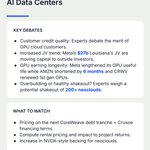
With the help of @AlphaSenseInc's SuperAnalyst we curated recent expert call content on AI infrastructure.
See our SuperAnalyst dashboard ⬇️
alpha-sense.com/data-center-…
The common thread is that hyperscalers still borrow cheaply and are shifting more of their builds into JVs and leases, while lenders are pulling back from neoclouds.
$NVDA $CRWV $META

michelle brophy retweeted
Forgot about how material Govt was -- coming up in checks with big consulting companies and integrators on a reason for Anthropic spend decel


michelle brophy retweeted
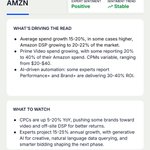
Good color from lots of ad agencies on what's happening with $GOOG search.
Why CPCs rising? Likely tied to AI overviews.
Bear case - reduced invy makes remaining invy more expensive
Bull case - AI overviews not yet monetized
(btw -- query growth highest in last 5 years -- is that including AI expansions of queries?)


$ANT has a few key debates going into its IPO: whether Claude can keep its price premium, whether margins hold up against the compute commitments, and whether the Q3 slowdown was a blip. @AlphaSenseInc Expert Insights and Channel Checks address questions around pricing and how deeply Claude is getting into enterprise customers.
Check out our primer, built by SuperAnalyst: alpha-sense.com/anthropic_da…
And the Channel Check Breakdown Here: research.alpha-sense.com/com…
solana:56DeqXiADWY2Y3iD8pdbpTi9jhXXneofTY5dp4Xjpump $GOOG $META


michelle brophy retweeted
The $ANT S-1 is public. SuperAnalyst built the primer, and it's now live on our site.
This primer not only draws on the S-1, but our Tegus expert interviews, news coverage, and our proprietary Canalyst model for #Anthropic.
Inside, you will find the full company snapshot, compute commitments, the competitive benchmark from enterprise buyers, registered risks and the bull and bear cases side-by-side.
Explore the dashboard: alpha-sense.com/anthropic_da…

michelle brophy retweeted
Updated Token Consumption Tracker
For Anthropic S-1 day, breaking out the surge in Ant tokens based on usage on AlphaSense
Update your models accordingly

$AMD channel checks, Q3 2026: demand is strong
Digging into @AlphaSenseInc channel checks on $AMD, drawing on roughly two dozen expert calls with distributors, server OEMs, integrators, and AI cloud providers. The signal is another beat for AMD, but the story is demand-positive and supply-constrained, not pricing-led. Key debates around component availability and the Helios ramp remain top of mind going into the quarter.
Full Breakdown ⬇️
research.alpha-sense.com/com…
$NVDA $MU

Learn more about AlphaSense Channel Checks: alpha-sense.com/solutions/ch…
1
134
michelle brophy retweeted
My Investment Memo builder in SuperAnalyst is now 🔥 – beats out what I was doing as a HF analyst. I’m looking for people that want to collaborate to draw smaller and smaller circles.
It uses a Canalyst model on my behalf. It reasons to assumptions (depending on type of company, builds out TAM and penetration, models cyclicality, etc), researches what experts are saying about key debates, builds to a valuation framework taking into account Comps / multiple history, etc. Full companion model / backup in excel.
Roll this forward a bit and it’s obvious HFs will be built trading on the back of something like this (much higher volume of getting to decisions faster, neutrally). I’d especially love to collaborate with some of you building AI HFs.
DM if interested – must have AlphaSense account (the skill calls our tools)
$IBM reports Oct 21. Can AI demand offset legacy software weakness?
@AlphaSenseInc 3Q26 Channel Check shows IBM-related business growing 5.6% y/y among 11 experts. Pricing pressure limits conversion.
Full Breakdown Below ⬇️
research.alpha-sense.com/com…
