

Ecologist. Physiologist. Professional seal wrangler.
Woods Hole, MA
Joined January 2018
- Tweets291
- Following208
- Followers368
- Likes236




Pinned Tweet
Excited for this one hot off the press (& while we happen to be at #SMM2022)! Iron and dive capacity as a novel cost of reproduction in a marine mammal. Today at @NatureComms nature.com/articles/s4146…. @WHOI @NSF (NMFS 17411)

Dr. Michelle Shero retweeted

🦭Antarctic Weddell seals may strategically time their most extreme dives, minimizing surface time and maximizing foraging time during daylight hours. @michellershero @WHOI @DanielPCosta2
nature.com/articles/s42003-0…

New paper out today 😊
Weddell seals offset their most extreme dives from mid-day, so they can spend less time recuperating and more time diving during prime foraging conditions.
whoi.edu/press-room/news-rel…

Dr. Michelle Shero retweeted

🦭How does iron impact seal pup survival? #WHOI biologist @michellershero + partners spent much of the winter investigating this question on a remote barrier island off #NovaScotia, supervised by a band of feral horses.
Read all about it: go.whoi.edu/sealsonsable

Dr. Michelle Shero retweeted
⁉️🦭🗺️ #InternationalSealDay Trivia: How far can a gray seal pup travel on its own in a month?
📲 Find out– and see more awesome pics of seals, wild horses, and field work from @michelleshero: go.whoi.edu/gray-seals
📸 taken under permits DFO 23-28A and NMFS 25794 © #WHOI


Dr. Michelle Shero retweeted
🦭🐴 What do you get when you cross gray seal pups + wild horses?
An amazing photograph, for one! But for #WHOI marine biologist @michellershero, it’s just what happens when she collaborates with @FishOceansCAN on #SableIsland, NS!
#NSFfunded with @NSF @TexasTech @UA_System

Dr. Michelle Shero retweeted
The remotely-operated vehicle #ROVJason was just beginning its descent to the #WestMataVolcano, off Samoa when the volcano exploded!
Jason dives have yielded no shortage of breathtaking adventure stories– check out 3 of the most memorable: go.whoi.edu/jason-stories
#NSFfunded
A great example showing why all these Antarctic science projects are so important!
These seals helped map the local bathymetry --- critical to knowing how water masses will interact with warming ice shelves too.

Seals help in assessing the bathymetry around Antarctica - Argos @IMOS_AUS @clive_mcmahon @AntarcticSciAus @Macquarie_Uni @IMASUTAS argos-system.org/seals-asses…
Thank you @ScienceMagazine @NewsfromScience for telling our story. Antarctic science is more important than ever in today's changing world. We just feel 'gutted' by this huge loss. science.org/content/article/…

Dr. Michelle Shero retweeted

The U.S. Antarctic research program is in trouble, as canceled field seasons imperil data sets and demoralize researchers. #LongReads scim.ag/46b
Woohoo! 🙌 Go Macquarie seal team!

It’s been a month since seal tagging on Macquarie Island 🦭 with the Seal Team and @AntarcticSciAus, @IMOS_AUS , @SydneyMarine, @AusAntarctic. Time for an update... 🧵 (1/3)

Dr. Michelle Shero retweeted
🦭 Cuteness alert! 🦭
A #WHOI-led study found that nursing Weddell seals provide so much iron to their pups that they have to limit diving & eating. Sound familiar, moms?
Learn more: go.whoi.edu/weddell-seals
📸 @michelleshero NMFS permit 17411-03
#NSFfunded

Really awesome work in @caroline_rzu 's first dissertation chapter out today! She's been using thermal cameras to 'pull out' and amplify animal respiration and heart rate - using only videos, so completely non-invasive!
This Post is from an account that no longer exists. Learn more
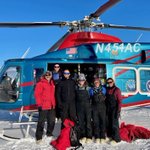
Now that the sea ice is melting and the seals are on the move, B-026 has started traveling by helicopter. Our seals have also been outfitted with radio tags ('pingers') that we can hear using antennas mounted on the helicopters.
NMFS 23273


Meet Orbit! She is the weaned pup B-026 handled today. Orbit's mother is Mary Jackson, a 15-year-old Weddell seal. Mary Jackson has only ever had 3 pups, but she devoted a lot of energy to raising Orbit! Orbit is only one-and-a-half months old, and weighed-in at over 250 lbs! 1/3
We use a little bit of hair dye, which has helped us to find and follow Orbit and Mary Jackson for awhile now. They are part of our project looking at what factors (behavior, physiology, genetics) contribute to variation in lifetime reproductive rates in these top predators. 2/3
Now that Orbit has been weaned, she has to start learning how to forage for herself. It's a lot of hard work for a pup! 3/3
NMFS 23273
@allysonhindle @caroline_rzu @AmyKlink7 @kn_allen @GBMerrjr @WHOI @UNLV
Meet Jennifer Doudna and CRISPR!
Our team is trying to figure out why there is so much variation in how many pups females produce throughout their lifetime - and how this can shape populations (whether it be Weddell seals, or any other species). (1/4)

We've been following this pair for awhile and Jennifer Doudna has been a very attentive mom. Last month, she weighed 383 kg (843 lbs) and now at the end of lactation she only weighs 258 kg (568 lbs) ---- that's 275 lbs she's lost while raising CRISPR! (3/4)