

AI, compute governance, and national security @CNASdc | Co-founder of WISE | personal views only
Washington, DC
Joined May 2014
- Tweets332
- Following512
- Followers649
- Likes1.6K



Great piece by @vivekchil outlining the security vs economics tradeoffs of using open-weight models – and showing that the supposed benefits of these models for “sovereign AI” initiatives are misleading: countries remain dependent on China or the US to release them (and on their infrastructure).
As Beijing and Washington both start to take the risks from advanced AI seriously, it seems plausible that Beijing will eventually close off its open-weight ecosystem. This would undoubtedly change the calculus of the US-China AI race.

Is the door closing on open-weight models as a strategy for AI sovereignty? I break down the trends in a new piece for @CNASdc.

Michelle Nie Duncan retweeted

i sometimes encounter this strange logic where people argue that, if we want to pace ai development, we need to start by expanding our lead over china by speeding up.
as this report demonstrates — there are other ways to widen our lead!
things like countering adversarial distillation and limiting overseas compute access allow us to retain our lead abroad, while pursuing more cautious development at home.

Big new IFP report from @GeorgiaCAdamson, @KonstantinPilz, and me on the US-China AI competition.
We spent the last 6 months digging into how Chinese AI companies’ access to compute and distillation of American models translate into the current US-China capabilities gap.
The result is a 23k-word research report, including an interactive analytical model that visualizes changes in the US AI lead under different policy interventions.
Our findings:
1. The US AI lead over China is currently only around 6 months.
2. The US could roughly double this lead, to over a year, using authorities already available to the federal government.
3. On chips: China’s access to AI chips will roughly double over the next year, with chips housed in data centers overseas accounting for roughly half of China’s 2027 compute.
4. On distillation: the current ~16x US training compute advantage would normally yield a 13-month lead. But we estimate adversarial distillation halves this to around 6.5 months.
5. Increasing the lead would have some obvious benefits:
- Give the US broadly a greater cyberdefensive advantage against Chinese threat actors.
- Give US AI companies breathing room to spend more R&D resources on making their systems safer and more secure, without fear of being overtaken by less safety-conscious Chinese competitors.
6. Provide the US government more leverage in negotiations with China about the future of AI.
7. The two most important interventions are:
- For BIS: Create a new end-use control to restrict China’s remote access to training clusters abroad — China’s largest and fastest-growing source of frontier-scale compute.
- For DOJ/FTC: Create a narrow safe harbor to allow US companies to coordinate on countering Chinese adversarial distillation.
8. Both interventions (and all the others we discuss in the report) are things the federal government could do today.
9. To estimate the effects of each policy intervention, we model the US lead as a function of its compute advantage over China and China’s ability to adversarially distill the capabilities of the US frontier.
10. The model makes many simplifying assumptions, but provides a useful way to assess and rank the impact of different policy interventions at a high level.
Read the full report here: ifp.org/how-to-increase-amer…


Michelle Nie Duncan retweeted

"AI companies such as OpenAI have sought to limit liability for themselves and transfer it to deployers or users."
Watch @michellesnie discuss AI risks and liability on @BBCNews.
Michelle Nie Duncan retweeted
i’m really glad to see OMI come out in favor of standards setting and federal guardrails for catastrophic risks — these questions need more engagement from different corners of the policy ecosystem.
agree with many things here:
- we should use Congressional oversight powers (including subpoenas) to hold executives accountable when their products cause harm; and liability law is a helpful but insufficient protection.
but take issue with others:
- while an SSO may be able to develop testing requirements without an exemption, i’m not confident it could legally organize a coordinated slowdown among the companies.
would appreciate feedback from people w/ relevant expertise.

New in @monthly: Daniel Hanley & Arnav Rao argue that AI companies do not need an antitrust exemption & should instead use a broadly representative, government-supervised standards body to set clear safeguards for frontier AI development. washingtonmonthly.com/2026/1…

I'm getting married and will be offline for about a week.
I recognize there's no crazier time in AI policy world to be offline, but I'm going to try my best to be present for my family and friends and my new husband.
See everyone next week!
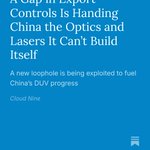
I wrote a Substack post recapping the Zeiss leakage news, why it matters, what other SME chokepoints remain vulnerable (spoiler: Trumpf lasers), and why it's in America and Germany's best interests to close these gaps.


Zeiss advanced optics were one of the most critical chokepoints controlled by the U.S. and allies. This was one of the major reasons China hasn't been able to catch up in EUV yet.
Zeiss lenses were presumed by many to be covered by existing U.S/Dutch controls, since Zeiss is an exclusive supplier to ASML. But it seems that this no longer holds. This is no longer a commercial matter but one critical to national security.
The U.S. should prioritize efforts to coordinate export controls with Germany to keep Zeiss lenses out of China's hands.

Unfortunately, it is one of the actually good coffee shop chains in DC. Also every location usually has free tables, and it’s open later than other options
I always offer Spot of Tea as an option for similar reasons, but few people take me up on it!


Michelle Nie Duncan retweeted

Export controls work.
"Export controls just make Chinese companies work harder or catch up" is propaganda ass shite

Michelle Nie Duncan retweeted

hm...

Actually “this guy” is one of the foremost experts on this topic.
The US does have a say. It has extraordinary leverage over DUV because so much of it is made using US components and knowledge.
Also the Dutch should realize they have a stake in safeguarding DUV too. DUV is being used for AI capable chips which train Chinese AI models. China is actively partnering with Russia, the Netherlands’/EU’s biggest security threat, on military AI. Not to mention China has launched cyberattacks and cyber espionage campaigns on the Dutch. It is in the Dutch interest, too, to stop exporting and servicing DUV.

Yes, DUV is extremely consequential and it's important to close this loophole. Yes, the US could act unilaterally to prevent further exports of DUV through a lever called the FDPR. And, our allies would view this as a very aggressive action.
The bipartisan MATCH Act would require allies to align their SME export controls to ours or face the FDPR. It forces them to take action and gives them a clear timeline and consequences for non-compliance.

CTS co-founder @KonstantinPilz says China makes all its AI chips on Western DUV machines, the US could cut that off tomorrow, and explains why it hasn't:
"China is relying entirely on Western machines to make its AI compute. They are not using EUV, which has been banned since 2019, but they are using DUV, the previous generation. China has rapidly ramped up the amount of DUV they are buying, and the US is just not doing anything about that."
"If the US wanted to, they could just restrict those exports and China would be making way less AI compute."
"Someone goes to policymakers and says, here's my first recommendation, ideally we'd also do this, this, and this. And policymakers are like, oh, maybe we'll talk about the first one."
"We've known about DUV for probably several years now. It's just a very slow process to convince people to actually act on it."
@techstatecraft
Michelle Nie Duncan retweeted
over the past week, I’ve gotten a lot of questions about what independent AI evaluations should actually look like in practice.
what about conflicts of interest between labs and evaluators? will evaluators actually get meaningful access? what if companies just block the publication of unfavorable findings?
these are good and important questions. and we shouldn’t assume voluntary arrangements alone will produce the conditions that credible independent evaluation requires.
so i’m very excited to see 100+ researchers, evaluators, and experts — including us at @AVERIorg — laying out minimum conditions for embedded evaluation, including:
meaningful independence, strong access, transparency / editorial control, protections against retaliation, and a diversity of perspectives and competencies.
and we shouldn’t try to incorporate those principles in ad hoc, one-off agreements, policy is critical to standardizing these safeguards across the industry.
glad to see @aievalforum leading on putting these principles on paper.

Today, more than 100 leading AI experts endorsed a set of minimum requirements to take seriously AI companies' recent call to embed external evaluators.
These evaluators need to be genuinely independent, transparent, and represent a range of expertise areas. They also need to be guaranteed employee-level access and to be protected from retaliation for findings that make companies look bad.
We welcome model developers’ recent calls for independent oversight, but it’s what they do next that matters. The labs must be accountable for ensuring these requirements are met, so that the public can have faith in the process and the outcomes.
Over the past week, the AI community has debated the appropriate role of external evaluation, including who should do it and on what terms. We may not agree on everything, but there is a lot of common ground.
To make embedded evaluations credible, more than 100 experts with varying backgrounds and ideas about AI risk agree in today’s letter that frontier AI developers should:
1. Guarantee embedded evaluators full editorial independence and mitigate conflicts of interest
2. Rely on multiple evaluators with differing viewpoints and areas of expertise
3. Publicly document the terms under which evaluators operate, as well as facilitating permissive publication of methods and findings
4. Shield evaluators from retaliation
5. Grant access equivalent to that of highly privileged employees
There is a thriving and growing ecosystem of independent AI evaluators who are advancing this science every day – but we need aligned standards, guaranteed protections, and independent funding. That’s why we created the AI Evaluator Forum.
Today we are entering our next phase. We’re launching an open call for new members, collaborators, and independent funding sources to help evaluators meet this moment and demand accountability from developers. Join us in building the evaluator ecosystem.
See the public letter here: aievaluatorforum.org/initiat…
Learn more at aievaluatorforum.org/path-ah…

@danielremler and I wrote a piece for @CNASdc about the importance of strengthening, not weakening, export controls ahead of the Xi-Trump summit next week.
Amid fears of recent Chinese progress in everything from AI models to DUV — and discussion about a potential framework for US-China cooperation on AI — some will inevitably argue that export controls haven't worked (or are harmful) and should be abandoned.
We argue the opposite: export controls are more important than ever and shouldn't be weakened at this critical time.

In either case, abandoning export controls at such a critical time would be a national security error. It is still in America's interest to strengthen and widen its technological lead over China.
Read the full CNAS Insights piece: cnas.org/publications/cnas-i…
Great to speak with Louise at @WIRED about US-China dynamics amid discourse about AI cooperation.
