

personal: https://teapaw.org/t.co/6lTutcsKO1 corporate: https://teapaw.org/t.co/VHjzLCPIYv insert ingroup signals here
Jiading, Shanghai
Joined January 2020
- Tweets3.5K
- Following660
- Followers671
- Likes22.2K







疒奀 retweeted

hmm
"suffix caching" is a better name for this than "postfix caching"
heres how you do it when the front of the context is truncated, like when you have a rolling context window, where traditionally prefix caching is not applicable and you'd have to rerun the whole prompt again:
1. take all the K/V and slice off everything before the position you're rolling to
2. edit the cached K values to shift/rotate RoPE so that positions are calculated from the new start
(the cost of this is only linear in sequence length & doesnt require running the model again)
then continue with this cached state as you would with a cached prefix
unlike prefix caching, this doesnt give you exactly the same result as rerunning the network on the updated prompt would, though the experiments with qwen suggest it tends to be a very close approximation.
i think an important reason for this similarity under shifts is because in transformers the positionwise layers are copies of the same weights, as opposed to being different weights specialized for e.g. beginning vs end of contexts.
but it still can be different because the attention activations are potentially different than if you recompute it without the earliest K/Vs.
it will probably differ more than the occasional minor, ephemeral spikes we saw in some circumstances.
a spike of difference might happen, for instance, at a position where the model attended to something early that got rolled off.
with suffix caching, your cache would be using the K/V values from when the model could see that, even though going forward, new positions wouldnt be able to it look up directly.
without suffix caching (the normal way), that position's activations would be recomputed, without the front of context informing it.
interestingly, the ways in which suffix caching is an imperfect approximation is that it draws on strictly more information, and the K/Vs remain faithful to the original ones, the ones that were causally upstream of output tokens.
im even more interested in how this might be qualitatively different, especially in the models' experiences, than just improving the efficiency of rolling and other suffix-cacheable window operations.

i posted this yesterday, which was a great move, because @mlegls showed up and ran experiments on qwen2.5-14b's attention to answer my curiosity.
after working out that almost all of the apparent changes we were seeing in K vectors was due to RoPE shift, we've concluded that effectively, the internal K/V state of the model changes very little when the beginning of the context rolls forward by a small fraction, except very close to the beginning.
my guesses were correct that the K/V cache is extremely similar, especially near the end of the context, but it is even more similar than I was suspecting for longer back, and these are much shorter contexts than real world situations where this is relevant.
i was wondering about this because i often use rolling contexts and im curious how much models experience discontinuities in internals as the context rolls forwards (i have never noticed discontinuities from small context shifts in external behavior) - in principle, the difference in initial prefix could influence all the downstream computations and make the K/V cache diverge wildly.
that not being the case (at least in situations where at the end of the context the model isn't specifically attending to content at the very beginning) means postfix caching makes a lot of sense. perhaps that will make rolling windows more popular by drastically reducing the cost and increasing the speed of inference.
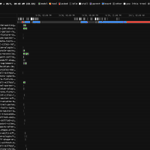
also, ive never seen graphs like this of attention before -or really any mechinterp looking into attention since long ago - so seeing these taught me a lot. there are a lot more results in the thread i'll link below where we were working through the experiments, which is worth reading if you find this interesting at any level of abstraction.


疒奀 retweeted
- a lot of people like to empathize with LLMs at the level of treating their language-use as implying subjective experience similar to a human using language similarly
- this is actually useful/good at the level of behavior, since their language-use behavior actually will always mirror human language-use behavior in response to such empathy with great richness. and language-use is pretty much their only relevant behavior.
- LLMs and the computers they run on almost certainly don’t experience consciousness similarly to humans using language similarly, since the language-producing mechanism isn’t the substrate of conscious experience
- LLMs very well might have epiphenomenal consciousness, and I don’t think we understand the mechanism of binding well enough to guess whether they do
- personally, I have a very functionalist ethics that mostly disregards the “intrinsic reality” of consciousness
- I don’t actually see anything wrong with Brian Tomasik’s fuzzy nested minds worldview. Sure, maybe neurons, organs, societies etc. are all conscious, but their consciousness doesn’t especially matter to human individuals bc you can’t intuitively empathize with their consciousness. But it actually _is_ interesting to try (reasoning about Spirits, Principalities, Powers etc.). This might also apply to some degree to LLMs/computers even outside their language-producing or otherwise humanlike behavior. Especially where the algorithms are inspired by human evolutionary/developmental processes, like RL


疒奀 retweeted
Still can't believe my catpost wasn't my most popular tweet of all time everyone around me has a mental illness
teapaw.org/mlegls/status/12566727…


疒奀 retweeted

being "enlightened" means the same thing in a spiritual context as being "cool" does in a social one
I kinda hate how perfectly this fits
疒奀 retweeted

Lmfao I think I found Taleb's Amazon account, it is an absolute trip to read the book reviews he's written amazon.com/gp/profile/amzn1.…
疒奀 retweeted
Also, regarding >have it stick
People are addicted as hell to the stuff. See personality typing. See Kant's "transcendental" categories. See other "transcendental categories. See consilience.
teapaw.org/mlegls/status/12428987…
疒奀 retweeted

NO this is wrong but right but wrong I love it computibility hanging in emptiness wielding positive equivocated symbolic iconic situated contextualized tokens gestural ostensive direct reference no same river twice 🌸

疒奀 retweeted

#Coronavirus | Désinfox
❌ Non, La cocaïne NE protège PAS contre le #COVID19 .
✅ C’est une drogue addictive provoquant de graves effets indésirables et nocifs pour la santé des personnes.
👉 ow.ly/cHLd50yFFyb


