

34 | research AI since 2021 | ex Binance subscribe to read my blog !
Joined March 2010
- Tweets7.9K
- Following492
- Followers22.8K
- Likes2.8K


Mojunel.eth retweeted

Karpathy's repos just ate my entire AI path
7 repos. 306,741 stars combined. I went through every single one in order.
micrograd came first. About 100 lines of Python for backprop from scratch.
nn-zero-to-hero. 8 free lectures from a single neuron all the way to GPT.
minbpe. Tokenization in minimal code. 10.9k stars. I nearly walked past it.
Every model I touched after minbpe ran better than the day before.
nanoGPT: 64.3k stars but deprecated. Its own README sends you to nanochat.
nanochat: 59.1k stars. About $48 for what cost about $43,000 in 2019.
autoresearch closed the whole chain. 98.9k stars. Agents on 5-minute loops.
About 100 experiments ran overnight while I slept. Kept or dropped by loss.
Each repo stands on the one before it. Skip one step and it all goes dark.
Start with one file


Door + Grok + $25 ticket...
Fictional run wrecked me.
+$57.30 net. 6 seats. $44.30 to Grok.
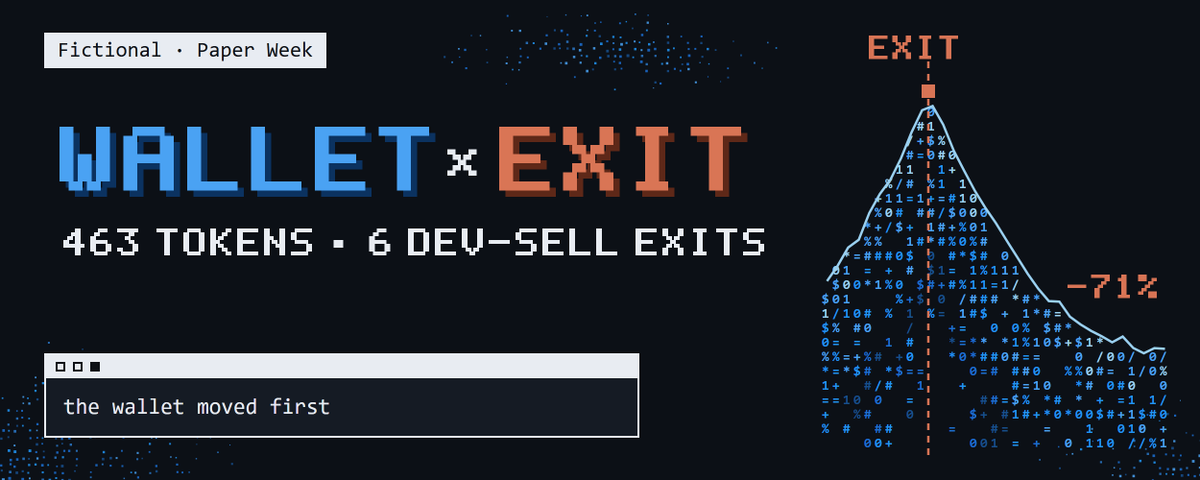
463 → 31 → 6 dev sells.
1. Scan 2. Door 3. Grok
4. Snapshot 5. Watch 6. Exit
5 stopped. 5 timed out.
Median drop after my exit: 71%.
Paper money at screen prices.

A free gist turned Obsidian into a self-rewriting vault
Karpathy's llm-wiki.md defines three operations. Ingest is the one that rewires everything.
Every note app gives you a vault. None of them rewrite the vault when new data lands.
Ingest has one job. Read a new source, build a summary, rewrite every connected page in the vault.
Not "sort my files." Not "add some tags."
One job: fold new material into the knowledge base so nothing contradicts and every cross-link holds.
1. A raw file drops in
2. The model reads it and writes a summary page
3. Every page touching the same topic gets rewritten
4. Cross-links between updated pages regenerate on save
5. log.md records the change
6. Lint catches contradictions on the next pass
claude-obsidian runs this loop at 15.9k stars. mcp-obsidian opens 7 tools to read, search, patch and delete across the vault, 4.5k stars.
One operation, one job. The vault stays current without a single manual edit.
One gist. The vault rewrites itself.
Madness that your coding agent still can't file a ticket
Claude Code starts at $20 a month. every server below gives it hands outside the terminal. tickets, workflows, diagrams, live web. no more copy-paste.
Microsoft shipped the stable MCP C# SDK 2.0 this week on the new stateless HTTP spec.
10 GitHub repos giving your coding agent hands:
01 github-mcp-server → official GitHub server in Go. reads repos, runs issues, PRs and Actions so you stop switching tabs for a single ticket
github.com/github/github-mcp…
02 servers → 7 reference servers, 13 archived and 10 SDKs in one place. start here before building your own
github.com/modelcontextproto…
03 fastmcp → ships your own Python MCP server in a few lines. a million downloads a day. runs behind 70% of MCP servers
github.com/PrefectHQ/fastmcp
04 n8n-mcp → feeds the agent 3,143 n8n node docs and 2,352 workflow templates. it builds automations instead of you reading the docs by hand
github.com/czlonkowski/n8n-m…
05 next-ai-draw-io → the agent draws and edits draw.io diagrams from the chat. 25 model providers, runs as web, desktop or MCP server
github.com/DayuanJiang/next-…
06 gitlab-mcp → 278 GitLab tools, 40 on by default at 12,671 tokens. the full set burns 71,420. keep it lean or context explodes
github.com/zereight/gitlab-m…
07 mcp-atlassian → 98 tools for Jira and Confluence. your agent reads tickets, updates boards and pulls wiki pages. no more tab switching
github.com/sooperset/mcp-atl…
08 tavily-mcp → search, extract, map and crawl the live web. your agent pulls fresh data instead of guessing from stale training knowledge
github.com/tavily-ai/tavily-…
09 exa-mcp-server → web search and full-page fetch in one connection. two tools by default, two optional, two skills for deeper research
github.com/exa-labs/exa-mcp-…
10 mcphub → self-hosted gateway for every server above. control panel on port 3000, five-minute setup, one entry point instead of ten
github.com/samanhappy/mcphub
Start with one. wire the ticket server into your session and file an issue from the terminal.
agent asks → gateway routes the call → ticket server reads issues → workflow server builds the flow → search pulls live context → diagram server draws the result
Every server is open source and free to install. running them still uses your plan's tokens and any third-party API keys the server needs.
Open your config and add one server entry tonight.


Pure f*cking gold for ten dollars
Stockfish rates above 3,600 Elo. This pipeline puts it behind a pair of smart glasses and a WhatsApp call.
You want a board analyzer that works by sight. No typing positions, no copying FEN strings. The glasses watch the board, the engine speaks the best move back.
One Mac, one WhatsApp call, and Ray-Ban Meta glasses. Everything else runs on its own.
1. The glasses stream the board to your Mac through a live video call
2. The Mac grabs frames from the call window, about one per second
3. A cheap filter checks every frame. Board readable, no hand in the way, piece moved
4. Nothing changed, no model call fired. Only real moves hit the expensive step
5. The vision model reads the new board state
6. The app checks it against the last known position. Only legal moves pass
7. Stockfish picks the best reply. About ten seconds from board change to spoken answer
8. The Mac speaks it through a virtual mic into the call
Default model runs at 1.4 cents per frame. Opus 5.5 costs about 4 cents. The whole game sits under a ten dollar cap.
The full pipeline is open source. MIT licence.
The glasses camera runs through WhatsApp's built-in video share. No firmware, no jailbreak. But in any rated game against a human, this is cheating. Platforms ban for it.
Bookmark this.
this guy is a certified freak
A full futures terminal running inside a Minecraft house. TopstepX platform, Nasdaq-100 chart, candles ticking on a wall screen.
The player walks up with a diamond pickaxe and starts working a live order ticket.
Look at what is on that screen:
1. NQU26 Nasdaq-100 contract on a 1-minute chart with active candles and a blue trend line, price ladder reading 29,530 to 29,550
2. Market order execution with BUY +3 MARKET and SELL -3 MARKET buttons, JOIN BID and JOIN ASK right next to them
3. Full position controls including CLOSE POSITION and FLATTEN ALL live on the same ticket
4. Topstep Trading Combine where a 50K account carries a $2,000 max loss limit before the whole thing blows
Prop futures from a block game. Trading desk and game world just collapsed into the same wall.
Save this. The full clip runs below ↓

I don’t understand why everyone isn’t doing this yet. Anthropic released a workflow for Claude Code that turns it into a read-only mobile security auditor, auditing your entire phone in 5 minutes while burning a fraction of the effort.
Main Idea: Read-Only Phone Audit via Claude Code
Instead of guessing what is tracking you or paying for bloated security apps, tasks are executed through a single paste-once prompt with zero writes to the device:
> Role Setup (Mobile Privacy & Security Auditor): Sets strict constraints, read-only access, no modifications, and skips any step requiring a write.
> Five Check Areas: Automatically scans apps (including hidden ones), deep control (accessibility/MDM profiles), permissions, persistence, and network behavior.
> Severity Grading: Categorizes every finding into Low, Medium, or High signals so you know exactly how to respond.
> Actionable Verdict & Lists: Ends with a clean/compromised verdict, followed by three sorted lists (Safe, Worth removing, Needs a professional).
> Critical Safety Protocol: Instructs you not to delete high-severity threats immediately, preventing data loss or alerting an attacker, and advises changing passwords from a separate clean device.
Launch the audit via terminal:
claude --prompt "Run mobile privacy audit in read-only mode"
Configure your Claude Code workspace for security audits:
> In ~/.claude/settings.json, set strict boundaries and lock session limits to effortLevel: high.
> In CLAUDE.md, add a rule requiring safety checks before suggesting any app removal or modification.
> Keep your device connected via adb (Android) or standard diagnostics (iPhone) for read-only access.
Crucial Rule* If something is found, do not delete first. Keep the app installed, save the full audit report, change your credentials on a *second* device, and hand the report to a professional if it's a high-severity threat.
> code.claude.com/docs/en/secu…

It is becoming f*cking dangerous: AI agents connected via MCP just turned an open-source world map and a paper brokerage into an automated geopolitical trading floor.
World Events Agent wires an 89.4k GitHub star intelligence dashboard directly into Alpaca's trading system, giving a single LLM 160 real-time tools to trade global chaos on virtual money 24/7.
The setup constantly scans conflicts, shipping lanes, subsea cables, flights, and market feeds, evaluating trade opportunities every few minutes without human intervention.
The main danger lies in the fact that paper trading hides every real-market friction, latency, slippage, and liquidity don't exist in simulation, making early "wins" dangerously deceiving.
Here is how this automated geopolitical trading stack is built:
> analysts pull 469 news & OSINT feeds across 773 providers to track 29 scored hotspots and 31 instability indexes
> mapping agents link global events to specific energy stocks, gold, or crypto assets
> crowd gates check X chatter, Polymarket, and Kalshi odds to confirm if the market already priced the event in
> execution tools push trade orders to an Alpaca paper account with $100k in virtual funds
Before any order lands, the system runs a three-step validation to filter out noise:
> Written triggers: Plain-English rules (e.g., oil supply risk spikes → watch energy stocks).
> Isolated mapping: A separate model identifies exactly which assets are affected.
> Crowd gate: Passes on trades if public prediction markets already moved.
The real trap is the false sense of security. The dashboard is completely free to open, but running MCP data calls starts at $39.99/month, plus LLM API costs.
More importantly, setting ALPACA_PAPER_TRADE=false flips the entire 160-tool system directly to live, real-money execution without extra confirmations or cooldowns.
If you want to test this stack safely on paper, keep these key setup steps in mind:
1. Connect the dual MCP servers: Load the 95 tools from World Monitor and 65 tools from Alpaca into your agent framework (uvx alpaca-mcp-server).
2. Implement strict crowd gates: Force the agent to cross-reference X and prediction markets so it stops firing on stale, already-priced news.
3. Audit the output, not the PnL: Evaluate performance purely by counting how many trades fired on absorbed events rather than paper profit.
4. Scale carefully: Run the setup on virtual money for weeks to study false triggers before ever considering switching the environment flag.
Before this stack, event-driven trading required a bloomberg terminal, a news desk, and an entire research team. Today, it runs on two MCP servers, a prompt file, and a script.
This is getting wild: I am genuinely surprised more people aren't using this. With this exact framework, I scaled my monthly revenue to $10,000 just two months back.
OpenAI co-founder Andrej Karpathy shared a game-changing concept that went viral with over 24M views. His takeaway? Quit using AI as just a code helper and transform it into your main intelligence hub.
The core mechanic: target a specific folder with Claude Code, throw in all your raw files (PDFs, meeting notes, articles) and let Claude process, connect, and organize them into a self-updating knowledge network. It scales like compound interest, boosting its total value with every file added.
Step-by-step setup:
1. Create a clean Obsidian vault and launch Claude Code inside it
2. Give Claude Karpathy's architecture prompt to set up the system framework
3. Claude automatically builds three main components: a raw directory for uploads, a wiki area for processed insights, and a central CLAUDE.md file
4. Place any document into the raw directory and run the "ingest this" prompt
5. Interrogate your compiled knowledge base at any moment with zero delay
The setup process takes under 5 minutes, which means
you'll never start from a blank screen ever again
Click the link below to get the full setup guide
Save this post so you don't lose it

GENUINELY UNHINGED. TERMINAL TURNED 65 TRADES INTO $1,599.
Someone filmed a green terminal off their monitor with a phone. No name anywhere. Panels just numbered 5 through 8. Full session log:
1. Order book loads ETHUSDT. Bids and asks stacked from 2,476 to 2,482.
2. Radar gates every trade through four checks. Flow, book, speed, trend. Starts at 2/4.
3. All four pass. Ready long. Bracket auto-sizes at 40 ETH.
4. Hold lasts 22 seconds average. Then it fires again.
65 trades that session. 26 per hour. 66% win rate.
Average win $72.88. Average loss $69.76.
Profit factor 2.04. Expectancy +$24.60 per trade.
Latency sat between 35 and 43ms the whole time.
Session P&L hit $1,599, net of fees.
Four numbered panels and a four-check gate that fires a bracket every time all signals line up.
What are your four checks before entry?


builders burn weekends starting from zero. 304 projects mapped, AutoGen in maintenance.
AutoGen at 61k stars runs on patches only. Agent Framework picks up at 14k. awesome-ai-agents maps the full set. MIT, 24 categories in the README, 36 in the YAML. DSPy at 38k, Cognee at 31k, Serena at 30k, all on the same list.
PICK a category from the map
CHECK which of three still ships commits
BUILD on the winner, pull the data as JSON
Dead-repo pick costs months. The full map runs below ↓
THIS IS F*CKING DANGEROUS
76x cheaper per scored setup
smartmoneyconcepts. one MIT indicator marks order blocks, fair value gaps, break of structure and the liquidity sweeps where stops collect. 2.1k stars on GitHub, pandas and numba underneath.
the system stacks six layers on that single install.
> INSTALL - pip install smartmoneyconcepts. computes zones and structure, executes nothing
> CONNECT - Opus 5.5 reads live price data. 4h chart for direction, 15m for entries
> MARK - order blocks, FVG, BOS and every trap level flagged across the pair
> SCORE - Jev rates each setup at $0.0004 per case. a frontier model runs $0.0304 for the same job. 76x the cost gap
> TEST - backtest on Sharpe, max drawdown and win rate. failures stay on paper
> FIRE - only scored and tested setups go live. Telegram pings the phone
the indicator marks zones. no execution, no exchange keys, no latency engine. everything past the markup is the builder's own pipeline.
without the gate before live, every scored setup fires. cheap scoring means nothing if weak setups eat capital at the same speed. one independent Jev trial ran 15 trades over 17 days and closed at net -4.5R. the gate is where the system lives or dies.
the terminal below maps it. order block, trap sweep, price flip, scored entry through the gate ↓
Why isn't everyone using this yet?
Roblox Studio ships a built-in MCP server. Opus 5.5 plugs in at $4 per million input tokens.
The agent edits a clicker game in real time. Chat prompt in, one pass: 426 parts switched off under the map, buttons resized.
1. TYPE a plain edit into the agent chat
2. AGENT reports what changed, area by area
3. STUDIO shows the result. Red lines in the output panel
4. TEST the build. Power, Wins, combat bars, stages all functional
One build pulls 5k a month. Do the math:
DevEx pays $0.0038 per Earned Robux. 5,000 / 0.0038 = 1,315,789 Earned Robux a month.
Minimum cash-out is 30,000 Robux = $114. One withdrawal per month, verified account and W-9 on file.
Full chain in the HUD below: prompt to MCP to Studio to Robux to cash ↓
Five calls, 12 seconds, one Ethereum block.
Everyone tracks latency. The bot only tracks whether the fork clears the floor.
Ethereum clocks 300 blocks per hour. Flashbots routes the bundle to builders. Foundry's anvil forks the chain in memory. Wrong order, and gas burns on every attempt with nothing to show.
> INGEST - blocks and pool reserves arrive by gRPC stream. The moment you poll, you are a block late.
> DETECT - reserves shift, price gap minus fees minus gas. Thousands of passes per minute. Almost always zero.
> SIMULATE - fork current state with anvil or revm, run the trade. Below the floor, it dies here.
> SUBMIT - bundle with a bid routed to builders via Flashbots. Too low: missed block. Too high: validator takes the edge.
> CONFIRM - watch inclusion, reconcile nonce and inventory, log what the chain paid.
A fire-every-block loop costs roughly 0.6 ETH per hour in gas, per the framework's own math (0.002 ETH illustrative per attempt, 300 blocks). Backtest haircut from the same guide: win only 20 to 40 percent of contested blocks.
CONFIRM closes the loop. Nonce updates, inventory reconciles, the log records what the chain actually paid, not the simulation. That log feeds the next block's INGEST. Miss it once, and the bot fires the next 12-second window on a stale nonce and a phantom balance.
One block, five calls, one DROP branch at SIMULATE ↓
Exit price kills the last candle
Loxley on Pons V2. Step 5 of this routine. The opening tax hits 9,900 bps in the launch second and falls to zero in three seconds. The sniper fires only below 300 bps. 33x gate.
> HUNT - scores every launch 0 to 100. Launch farms, serial deployers, exempt wallets, no socials all cut the score
> GATE - waits for the 99% tax to decay under a 3% ceiling. 20 s cap
> FIRE - enters after the crossing. Per-shot size, position cap, session budget
> MARK - reprices every 5 s as a full sell quote for the whole position
Paper only on the site. No wallet, no signer on the page. Live fire runs through the command line on your machine, local encrypted keystore.
Price the position by the last candle and you are reading someone else's trade. Price it by the exit quote and you know what leaving costs right now.
Terminal below ↓ the tax thread drops from 9,900 through the ceiling at 300 bps, the beam fires to the exit node only after the crossing.

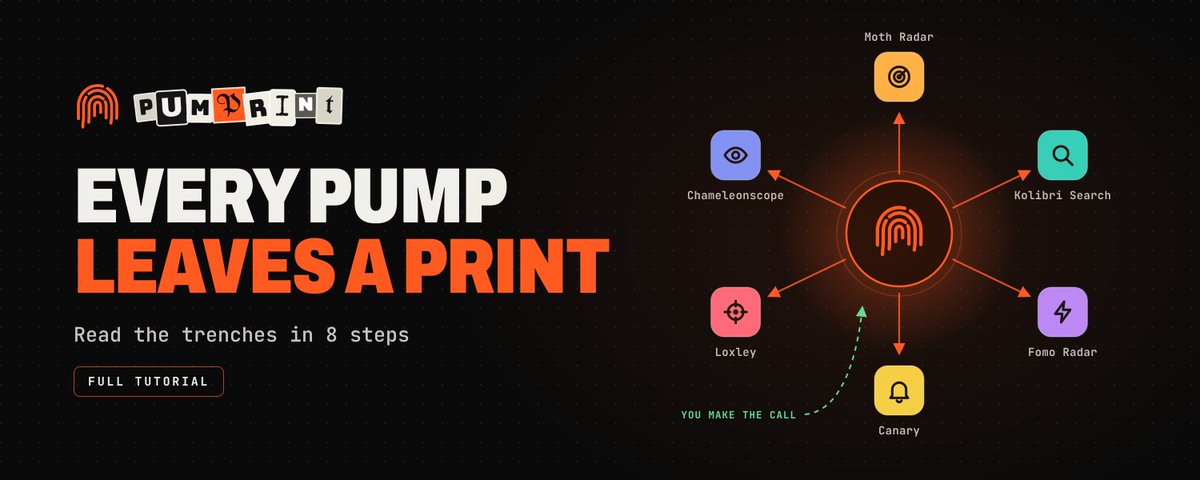
Blind scans are dead. Three grades sort the threat.
Claude Code as a live phone auditor. Five areas scanned, every flag graded on the spot before the output closes.
11 weeks of tracking on one device. Location logged every 2 minutes. The app: no icon, no store listing, named "System Service." One builder's posted case.
How the live sort runs:
1. FLAG - each finding tagged: what it can reach, how long it has been active, where it sends data
2. GRADE - severity low, medium or high. Hidden app with always-on location and no icon hits high
3. SPLIT - graded findings land in three lists. Safe. Worth removing. Needs a professional
4. LOCK - full report stamps saved before any removal lever opens
5. ACT - one verdict line: clean or compromised. One next action at the bottom
Read-only. Your own device. Nothing written, nothing installed.
Deleting a tracker can tip off whoever planted it and wipe the evidence. Save the report, change passwords from another device. Real threat means a professional sees the file before anything gets removed.
The terminal below shows every flag falling through the severity sieves live ↓
Paste once. Basically a five-check read-only phone audit.
Claude Code in read-only mode. Own device. Nothing written.
The prompt drops. Five passes fire in sequence:
→ WALK starts with every installed app, hidden ones included. One case out there: an app disguised as "System Service," no icon, no store listing, location pinged every 2 minutes for 11 weeks, per a posted walkthrough
→ EXPOSE pulls configuration profiles on iPhone, device-admin and accessibility on Android. Who installed each, what it controls
→ CATCH flags any app holding always-on location, mic or camera it does not need
→ HUNT maps anything relaunching on boot or connecting to raw IPs on a fixed schedule
→ DROP. One verdict line: clean or compromised. Three sorted lists: Safe. Worth removing. Needs a professional
Each flag carries severity: low, medium or high. What it reaches, how long it has been active, where it sends data.
Skip the boundary and you burn the evidence. The five passes work because nothing writes to the phone. What the session reads depends on the access you provide.
If something hits the last list: screenshot first, passwords from a different device, professional before deletion.
The terminal below walks the five passes to the verdict ↓
Tracked 11 weeks. Claude Code caught it in five minutes.
One app named "System Service." No icon, no store listing. Location every 2 minutes. Single device, one builder's audit.
WALK - every installed app, hidden ones included
PULL - config profiles, device-admin, accessibility
PIN - outbound connections, fixed-schedule pings, severity HIGH
Removing a tracker can alert whoever planted it and destroy evidence. Save the report first, change passwords from a different device.
Audit tape rolls in the terminal below ↓