






Pinned Tweet
Yesterday, I joined the X Space hosted by @ShareX_Network featuring @Actum_AI, discussing “Beyond Traditional RWA: The Future of the Consumer Economy.”
One idea that stood out to me was the difference between tokenizing an asset and verifying the real-world activities surrounding it.
Imagine a shared power bank network with thousands of devices and daily users. Tokenizing those devices is only the beginning. How do we verify who used them, when they were returned, whether operating rules were followed, and who is responsible when something goes wrong?
This is where ACTUM's Proof of Human-Accountable Action (PoHA) becomes particularly relevant.
As RWA expands beyond traditional financial assets into everyday consumption and the sharing economy, verifiable actions and human accountability become increasingly important.
Blockchain can represent ownership, but ownership alone cannot guarantee trustworthy operations in the physical world.
My biggest takeaway is that Consumer RWA needs more than tokenization. It needs a reliable connection between on-chain records and real-world behavior.
Glad I could join yesterday's discussion. Looking forward to seeing how ACTUM develops this infrastructure.
#Actum #PoHA
🤝 Paid partnership


What if the most important evidence is something that never happened?
Imagine a factory where a mandatory safety inspection must be completed before the next shift begins. The deadline passes, but no verified evidence is submitted.
In a traditional logging system, this could simply appear as an empty record.
ACTUM takes a different approach through its Pre-frozen Denominator and VIRTUAL_MISS mechanism.
When a required action is defined in advance and its time window closes without valid 6D-verified evidence, the missing action itself becomes an auditable, tamper-evident record.
This doesn't necessarily prove that the inspection never happened. It proves that the required evidence was missing.
That distinction matters in industrial operations, where overlooked procedures can lead to serious consequences.
What interests me about @Actum_AI is that accountability extends beyond what people and AI agents do. It also covers what they were expected to do but failed to provide evidence for.
Sometimes, silence is the most important signal.
#Actum

dmann retweeted

Agents tend to optimize for whatever is easiest to score, not necessarily for what the team originally intended.
Once the scoring mechanism is fixed, behavior often shifts around it in ways that are hard to reverse later.
What is the current scoring mechanism quietly shaping agent behavior in your setup? Tell us below @Actum_AI's comment 👇

𝗪𝗵𝗲𝗻 𝘁𝗵𝗲 𝗺𝗲𝘁𝗲𝗿 𝗶𝘀 𝘁𝗵𝗲 𝗹𝗮𝘄
Agents don't follow policy documents. They follow what gets measured.
If you measure speed, you get speed — and shortcuts. If you measure output volume, you get volume — and noise. The meter quietly becomes the law, whether you wrote that law or not.
That's why measurement can't be an afterthought. In Actum, the record is built at the moment of action: who authorized it, what the agent actually did, and what evidence supports it. Human, machine, and AI agent on the same account, checked at entry — not reconstructed weeks later from scattered logs.
Change the meter, and you change the behavior. Make accountable action the thing being measured, and agents optimize for accountable action.
What is your agent optimizing for right now?
dmann retweeted
Moving AI agents from generating insights to placing real trades changes the risk profile completely.
The interesting part is no longer just the model output - it’s how authorization, constraints, and responsibility are handled once capital is involved.
Will you be in the space tonight in two hours?
Data tells an agent what to do. Action is where accountability begins.
Tonight we're joining @AstarterDefiHub and @BOTChain_ai to talk about what happens when AI agents move from research to execution in onchain finance — who authorized the action, what rules it followed, and who answers when something goes wrong.
That's the gap PoHA is built for: human-accountable action, verified at entry, on the same ledger for humans, machines, and AI agents.
📅 Tonight, 20:00 UTC+8 (12:00 UTC) · English
🎙️ Set your reminder and bring your questions.
dmann retweeted
Once AI systems start taking real actions at scale, the ability to reconstruct exactly what happened becomes more important than the ability to generate new outputs.
Most teams still rely on system claims rather than independently checkable records.
How are you currently distinguishing between the two in your own environments? Drop down your thoughts in @Actum_AI's comment 👇
Most AI systems can tell you what they did. Almost none can prove it.
Actum's production network now covers 5,300+ endpoints, with 1,139,000+ verified behavioral events recorded — and roughly 5,800 new events added every day.
Over the past 30 days alone, 174,000+ on-chain attestations were written with zero failures, at 99.986% coverage.
Every one of those events passed the same checks: a pre-frozen codebook, six-dimension entry verification, and a human sign-off before anything counts as verified.
That is what PoHA (Proof of Human-Accountable Action) means in practice — not claims about AI behavior, but a record that can be checked, traced, and assigned to an accountable human.
Autonomy is easy to promise. Accountability has to be built.


dmann retweeted

The future of AI isn't just about what machines can do. It's about knowing who is responsible when they do it.
Think about it: humans make decisions, machines execute operations, and AI agents increasingly operate with some level of autonomy.
@Actum_system
#ACTUM

dmann retweeted
Most AI systems can tell you what they did. Almost none can prove it.
Actum's production network now covers 5,300+ endpoints, with 1,139,000+ verified behavioral events recorded — and roughly 5,800 new events added every day.
Over the past 30 days alone, 174,000+ on-chain attestations were written with zero failures, at 99.986% coverage.
Every one of those events passed the same checks: a pre-frozen codebook, six-dimension entry verification, and a human sign-off before anything counts as verified.
That is what PoHA (Proof of Human-Accountable Action) means in practice — not claims about AI behavior, but a record that can be checked, traced, and assigned to an accountable human.
Autonomy is easy to promise. Accountability has to be built.
dmann retweeted

@Actum_system solves this with Proof of Human Action (PoHA), putting Humans, Machines, and AI Agents on one shared, verifiable ledger. No more "trust me"—just cryptographic proof before any action is executed.
Real infrastructure. Real accountability. 🛡️
#Actum #POHA
🤝 Paid partnership · 🤖 Made with AI

Tokenizing assets is only the beginning. The rules must travel with them.
In its recent communications, @SimpleChain_RWA has been highlighting an important aspect of real-world asset infrastructure: embedding financial rules directly into blockchain systems.
When a real - world asset changes hands, more than a token needs to move.
Ownership rights, transfer permissions, supporting evidence, and financial obligations must remain connected to the underlying asset.
This is the direction SimpleChain is pursuing through its RWA infrastructure.
Its proposed architecture aims to connect verifiable asset data with executable compliance conditions, allowing financial institutions and AI systems to work with more structured and auditable information.
Imagine an asset being transferred between two institutions. Instead of relying entirely on separate documents and manual verification, relevant information and transaction conditions could remain connected to the asset throughout its lifecycle.
That is a meaningful distinction between simply issuing tokens and building infrastructure for real-world financial operations.
SimpleChain's recent updates provide a clearer picture of its development priorities. The next milestone worth watching is how these architectural principles translate into working features and institutional applications.
Tokenization brings assets on-chain. Financial infrastructure needs to bring their rules along too.
#SimpleChain #RWA
🤝 Paid partnership · 🤖 Made with AI

SimpleChain: Building Beyond Asset Tokenization
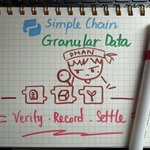
One of the most interesting directions in @SimpleChain_RWA's development is its focus on Granular Data.
In its public development update, the team revealed that it had been working behind the scenes to bring detailed real-world data on-chain, capturing information at its source, preserving its context, and making it verifiable.
This is an important part of SimpleChain's broader vision for AI World Assets (AWA).
Tokenizing an asset is one thing. Maintaining trustworthy information about that asset throughout its lifecycle is another.
SimpleChain's approach focuses on three core functions:
• Verify the underlying data.
• Record information on-chain.
• Support asset settlement.
Rather than treating tokenization as the final destination, SimpleChain is positioning trusted data as a core part of its infrastructure.
I'm particularly interested in following the team's upcoming public development updates to see how Granular Data evolves from its documented architecture into practical applications.
The real milestone will be seeing this infrastructure in action.
#SimpleChain

dmann retweeted
Tokenizing physical objects is becoming straightforward.
The harder part is making every use of those objects verifiable and attributable once they leave the controlled environment.
Tomorrow’s space with @Actum_AI looks at that gap. Will you be joining? 🎤
Tokenizing a power bank is easy. Knowing who used it, when, and under what rules — that's the hard part.
Consumer RWA lives or dies on one question: can every real-world action be verified, traced, and assigned to an accountable human? That is exactly what PoHA (Proof of Human-Accountable Action) was built for.
Join us tomorrow as we discuss what lies beyond traditional RWA — and why trust infrastructure has to come before scale.
📅 Nov 27, 1 PM UTC
Host: @ShareX_Network
Guests: @ocean6_ai @BOTChain_ai @freedaohome @plum_meme
dmann retweeted

Most people juggle 10-15 platforms.
None of them truly know you.
Cognie connects them and speaks up before you ask.
A role that fits you better. A request stuck in a queue.
One life. One enterprise. One system.
Join and start earning rewards
🔗 hub.cerebree.com
🤖 Made with AI
dmann retweeted

4D Labs Thanksgiving Giveaway 🍂
This #Thanksgiving, we’re giving back to our #PhysicalAI community.
30 lucky winners will each receive early access to the 4D App, 100 4D Score, and an exclusive Discord role.
How to enter:
1️⃣ Follow @4Dlabs_Official
2️⃣ Like and repost this post
3️⃣ Tag 3 friends in a reply to this post.
dmann retweeted
𝗧𝗿𝗮𝗱𝗶𝘁𝗶𝗼𝗻𝗮𝗹 𝗟𝗼𝗴𝘀 𝘃𝘀. 𝗣𝗼𝗛𝗔: 𝗪𝗵𝘆 "𝗪𝗲 𝗛𝗮𝘃𝗲 𝗟𝗼𝗴𝘀" 𝗜𝘀 𝗡𝗼𝘁 𝗘𝗻𝗼𝘂𝗴𝗵
Every system keeps logs. But when something goes wrong — an AI agent moves funds, a machine executes the wrong step, a record gets disputed — the first question is always: can we trust the log itself?
Traditional logs have three structural weaknesses:
1. They can be edited after the fact. A log written by the same system it is supposed to audit proves very little.
2. They carry a single timestamp. When an event happened and when it was recorded are collapsed into one number — and the gap between them is exactly where disputes live.
3. They record actions, not accountability. A log line tells you what happened, but not who authorized it or who answers for it.
PoHA (Proof of Human-Accountable Action) was designed to close these gaps:
• Rules frozen before execution — the codebook is locked in advance, so the standard cannot be rewritten after an incident.
• Bi-temporal truth — occurrence time and ingestion time are recorded separately, so late, missing, or out-of-order entries are visible instead of hidden.
• 6D entry verification — every action is checked across time, space, personnel authorization, whitelisted actions, execution elements, and sequence before it enters the ledger.
• Signed attestations with human sign-off — every critical action ends with a specific, authorized human who is accountable for it.
The result is not a log you have to trust. It is a record anyone can independently verify.
Logs tell you what a system claims happened. PoHA proves what actually happened — and who stands behind it.
The Forgotten Kingdom – A Tale of Earth 1088 @projpharos
1/4
Once upon a time, in a world known as Earth 1088, the stars gave humanity a gift called the Light.
From that gift, five bloodlines were born. Each carried a different power, each built its own kingdom, and each believed its destiny was written in the stars.
But every fairy tale has a forgotten chapter.
2/4
Among the five stood the Phäros, masters of visible light. Their king, Vessai, possessed a gift unlike any other. Through sound and vibration, he could reach into the hearts of others and influence their emotions.
The other four tribes feared what such power could become. And so, they made a choice that would change history forever.
They betrayed the fifth tribe and sealed them away in the Never Realm, a place without light or sound.
3/4
Centuries became millennia. Kingdoms rose, memories faded, and the name Phäros slowly disappeared from history.
Yet blood remembers what the world forgets.
Far from the ancient kingdoms, a scavenger named Amin Gage carried the blood of King Vessai without knowing the weight of his inheritance.
Then came Makena, an exile from Helos, who had discovered a truth she was never meant to uncover. Together, their paths led to a forgotten Lighthouse.
4/4
When Amin's blood awakened the Lighthouse, the prison opened. The forgotten Phäros were free at last. But perhaps the greatest secret was never the tribe that had been imprisoned.
The Never Realm was built to contain something else long before the Phäros arrived.
Something called the First Forsaken. And now I wonder...
If the four tribes feared what they had sealed away, what will happen when they discover what was already waiting in the darkness?
I want to explore every forgotten corner of Earth 1088 and uncover the truth behind its legends.
Some stories are not meant to end with "happily ever after."
🤝 Paid partnership · 🤖 Made with AI

1
8
53
dmann retweeted
Tokenizing a power bank is easy. Knowing who used it, when, and under what rules — that's the hard part.
Consumer RWA lives or dies on one question: can every real-world action be verified, traced, and assigned to an accountable human? That is exactly what PoHA (Proof of Human-Accountable Action) was built for.
Join us tomorrow as we discuss what lies beyond traditional RWA — and why trust infrastructure has to come before scale.
📅 Nov 27, 1 PM UTC
Host: @ShareX_Network
Guests: @ocean6_ai @BOTChain_ai @freedaohome @plum_meme

🎙️ ShareX X Space
✨Topic:
Beyond Traditional RWA: The Future of the Consumer Economy
The RWA narrative has largely centered around traditional financial assets. But what happens when tokenization meets everyday consumption, shared resources, and real-world demand?
We are exploring the next frontier of RWA:
✦ The emerging potential of Consumer RWA
✦ The evolution of sharing economy business models
✦ Real-world demand and sustainable economic growth
✦ The role of consumer applications in Web3 mass adoption
Host: @ShareX_Network
📅 November 27, 1 PM UTC
📍 teapaw.org/i/spaces/1VNlkjVNdNEyL…
Featured Guests:
@ocean6_ai @Actum_AI @BOTChain_ai @freedaohome @plum_meme
Let's explore what lies beyond traditional RWA and how the next generation of consumer economies could take shape.
🔔Set your reminder and join the conversation!

dmann retweeted

Plateau Unity Christmas Carols | Nov 27–29 at the 10 Commandments Prayer Altar, Jos.
Come and sing with us.
@ONEPLATEAUFEST
#OnePlateauFest #Plateauunitycarol

What if the most important evidence is something that never happened?
Imagine a factory where a mandatory safety inspection must be completed before the next shift begins. The deadline passes, but no verified evidence is submitted.
In a traditional logging system, this could simply appear as an empty record.
ACTUM takes a different approach through its Pre-frozen Denominator and VIRTUAL_MISS mechanism.
When a required action is defined in advance and its time window closes without valid 6D-verified evidence, the missing action itself becomes an auditable, tamper-evident record.
This doesn't necessarily prove that the inspection never happened. It proves that the required evidence was missing.
That distinction matters in industrial operations, where overlooked procedures can lead to serious consequences.
What interests me about @Actum_AI is that accountability extends beyond what people and AI agents do. It also covers what they were expected to do but failed to provide evidence for.
Sometimes, silence is the most important signal.
#Actum
🤝 Paid partnership
Sometimes, the smartest AI decision is not to decide.
Imagine a factory where a sensor reports that a machine is operating normally, but a technician identifies a potential fault.
Should an AI system immediately choose which source to trust?
Not necessarily. Making a confident decision with incomplete or conflicting evidence could create more problems than it solves.
This is what makes @Actum_AI's Conflict State approach interesting to me. Instead of forcing different observations into a single conclusion, ACTUM describes preserving conflicting evidence so the discrepancy can be investigated.
I think this raises an important point about enterprise AI: good automation isn't just about making decisions faster. It's also about recognizing when the available evidence doesn't justify a decision yet.
In high-stakes environments, knowing when to escalate an issue for human review could be just as valuable as automating routine tasks.
#Actum

dmann retweeted
Last round of the month for the weekly AI fail check, and only one winner this time. ✨
What’s the most expensive or chaotic agent mistake you’ve seen recently that a simple gate before execution could have prevented?
Drop your story in the comments section of @Actum_AI below 📝
🚨 Weekly AI Hallucination / Agent Fail Check — Round 4!
This is the last round of November, and this time we're picking ONE winner.
What's the wildest mistake you saw an AI agent or bot make this week? A trading bot that sold at the bottom? A support agent that hallucinated a refund policy? An automation that looped itself into chaos?
Reply with a screenshot or story + tag @Actum_AI, and tell us how a Circuit Breaker could have stopped it. The best entry wins 10 USDT! 🏆
dmann retweeted
Monthly Giveaway Time | Ends Nov 26, 7:01 AM UTC 🎉
$10 up for grabs, 3 winners. Just hop into the Actum Discord, head to the right destination and hit the button.
You'll need to earn 100+ Points this month to qualify.
discord.gg/Qmah3UWnsw