





I'm pre-registered for the DAC mainnet launch. Mission card in hand — see you at the gate. @dac_chain interstellar.dachain.io/api/…

2
68
AFK Fishing whitelist is live on Solana.
Fish, upgrade, go AFK, and come back stronger.
Join me here:
afkfishing.fun/ref/WKVASZ teapaw.org/afkfishingsol/status/2…
54
MØRTY retweeted

Most people look at RWA and see another crypto trend. I see something much bigger
For years, trillions of dollars worth of assets have existed outside the blockchain world. Real estate. Bonds. Commodities. Private investments
The technology was there
The liquidity was there
The interest was there
But one thing was missing
Trust.
That is why @SimpleChain_RWA caught my attention
Instead of building another blockchain and then trying to figure out compliance later, they are doing the opposite
Verification first
Compliance first
Trusted data first
Then comes tokenization
And honestly, that approach makes far more sense if the goal is real adoption
The future of RWA is not about creating more tokens
The future of RWA is about bringing real value on-chain in a way that institutions, businesses and everyday users can actually trust
That is the idea behind my artwork🎨
A world where traditional assets are no longer trapped in outdated systems
A world where ownership becomes transparent, accessible and global
A world connected through Simple 🌍⚡
The RWA revolution is only getting started
And infrastructure will decide who wins
#SimpleChain #RWA
🤝 Paid partnership · 🤖 Made with AI


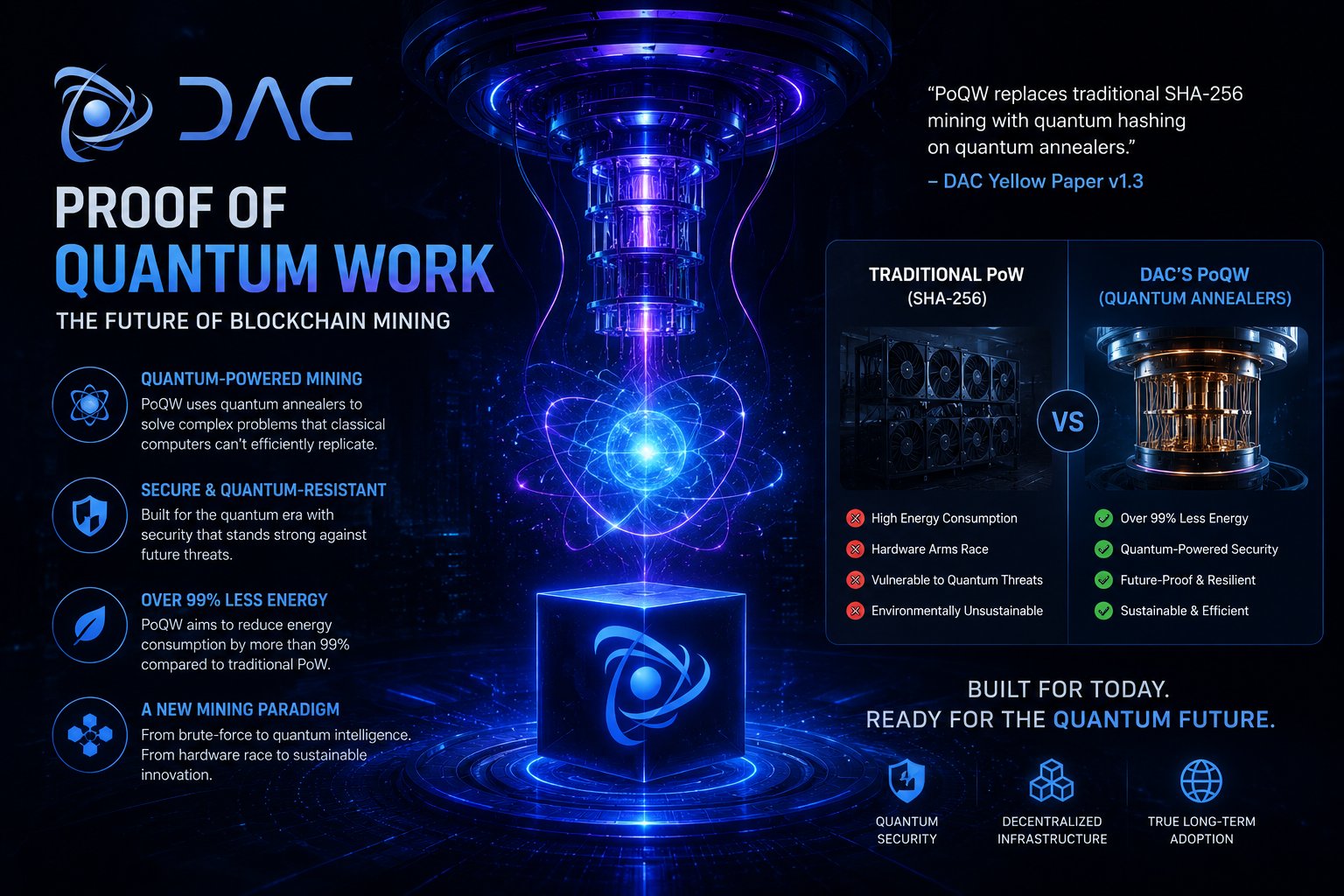
For years, blockchain mining has been a race for more hash power, more machines, and more energy consumption
DAC's Proof of Quantum Work (PoQW) introduces a completely different vision
According to the DAC Yellow Paper, PoQW replaces traditional SHA-256 mining with quantum hashing performed on quantum annealers. Instead of rewarding raw computational brute force, the network relies on genuine quantum computation for block production
What makes this important?
• Classical hardware cannot efficiently reproduce the same quantum process.
• Mining becomes tied to real quantum resources rather than endless hardware scaling.
• The model aims to reduce energy consumption by more than 99% compared to traditional Bitcoin-style mining.
• It creates a path toward blockchain infrastructure designed for the quantum era rather than trying to patch existing systems later
What caught my attention is that DAC isn't only talking about quantum-resistant security. They are rethinking the mining layer itself
If quantum computing becomes a major technological force over the next decade, PoQW could be remembered as one of the first serious attempts to build a blockchain where consensus is native to the quantum age
The future of mining may not be more GPUs
It may be quantum
@dac_chain
#DAC #QuantumComputing #Blockchain #Web3 #Crypto
The quantum clock is ticking. most chains are ignoring it.
@dac_chain isn’t.
Here’s what the 2026 roadmap actually means
supply chains get hacked. records get faked. ESG reports get greenwashed.
DAC fixes this with verifiable provenance on a quantum-resistant chain every step of a product’s journey, immutably recorded and cryptographically protected.
RWAs (real-world assets) are only as valuable as the infrastructure holding them. tokenizing real estate, commodities, or carbon credits on a chain that quantum computers can crack in 9 minutes is not a solution.
DAC’s architecture was built for post-quantum from day one, not patched, not planned, built.
Identity-linked access means only verified parties interact with sensitive workflows. IoT automation runs on-chain, confidential enterprise data stays confidential even from the network itself and when quantum wrapping goes live in Q1 2027, even Bitcoin holders can protect their assets by wrapping 1:1 onto DAC, no governance vote, no waiting for ETH or BTC to figure it out.
Quantum-resistant cryptography isn’t optional anymore.
NIST finalized the standards. Google’s team says 2029 is the deadline @dac_chain already started moving.
🤝 Paid partnership · 🤖 Made with AI

2
47
Season 1 of @The_Beacon_GG goes live May 25 alongside $BCN!
Use my code and get a 50 Gobloonz + 1 Umbra Chest head start on everyone else 👇🏼
app.thebeacon.gg/pre-registe…
3
77
Most blockchains talk about the future. @dac_chain is actually building for it
Real-world use cases of DAC:
🏥 Healthcare medical records stored immutably, shared only with consent via smart contracts
🏭 Supply Chain every product tracked on-chain, fraud eliminated, full transparency
🏦 Banking secure, instant financial transactions without intermediaries
🌱 Carbon Credits ESG data certified and verified on-chain, no greenwashing
🏠 Real Estate tokenized property ownership, transparent land registry
🤖 AI/IoT secure data flow between devices and AI models automatically
But here’s what makes DAC different 👇
Quantum computers are coming. And they’ll break most encryption that blockchains rely on today.
DAC already solved this.
→ Quantum-resistant digital signatures for block validation
→ In 2022, DAC’s team executed a real quantum-secure transaction using actual quantum hardware one of the first in the industry
→ Post-quantum cryptography built directly into the architecture, not added later as a patch
Most chains are built for today. DAC is built for what’s next.
🤝 Paid partnership · 🤖 Made with AI

5
85
DAC runs on a dual-asset system and once you get it, everything clicks
DACT = the governance token. Fixed supply of 1B. You use it to activate nodes, stake, and regulate how DACC gets issued. Think of it as the “key” to the network.
DACC = the native coin. Used for gas fees, smart contract execution, and daily operations. It’s minted dynamically the more activity on the network, the more DACC gets created.
Why two tokens?
Simple: one handles power & governance, the other handles utility & transactions. Separating them keeps the economy stable and scalable long-term.
How to earn DACC on Inception Testnet:
→ Run a Validator Node (need 1,000 DACT)
→ Run a Supervisor Node (need 100,000 DACT)
→ Nodes that participate in consensus get rewarded in DACC every Epoch
Tips from the testnet:
• The faucet can be slow claim early and be patient
• Block time is ~5 sec, so epochs move fast
• Supervisor Nodes earn a bigger share than Validators
Two tokens. One vision. @dac_chain is building infra that actually makes sense 👀
🤝 Paid partnership

3
149

I just claimed my Gold Early Badge on @dac_chain! 1.5x QE multiplier activated 🔥
Join the testnet → inception.dachain.io
5
83
Everyone talks about crypto security… until quantum computing breaks it.
Quantum tech isn’t “future” it’s already being built.
And most blockchains? Not ready.
That’s why DAC Quantum Chain matters.
It’s designed with quantum-resistant security from day one.
Not patched later. Not an afterthought.
Faster computation. Stronger encryption. Future-proof mindset.
If you can’t explain why your chain is safe in a quantum era… it probably isn’t.
@dac_chain is building for what’s coming, not what’s comfortable.
🤝 Paid partnership

6
100
If you can’t explain your yield you’re probably the yield.
Been thinking about DeFi lately…
Most people just see a high APY and hit “deposit”.
No one really asks:
where is this yield actually coming from?
And that’s the uncomfortable part.
Because once you look closer,
that % isn’t as “clean” as it seems.
There’s:
fees, volatility,
impermanent loss,
hidden costs most people ignore.
And suddenly that high APY?
It shrinks. Fast.
Sometimes you’re not even earning you’re the one paying into the system without realizing it.
Because yield has to come from somewhere:
• traders
• borrowers
• liquidations
• token emissions
And if you don’t understand the mechanism,
there’s a good chance you’re the one funding it.
Feels like DeFi is slowly shifting from
“see APY > ape in”
to something more thoughtful.
Where you actually:
model outcomes,
consider risk,
and focus on net returns.
Personally, I like the idea of automating part of this.
Something like @ConcreteXYZ vaults where strategies and rebalancing are handled for you.
Less guessing, more structure.
Because at the end of the day: yield isn’t just a number.
It’s what’s left
after costs and risk.
Explore Concrete at app.concrete.xyz 🚨
🤝 Paid partnership

1
7
79
MØRTY retweeted

Quantum threats cracking PoW is like asking Einstein to do kindergarten math.
The problem was never hard enough.
PoQW doesn't give quantum that advantage. Every variable shifts the problem. There is no easy answer.
That's how DAC secures its chain.

Just applied for @remekoAI allowlist.
remeko.io/join?ref=morty8x
5
71
$150B+ in crypto treasuries are sitting idle.
No yield.
No transparency.
No real ownership for users.
@Fair_Shares changes that.
• Turn idle assets into on-chain yield
• Distribute tokenized shares
• Enable real ownership for users
Stake Contribute Own
This is the missing layer between capital and ownership in Web3.
#FairShares
🤝 Paid partnership · 🤖 Made with AI

1
7
90
i'm now on the @dac_chain waitlist.
Early on the quantum-resistant L1. Aiming for OG-CHIP next.
grab your DAC Q-CHIP: waitlist.dachain.io/ref/DAC0…

8
115
gmcrete 🧱
How do @ConcreteXYZ vaults actually work? Let’s break it down.
You deposit > get vault shares > your balance grows.
Simple on the surface.
But under the hood, this is where DeFi vaults get interesting.
1. Ownership layer
When you deposit into Concrete vaults, you don’t just hold tokens
you own a piece of the system via vault shares.
2. Value layer
Your share value is tracked through eRate
while NAV represents the total value of the vault.
NAV grows = your slice becomes more valuable
3. Execution layer
This is managed DeFi in action:
capital is actively moved through onchain capital deployment
across strategies, not sitting idle.
4. Growth layer
Yield isn’t instant it compounds.
That’s where automated compounding + time do the heavy lifting.
Key insight:
Concrete vaults aren’t just yield tools
they’re systems optimizing capital over time.
The longer you stay, the more the system works for you.
🚨 Explore: app.concrete.xyz
🤝 Paid partnership · 🤖 Made with AI

6
18
181
Explore @ConcreteXYZ at app.concrete.xyz 🚨
DeFi has unlocked a massive opportunity set but it comes with a hidden cost: complexity.
Today’s landscape is fragmented across hundreds of protocols, multiple chains, and constantly shifting yields. To stay competitive, users must actively monitor APYs, move liquidity, claim rewards, and rebalance positions. In practice, this turns DeFi into a full-time operational task rather than a passive capital system.
This creates friction.
Capital sits idle.
Strategies become outdated.
Opportunities are missed.
The issue isn’t access to yield it’s the lack of infrastructure to manage it efficiently.
This is where DeFi vaults change the paradigm.
Instead of manual strategy execution, Concrete vaults introduce a model of managed DeFi, where capital is deployed, optimized, and maintained automatically. Through onchain capital deployment and automated compounding, vaults ensure funds remain continuously productive without constant user intervention.
The result is improved capital efficiency not by chasing yield, but by systematizing how capital moves.
Concrete vault architecture is built around structured coordination:
• Allocator → actively deploys capital
• Strategy Manager → defines the strategy universe
• Hook Manager → enforces risk parameters
Together, these components transform DeFi into programmable financial infrastructure rather than manual execution.
A clear example is Concrete DeFi USDT, offering ~8.5% stable yield. Instead of requiring users to actively manage positions, the vault handles rebalancing, compounding, and optimization behind the scenes delivering a smoother and more sustainable experience aligned with institutional DeFi standards.
As DeFi continues to evolve, complexity will only increase.
Manual strategy management does not scale.
The future belongs to infrastructure where vaults become the default interface, and success is defined not by who finds yield fastest, but by who builds the best systems to manage capital.

5
13
84
I don't want to throw around big words until I've fully explored the ground myself. Right now @RAFA_AI is on my radar: I'm sitting in Discord, studying the atmosphere and waiting for my role. Who's already there?
Is there any point in flying in or what? 👇
🤝 Paid partnership · 🤖 Made with AI

18
201
DeFi spent years chasing the highest APY.
But serious capital doesn’t chase numbers it evaluates risk-adjusted yield.
Two strategies can show the same returns, yet carry completely different risks:
volatility, liquidity issues, impermanent loss, or slippage during market stress.
This is why the next phase of DeFi is moving toward smarter onchain capital allocation.
Instead of manually jumping between protocols, managed DeFi strategies and DeFi vaults are starting to automate the process optimizing positions and enabling automated compounding of rewards.
Platforms like Concrete vaults are part of this shift.
They focus on structuring strategies around sustainable risk-adjusted yield, not just headline APY.
And that’s exactly the kind of infrastructure needed for institutional DeFi to scale.
The future of DeFi isn’t yield chasing.
It’s intelligent capital allocation.
#ad

7
95
Web2 gave us scale.
But it also gave us gatekeepers.
Most cloud platforms operate like walled gardens.
Upload your data and you’re no longer fully in control.
Monetization, distribution, even visibility can be restricted, demonetized, or removed.
That’s the structural gap.
@shelbyserves is trying to redesign this layer.
Instead of passive storage, it introduces programmable infrastructure where usage rules are embedded at the protocol level.
Who can read the data.
When.
Under what conditions.
Monetization isn’t optional paid reads route micropayments back to creators and node operators automatically via smart contracts.
The model is compelling.
But there’s an open question: once data is downloaded, enforcement shifts beyond the protocol into legal or DRM territory.
Still, as an attempt to rebalance control in Web3 storage, Shelby is worth watching.
#Shelby #aptos #Web3

7
16
205