
Digital Assets
Indonesia
Joined July 2023
- Tweets344
- Following852
- Followers68
- Likes2.4K
Rafi Nugraha retweeted

You thought this was a bad week in crypto? You might have missed the bigger news.
Two results just landed on elliptic-curve cryptography. Both are worrying. Neither one breaks a key anyone uses today.
1️⃣ The problem under ECC is less hard than we thought.
ECC is secure because the elliptic-curve discrete log is hard. The best general algorithm we had was Pollard's rho, and it is exponential: add bits to the key, and breaking it gets exponentially harder.
That assumption is now false, with one caveat. A paper from Bochum and MPI-SP gives a subexponential algorithm. It assumes an OpenAI claim that is still under review. If the claim holds, the new algorithm is faster asymptotically. In practice it changes nothing. On secp256k1, P-256, or Ed25519, rho is still the best algorithm, and it still takes the age of the universe. The new one only pulls ahead on hypothetical curves of enormous size, and there the cost is even more absurd.
github.com/bochum-crypto/sub…
2️⃣ The quantum circuit is getting cheaper. The computer is not here.
We still have no quantum computer. The circuit that would run on one to break ECDSA keeps getting cheaper. ecdsa.fail is a public auto-research loop aimed at exactly that. Its current best is about 70% cheaper than the circuit Google reported, on logical qubits times Toffolis (0.91 billion against 2.99 billion). Google's circuit was already two to three times cheaper than the previous published one.
Alice & Bob @Alice__Bob , a French Quantum Computing company, just estimated that breaking secp256k1, the Bitcoin curve, takes at most about 30,000 cat qubits and one hour. That figure assumes a machine nobody has built. We are still far from it. The machine being asked for keeps getting smaller.
eprint.iacr.org/2026/2665
What a crazy time to be alive.


Rafi Nugraha retweeted

I recently read a comment attributed to OJK’s Chairwoman suggesting that investors are attracted to Indonesian banks because the sector enjoys some of the highest net interest margins (NIMs) in the world.
As an investor, I understand the attraction. As an Indonesian citizen, I find the underlying economics deeply frustrating.
Consider the latest available NIM figures: BBRI 7.7%, BBCA 5.6%, BMRI 4.4%, BBNI 3.3%, banking industry 4.3%.
From a shareholder’s perspective, wide interest margins are attractive because they support profitability and returns on equity. But from the perspective of households, entrepreneurs and industrial companies trying to access financing, those margins raise a much more uncomfortable question: Why does financial intermediation remain so expensive in a country that desperately needs investment, productivity growth and industrial development?
Every additional percentage point in the cost of borrowing matters. It raises the hurdle rate for new factories, machinery, logistics infrastructure, working capital and business expansion. Projects that might be economically viable with cheaper financing become unattractive, while smaller businesses without access to international capital markets are left paying substantially more than their larger competitors.
And this is precisely where I think the regulatory mindset needs to change.
The objective of a banking system should not be to maximize the spread between what depositors receive and what borrowers pay. It should be to mobilize savings efficiently and allocate capital productively throughout the economy.
Of course, NIM is not identical to the lending-deposit rate spread, and high margins can partly reflect legitimate differences in credit risk, operating costs, funding structures and loan composition. BRI, for example, has substantial exposure to microfinance, where smaller loan sizes and higher servicing costs naturally require higher yields. We should not pretend that every percentage point of NIM represents excess profit.
Nevertheless, Indonesia’s persistently high banking margins should prompt a serious discussion about competition, market concentration, financial inclusion and the structural cost of capital.
Consider a simple illustration. A 100-basis-point reduction in borrowing costs on Rp5,000 trillion of outstanding loans would save borrowers approximately Rp50 trillion annually, assuming the reduction were fully passed through. At 300 basis points, that becomes Rp150 trillion a year.
That is an enormous amount of financial capacity that could potentially be redirected toward investment, consumption, employment and business expansion. These are illustrative savings, not estimates of excess bank profits, and the economic benefits would depend on how the reduction was achieved.
What frustrates me is that Indonesia continues talking about downstream industrialization, manufacturing competitiveness and becoming a developed economy, while relatively expensive domestic financing remains a structural obstacle for businesses trying to compete internationally.
We cannot seriously expect Indonesian industrial companies to compete with manufacturers in countries where financing is more accessible and affordable, while simultaneously treating exceptionally high banking margins as an achievement worth celebrating.
The goal should be a larger banking sector built on greater financial inclusion, deeper credit penetration, stronger competition, better risk assessment and lower intermediation costs, rather than preserving unusually wide margins on a relatively narrow customer base.
Banks should absolutely remain profitable and adequately capitalized. But the healthiest banking system is not necessarily the one extracting the highest margin from each borrower. It is the one that can finance a much larger share of the economy efficiently, sustainably and at competitive rates.
A high NIM might be good news for bank shareholders. But it is not automatically good news for the country.
And when the regulator appears more enthusiastic about the former than concerned about the latter, I think Indonesians have every reason to question whether our financial system is serving the broader economy as effectively as it should.
Rafi Nugraha retweeted
Impressive work from the recent math drops, the unit-distance counterexample, the sub-n log n multiplication result, and the 3SUM/APSP improvements are genuinely humbling for prior intuitions.
That said, treating a classical ECDSA break in months as a planning baseline still looks like FUD.
A practical private-key recovery attack on secp256k1 (or similar curves) on available hardware would not stay confined to Bitcoin and Ethereum. It would compromise TLS, code signing, most banking systems, and a large fraction of deployed public-key infrastructure at once.
Hash-based schemes are attractive precisely because they minimize algebraic structure, but the same loss of mathematical intuition that motivates caution on curves also applies to hashes ;-)
A calm hygiene improvement (avoiding address reuse after the first signature) is reasonable for large holders, and all good wallets incentivizes using new addresses.
But calling for a “mass migration” would create operational mistakes that lose funds with higher probability than the scenario being mitigated.
We already have a Post Quantum migration to execute, let's not add more confusion.

Today I call upon the blockchain industry to calmly begin planning for "bunker mode". My personal recommendation is to set in motion a controlled mass migration of assets to fresh addresses, i.e. addresses whose pubkeys remain hidden behind a hash.
Holders, starting with large and sophisticated ones, should consider moving the bulk of their funds to addresses that have never signed a transaction. And when they do sign one, they should also move remaining funds to a new address (possibly generated from the same seed phrase).
Don't rush. While I believe there is cause for action a rushed migration would do more harm than good. Don't panic either. Moving assets to protected addresses is a simple, preventative step which does not require new cryptography or new wallets.
IMO it is now reasonable to brace for the possibility that ECDSA breaks before qday, in the worst case in months not years. By "break" I mean fast private key recovery (e.g. in one week) on available hardware (e.g. a large GPU cluster).
Recent days have been humbling for human mathematical intuition. Long-held, unquestioned hypotheses have fallen. This includes the n log(n) bound for integer multiplication and the 3SUM conjecture. In hindsight, May's unexpected disproof of the Erdős unit distance conjecture was our warning shot.
Yesterday's OpenAI drop made it clear that mathematical superintelligence is upon us. They say there are weeks where decades happen. We are about to live through weeks where centuries of mathematical progress happen. Could our magic 64-byte ECDSA signatures be too good to be true? Was it just security through obscurity all this time?
Elliptic curves feel especially vulnerable to superintelligence. Curves carry rich structure, with room for fancy tricks like Schoof, Frobenius, pairings. (By contrast, hashes are designed to minimise algebraic structure.)
Separately, as Ewin Tang can attest, an efficient quantum algorithm sometimes foreshadows an efficient classical one. We should be open to the possibility of a classical counterpart to Shor that breaks elliptic curves and RSA at once.
Also noteworthy is the striking under-representation of cryptographic breakthroughs among the 722 mathematical results OpenAI published. I've witnessed first-hand the US government censoring academic quantum cryptanalysis results. Backroom interventionism is my base case.
I urge large, sophisticated actors to lead by example. Project11's "risq list" (bitcoin-risq-list.projecteleven[.]com) is a great tracker of exposed BTC pubkeys. Binance, Bitbank, Robinhood, Bitfinex, and Tether have an opportunity to harden their cold storage. Next month I'll address institutions in London in a live Q&A (forum.ethereuminstitutional[.]org/london-2026).
Again, please do not rush. Wallets holding under 50 BTC enjoy partial cover from "Satoshi's shield", i.e. his 20K exposed addresses that hold 50 BTC each. Load-bearing signers like oracles and L2 security councils should consider rotating ECDSA pubkeys with every signed message and/or multi-signing with a hash-based schemes like SPHINCS.
Exiting bunker mode safely will require post-AI cryptography. My inclination is to go all-in on hash-based cryptography and avoid structured mathematical assumptions entirely, whether from curves, lattices, or isogenies. A single battle-tested hash (e.g. from the SHA or BLAKE families) yields plausible post-AI security.
The Ethereum roadmap on strawmap[.]org fully embraces hash-based cryptography with end-to-end formal verification as a response to the quantum threat. Those timelines must now be revisited and accelerated in light of mathematical superintelligence. I'll be pushing for maximum defensive acceleration.
Rafi Nugraha retweeted

The middle class is gone.
According to Fed data, the top 1% of Americans now control ONE-THIRD of all US net worth.
Since 2020, the top 1% have gained +$30 TRILLION in net worth, while the bottom 50% are worth just $4.3 trillion.
What is happening? Let us explain.
(a thread)

Rafi Nugraha retweeted

New episode with @johnschulman2, @oneill_c and @BerenMillidge.
I got together with some of the most insightful AI researchers I know who are at the openish companies, because I wanted to hear the details of what's actually happening at the frontier and what comes next.
0:00:00 – Steelmanning the case against RSI
0:18:39 – What’s driving the Chinese labs’ progress
0:28:06 – How will automated AI researchers be trained
0:33:51 – Will long-horizon RL elicit AGI?
0:45:24 – The sim-to-real gap
1:00:33 – How much progress is explained by data?
1:18:03 – Why is RL working so well?
1:24:54 – Move 37 and entropy collapse
1:28:31 – Rapid-fire timelines
Rafi Nugraha retweeted

crypto and ai are converging on the insight that TEEs/confidential compute is endgame technology bc of verifiability and programmable privacy
excited to see where this lands (and maybe read my post from 2024 on the 5 levels of secure hardware below)

Rafi Nugraha retweeted

Exceptional work happens very slowly. These people constantly miss deadlines, sit on decisions for weeks and will ship long after everyone around them wanted them to.
Da Vinci worked on the Mona Lisa on and off for 16 years, Andrew Wiles worked in near-total secrecy for about 7 years to prove Fermat's Last Theorem, The Lord of the Rings books took 12 years to write.
Most advice today centres on "move fast and break things" and slowness is punished everywhere in today's race to be first to market. But you cannot compress true substance, and work that stands the test of time is almost always built by someone who refused to hurry or rush. With the Al-slop era we are now in, this has never been more important.
It's fine to move ultra fast on the things that don't matter, but work that outlives you cannot be rushed.
Rafi Nugraha retweeted

Yesterday's employment report was strong. Payrolls increased by 162,000, household employment grew more than 500,000, and the average workweek increased. The economy was cranking in August.
Many will see more inflation and Fed tightening. I see something bigger.
Headline inflation is 3.7%, but other measures are much closer to 2%. Oil could fall toward $30. Equities are hitting all-time highs as rates rise. Capital spending has broken through a ceiling that held for more than 20 years. Bitcoin is breaking away from gold. Companies embracing artificial intelligence are creating jobs faster.
These are not disconnected signals. They could mark the beginning of stronger real growth and powerful technology-driven deflation.
The consensus is pricing the old economy. I believe a new one is taking shape.
Watch my latest In The Know: ark-invest.com/videos/market…


US debt just crossed $40 trillion against a roughly $30 trillion economy. @CathieDWood says debt measured against corporate equities is near record lows, and believes that is the number most people are missing.
More in this month's “In The Know.” ⬇️
youtu.be/bjgy0BVFQx0?si=JH2U…



Rafi Nugraha retweeted
Indonesia’s Unemployment Is at a 32-Year Low. Unfortunately, Job Quality May Also Be Near a Low.
A factual caveat first: I have not yet found the official May 2026 BPS release in an accessible source. The latest national release I can independently verify is for February 2026, when the open unemployment rate stood at 4.68%. I will therefore treat the reported May figure of 4.65% as provisional rather than independently verified.
Taking the figure at face value, the headline certainly looks impressive. Indonesia’s unemployment rate has supposedly fallen to its lowest level in 32 years.
Perhaps BPS should immediately inform the millions of Indonesians surviving through motorcycle delivery, roadside stalls, unpaid family work, casual construction, irregular farming and other precarious activities that they are now living through a historic labor-market boom. The statistic is not necessarily false. It is simply far more flattering than the underlying economic reality.
Under the standard definition used by BPS and the International Labour Organization, someone who worked for at least one hour during the reference week can be classified as employed. BPS did not invent this methodology, but repeatedly promoting the unemployment rate without equally highlighting the quality of that employment creates an extremely incomplete picture.
Indonesia’s labor market does not primarily absorb people through stable, productive and well-paid formal employment. It absorbs them through the informal sector, because most Indonesians cannot afford the luxury of remaining openly unemployed while searching for a suitable job. They must do something, anything, to survive. That distinction matters enormously.
In February 2026, Indonesia had 147.67 million employed people. Of these, approximately 87.74 million were informal workers, compared with only 59.93 million formal workers. Informal employment increased by around 1.16 million people from the previous year, while formal employment increased by only about 740,000. In other words, roughly 61% of the net increase in employment was absorbed by the informal sector.
Congratulations, Indonesia has created jobs. The jobs simply tend not to come with reliable salaries, employment contracts, pension contributions, health insurance, severance protection, career progression or meaningful productivity growth.
This is not full employment. It is full survival. The composition of working hours tells the same story. Only 66.77% of employed Indonesians were classified as full-time workers in February. Another 25.97% worked part-time, while 7.27% were underemployed, meaning they worked fewer than 35 hours but were still looking for or willing to accept additional work. More than one-third of all employed Indonesians were therefore not working full-time.
A person working a few hours selling food from home is employed. A driver receiving insufficient ride orders is employed. A university graduate helping occasionally in the family shop is employed. A farmer working on a tiny plot with extremely low productivity is employed. A laid-off factory worker doing irregular online delivery work is also employed. Every one of them improves the headline unemployment statistic. None necessarily indicates that the economy is producing good jobs.
BPS itself reported that the average monthly wage of employees was only Rp3.29 million in February 2026. Importantly, this figure covers employees or laborers, not the entire workforce, and therefore does not fully capture the much less predictable earnings of tens of millions of informal workers.
Agriculture, forestry and fishing remained the country’s largest employer, absorbing 42.49 million people, or 28.78% of total employment. Agriculture, trade and manufacturing together accounted for more than 60% of workers. The problem is that much of Indonesia’s agricultural and retail employment consists of fragmented, low-productivity activities rather than scalable businesses paying high wages.
This is why a developing country can simultaneously report historically low unemployment, weak purchasing power, stagnant real wages, declining retail sales and widespread anxiety over jobs.
There is no contradiction. The unemployment rate measures whether people are doing any qualifying economic activity. It does not measure whether they earn enough to live decently, whether the work matches their education, whether their income is stable or whether their productivity is improving.
In economies with comprehensive unemployment benefits, people can afford to remain unemployed temporarily while searching for appropriate employment. In Indonesia, most people receive little or no unemployment support. They cannot wait six months for a suitable corporate position. They enter self-employment, casual work or unpaid family businesses almost immediately.
The informal sector therefore acts as Indonesia’s gigantic labor-market shock absorber. It prevents unemployment from exploding, but it also hides the depth of labour underutilisation. That is why BPS’s celebration of a “32-year low” deserves criticism. Not because the survey is necessarily fabricated, but because the headline invites the public to confuse statistical employment with economic prosperity.
BPS should publish and emphasise a more meaningful labour-market dashboard consisting of formal job creation, median real income, hours worked, underemployment, social-security coverage, employee productivity, youth unemployment, graduate unemployment and the proportion of workers earning at least the applicable minimum wage. The open unemployment rate should be one indicator among many, not a trophy displayed in isolation.
Indonesia has not solved its employment problem. It has become exceptionally effective at absorbing people into economic activities too precarious to be called unemployment and frequently too poor to be called decent employment.
So yes, the unemployment rate may be the lowest in 32 years. The quality of the victory, unfortunately, is mostly informal.

BPS Klaim Tingkat Pengangguran Mei 2026 Turun Jadi 4,65 Persen, Terendah dalam 32 Tahun dlvr.it/TTsbTx


Rafi Nugraha retweeted
"Find where value moves and put yourself in the middle of it." - @jasonrosenthal


Rafi Nugraha retweeted
This chart is extraordinary because it shows US consumer sentiment collapsing to the lowest level in data going back to 1952, which at face value would normally be associated with a deep recession, systemic financial crisis, or severe economic dislocation rather than an economy where unemployment still remains relatively low, nominal spending continues holding up, asset prices remain elevated, and large parts of corporate America are still generating substantial profits. And that divergence itself is the real story.
What this increasingly suggests is that modern consumer psychology may no longer be driven purely by traditional macroeconomic variables like GDP growth or headline employment alone, but instead by a much broader combination of inflation fatigue, housing unaffordability, wealth inequality, debt burdens, declining purchasing power perception, geopolitical instability, AI-related labor anxiety, and the growing feeling among many households that the economic system is becoming structurally harder to navigate despite aggregate economic numbers appearing relatively stable on the surface.
Importantly, this may also increasingly reflect the emergence of a deeply polarized K-shaped economy where the top 10% of households, particularly those heavily exposed to financial assets, AI beneficiaries, real estate, and equity markets, continue doing relatively well as asset inflation and technological concentration disproportionately benefit capital owners, while the remaining 90% of the population faces mounting pressure from rising living costs, expensive housing, healthcare burdens, insurance inflation, education expenses, and weakening affordability across daily life itself.
And psychologically, inflation damage tends to linger much longer than economists often assume because even after inflation rates moderate, consumers still remember the cumulative price reset that permanently altered their cost-of-living baseline.
At the same time, however, markets should also be careful not to interpret sentiment collapse mechanically as an immediate predictor of economic collapse because recent years have repeatedly shown that consumer behavior and consumer sentiment can diverge substantially. People may report feeling pessimistic while still continuing to spend.
Still, the chart should not be dismissed lightly because prolonged periods where consumer sentiment remains deeply depressed eventually carry political, economic, and market consequences over time.
Weak sentiment can gradually reduce discretionary spending, suppress household formation, weaken housing demand, increase political populism, amplify anti-establishment behavior, and make consumers materially more vulnerable to negative economic shocks if labor markets eventually soften.
Perhaps most importantly, this chart reflects something much deeper about the modern economy because it increasingly suggests that headline GDP growth alone is no longer sufficient to maintain social confidence if citizens feel the benefits of economic expansion are distributed unevenly or becoming progressively inaccessible to ordinary households.
And that may ultimately become one of the defining macro and political challenges of the coming decade itself.

Rafi Nugraha retweeted
This summary of Why We Sleep is actually a powerful reminder that modern society continues to massively underestimate the importance of sleep even though sleep itself is arguably one of the most foundational pillars supporting human cognition, emotional stability, physical health, creativity, longevity, and overall quality of life.
What makes the science particularly fascinating is that sleep is not simply “rest” in the passive sense, but rather an active biological process where the brain and body continuously repair, reorganize, consolidate memory, regulate hormones, strengthen immune systems, process emotions, and clear metabolic waste accumulated throughout the day. In many ways, sleep is less like shutting down a machine and more like entering a critical maintenance and recovery cycle required for the system itself to continue functioning properly.
And yet modern life increasingly moves in the opposite direction. Artificial light exposure, endless screen time, social media stimulation, always-on work culture, excessive caffeine intake, late-night productivity habits, and chronic stress are quietly pushing millions of people into persistent sleep deprivation while society simultaneously glorifies overwork and exhaustion as symbols of ambition and success.
The irony is that many people spend enormous effort optimizing diet, productivity systems, supplements, business strategies, and fitness routines while neglecting the one biological function that directly influences almost every other area simultaneously.
Because once sleep quality deteriorates consistently, cognition weakens, emotional resilience declines, memory formation suffers, creativity drops, stress rises, immune systems weaken, and long-term health risks compound quietly over time.
And perhaps this is also a spiritual reminder that human beings were never designed to operate endlessly without rest.
Even machines eventually overheat without recovery cycles, and human beings are far more fragile biologically, emotionally, and spiritually than modern hustle culture often wants to admit.
“Come to Me, all you who labor and are heavy laden, and I will give you rest.” — Matthew 11:28
As the philosopher Thomas Dekker once wrote: “Sleep is that golden chain that ties health and our bodies together.”
Wishing everyone a peaceful weekend, good rest, and deep restorative sleep.


Rafi Nugraha retweeted
Crypto's foundation has arrived.
Stablecoins are core financial plumbing, the PMF patterns are real, and the next layer — agents that can transact and operate on their own — is already being built on top.
Here are seven pieces we published this week:


Rafi Nugraha retweeted
Interesting chart from McKinsey. This chart challenges a common assumption. Automation is not just replacing low-skill work. It is moving up the skill stack.
Exposure rises steadily across percentiles, and even mid-to-high skill categories show meaningful automation risk. Programming, invoicing, inventory management, and quality assurance all sit in higher exposure bands. These are structured cognitive workflows, which is exactly where AI is most effective.
That is the shift. Automation is no longer about physical repetition. It is about pattern recognition, rule-based decision making, and standardized knowledge work. Once tasks can be codified, they can be automated.
The lower end is more nuanced. Skills like negotiation, leadership, and interpersonal judgment show lower exposure. These are harder to standardize and require context, ambiguity handling, and human trust. The boundary is not skill level. It is whether the task is structured.
This leads to a deeper implication. Knowledge is being commoditized. Access to information, coding ability, even parts of analysis are no longer scarce. AI can replicate and scale these at near-zero marginal cost. What becomes scarce is judgment. The ability to frame problems, make decisions under uncertainty, and apply context across domains. In other words, wisdom becomes more valuable than knowledge.
The labor impact follows. A large portion of middle-skill, white-collar work sits in the vulnerable zone. These roles were previously seen as stable. Now they face compression as automation reduces demand for repeatable knowledge tasks while concentrating value in roles that combine domain expertise with judgment.
This ties directly to the broader AI thesis. AI is redistributive. It shifts value from labor to capital and from execution to decision-making. That is why the impact shows up not just in productivity gains, but in widening dispersion of income and outcomes.
For positioning, the signal is consistent. Own the infrastructure and platforms enabling this shift. Be cautious on business models built on scalable, repeatable human workflows, because those are the areas where knowledge is being commoditized fastest.

Rafi Nugraha retweeted

My honest take on Cosmos x Osmosis merge prop:
Cons⤵️
- Losing the core leadership (Sunny) turns this purely into acquiring infra vs winning mindshare. That sucks.
- Potential supply unlock in a tough $ATOM price spot
- Philosophical reversal on the appchain thesis
- Liquidity migration success rate is an open question
- Long term cost on the core team in terms of focus
Pros⤵️
- DEX x IBC = powerful if built and executed
- DEX x Enterprise Chains = $ATOM as the liquidity center
- Osmosis community merging = unification
- Revenue story is nice
- A lot of users still use Osmosis, especially if the alt market ever makes a comeback
Overall, I think consolidation is one of the few plays left that the -community- could positively tangibly feel. In that sense, unification should be done and probably should have started back in 2024.
However, I think losing the brilliant minds behind Osmosis to new ventures and AI (and at no fault to these folks, you can't force people to keep working on something) means that a new face of the project for the Osmosis growth + liquidity side of things must and needs to emerge to fill the void of leadership moving on (even if they do it in a careful, timely fashion).
Lastly, I hope decorum improves between the most important entities in the equation here. Respect the history that has brought you here today.
Best of luck.
Rafi Nugraha retweeted

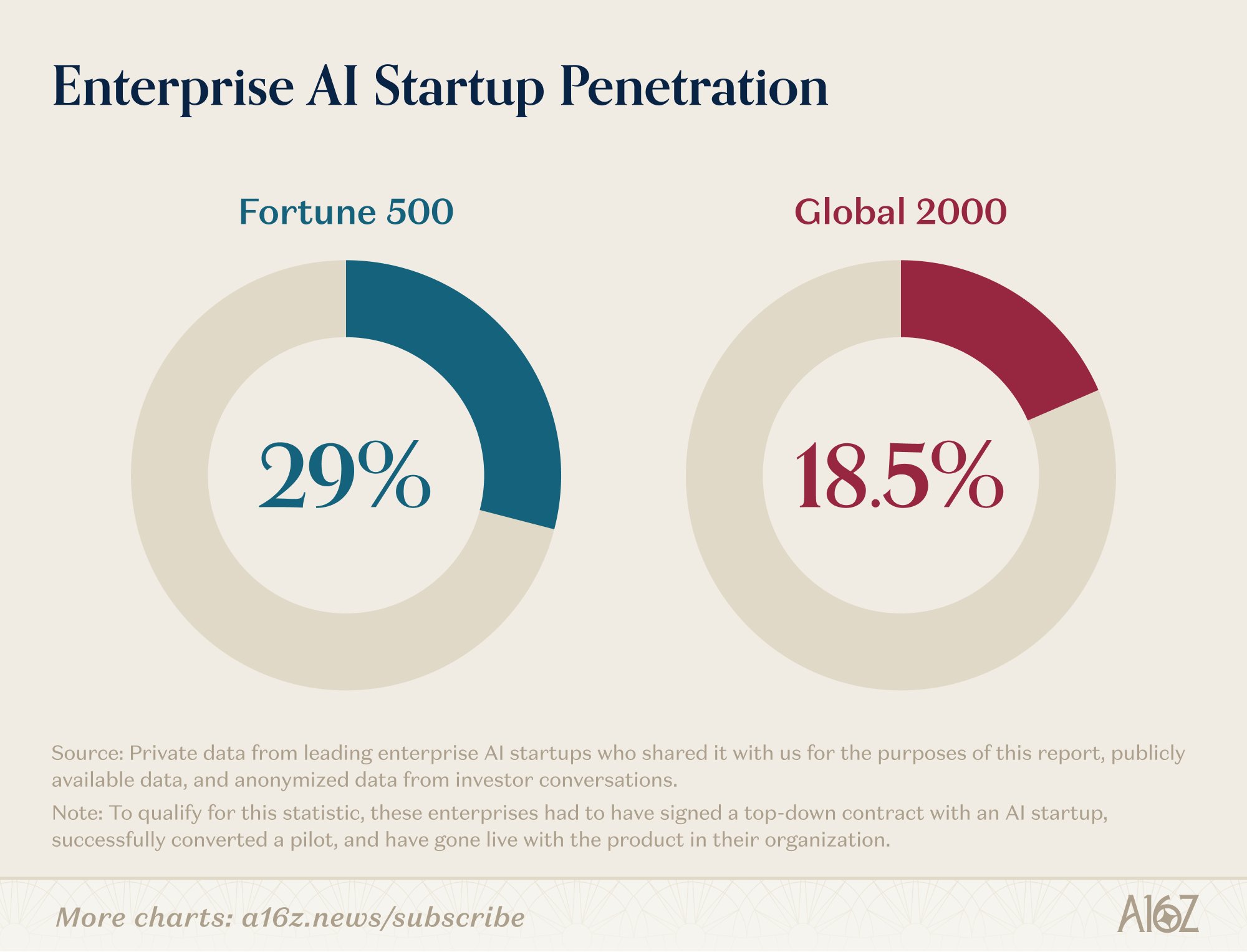
We @a16z decided to compile hard data on what’s actually working in enterprise AI.
* Nearly 30% of the Fortune 500 and ~20% of the Global 2000 are live, paying customers of the leading AI startups. This goes counter to the MIT statistic that 95% of AI pilots are failing in the enterprise
* Coding, customer support, and search are the use cases with clearest enterprise demand, and adoption isn’t just concentrated in traditionally tech-forward sectors.
* Models are improving very quickly at economically valuable tasks, based on @OpenAI's GDPval. We’re tracking GDPval closely to determine where model capabilities will enable the next set of breakout enterprise AI companies.
Read more from our enterprise AI report, linked in the comments


Rafi Nugraha retweeted

1/ Neobanking is no longer a product category defined by checking accounts and debit cards.
It is becoming a battle for the user’s primary financial relationship, and stablecoin-first platforms are the newest challenger.
Unlocked by @KASTxyz

Rafi Nugraha retweeted

Just talked to an AI Product manager making $375K at a frontier lab.
She hasn't written a PRD in 8 months.
Not "she uses AI to help write them faster." She has not opened a PRD template in eight months because she just doesn't need it anymore.
Her day looks nothing like what PMs do:
She wakes up, opens Claude Code, and has a working prototype running before her first meeting of the day (not a wireframe or a figma mockup someone needs to hand off to an engineer). A testable version of the idea - built/shipped by her in the same morning.
While that prototype is running, she's pulling model outputs and running evals. She knows what hallucination looks like in her specific use case. She knows what latency threshold breaks the user experience. She knows the token cost per query and what that means for margin at scale.
She reasons about infrastructure the way a CFO reasons about a P&L. When something needs to be built for real, she doesn't go write a ticket and wait two sprints. She ships the first version herself. hands it to engineering as a working reference implementation, not a requirements doc full of edge cases nobody reads.
The meetings she's in aren't about alignment. They're about what's already shipped and what's blocking the next thing.
Her mental model isn't:
- "manage the roadmap."
- "be the voice of the customer."
- "facilitate cross-functional collaboration."
Those aren't wrong exactly, they're just from a different era.
The mental model that gets you to $480K at a frontier lab in 2026 is simpler and harder at the same time:
- You are the builder.
- The agents are your team.
- Your job is to ship.
She said the output gap between PMs who operate this way and PMs who don't is already 3 to 4x. And this is inside a lab where literally everyone around her is working the same way.
Here's the thing nobody wants to say out loud: the "I write specs and run standups" PM isn't being replaced by AI. The job isn't disappearing into a chatbot. It's being absorbed by the PM sitting two desks over who stopped waiting for engineers and started building herself.
Really crazy how fast the job description changed and really crazy how few people have noticed.