

Senior Research Officer, focus on research e-infrastructure. ❤️community standards, #openscience & #FAIR. Proud member of @CSCCE and @OscSweden. Ex-@INCForg.
Stockholm, Sweden
Joined March 2009
- Tweets16.1K
- Following3.5K
- Followers1.7K
- Likes13.4K




Pinned Tweet
I am not leaving Twitter yet, but I am now also on mastodon, as @msandstr@fediscience.org
TT: collaboration between infrastructures is needed, but we need other funding mechanisms. DARIAH and CLARIN will be involved in building the cloud for cultural heritage data
LB: access to DARIAH can only enrich us - even though we already have collaborations and support, it is clear that a broder uptake will be beneficial to us
JL: the benefits of DARIAH include access to colleagues and to tools/infrastructure we now don’t have to build ourselves. There is a lot to do in this field, and we need meeting places for experts to meet
LB: this infrastructure is mainly made up of *people*, not equipment - a significant difference that is hard to convey to those used to more conventional infrastructures
LB: Swe-CLARIN is embedded in Språkbanken, a language technology infrastructure for supporting research in language technology, linguistics, digital humanities and social science. The outputs can often be put back into the infrastructure!
LB: the idea behind CLARIN is a federation of European digital repositories with language data and tools, with uniform sign-on and access
ES: the humanities are brining another viewpoint into research infrastructure, different from the traditional technical view. It is the job of humanities to engage with data critically. Infrastructure frameworks are man-made and can be shifted!

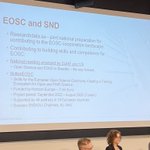
ES: one of our major goals is to launch researchdata.se, to become a data portal for all national research data and function as a Swedish node to EOSC
JK: the process of state application is complicated in Finland, with several steps including a committtee statement, the education ministry and the parlament.
Now: Johanna Lilja from the Research Library of the National Library of Finland, about DARIAH-FI and FIN-CLARIN
TT: for an overlay journal to work we need clear guidelines and criteria for peer review: is it readable, methodologically sound, etc
TT: a change in research assesment is crucial for the social sustainability of research infrastructures
TT: the infrastructure for this exists: episciences.org/