

CEO and Co-Founder, @tahoe_ai, Princeton PhD *15 زن، زندگی، آزادی
Joined March 2015
- Tweets2.2K
- Following678
- Followers3.9K
- Likes6.8K





Pinned Tweet
We are making Tara available to the public. Tara is a plug-in we developed internally to connect reasoning models with our datasets and the tools we build on top of them. Going forward, Tara will be the channel through which @tahoe_ai releases some of our other frontier datasets and models. Stay tuned.
You can connect your agent to Tara with a single prompt. It currently includes our Tahoe-100M dataset and its derivatives. It is particularly good at making connections between Tahoe’s data and other public datasets and models.
Our team, from AI scientists to drug hunters, has been using Tara extensively for a wide range of tasks. It has become a foundational tool for building and conducting research on large-scale biological datasets. We have been constantly surprised by how frontier AI, coupled with Tara, can uncover non-obvious connections across vast sources of biological data and enable discoveries that were difficult to imagine before.
We are excited to see what other creative minds do with it.
Nima Alidoust retweeted

Introducing Flint, @Recursive_SI’s first model: a fast local coding model built with our automated research system, the Eureka Machine.
• Best-in-class fast local coding
• Up to 2x faster than comparable models: 125+ tokens/sec on a MacBook Pro, 150+ on RTX Spark
• Built from scratch in under 4 months
Private, unmetered intelligence on your own machine. Open weights available now on @huggingface, run it locally on your favorite framework or try it for free on @opencode or @pidotdev.
Nima Alidoust retweeted

Excited about this announcement... introducing RNA-Logix, as the first AI RNA biologist (that I know of). RNA-Logix leverages Therna's data world and custom-built AI stack to reveal novel molecular insights about regulatory functions of RNA, and design therapies to target them. From new mechanistic understanding, to programmable mRNA design, to ASO/RNAi nominations, RNA-logix does it all. And Therna's scientists as well as outside partners have successfully completed many validation campaigns to experimentally confirm its findings in cells and mice.
What makes RNA-Logix unique, in my opinion, is that it is built on a rapid verification loop. Where lab-in-the-loop takes months to cycle, RNA-Logix leverages Therna's massive world of in-house RNA measurements to implement a test-time recursive self-improvement loop. I have put it in so much time, and burned so many tokens, test driving RNA-Logix and every time it gives me "Claude Code circa December 2025" vibes... where the programming interface is biology rather than silicon. And all the credit goes to @thernabio's amazing team!
The brain behind RNA-Logix is an RNA-native reasoning model called BioReason-RNA, which we trained in partnership with @NVIDIAHealth (Laksshman Sundaram's team). With support from @PrimaMente
and @tamarindbio, we are giving early access to BioReason-RNA to our select partners. However, we are working to open-weight this model in a not too distant future, so stay tuned for that.

Meet RNA-Logix™, our AI RNA Biologist. It proposes why an RNA behaves as it does, then checks the answer against tens of millions of our measurements.
Its reasoning model, BioReason-RNA, was developed in collaboration with @NVIDIAHealth .
Thank you to @PrimaMente and @tamarindbio for hosting BioReason-RNA exclusively for our customers
businesswire.com/news/home/2…
#RNA #AIinBiotech

Nima Alidoust retweeted

The goal of n-representability is to characterize when a 2-particle reduced density matrix (2-RDM) comes from a valid n-fermion quantum state -- usually by finding 2-body "witnesses" that are non-negative. After working on this a long time I am excited to share our solution!

No it’s not AI. AI couldn’t have pulled this off. In fact, this should become an eval for video gen models. This is insane.
Nima Alidoust retweeted
I have had the privilege of using Tara for the past few months to explore @tahoe_ai's ever expanding datasets with increasingly challenging questions. Closest thing to a chatGPT moment in bio that I have experienced... y'all should take it for a spin!

We are making Tara available to the public. Tara is a plug-in we developed internally to connect reasoning models with our datasets and the tools we build on top of them. Going forward, Tara will be the channel through which @tahoe_ai releases some of our other frontier datasets and models. Stay tuned.
You can connect your agent to Tara with a single prompt. It currently includes our Tahoe-100M dataset and its derivatives. It is particularly good at making connections between Tahoe’s data and other public datasets and models.
Our team, from AI scientists to drug hunters, has been using Tara extensively for a wide range of tasks. It has become a foundational tool for building and conducting research on large-scale biological datasets. We have been constantly surprised by how frontier AI, coupled with Tara, can uncover non-obvious connections across vast sources of biological data and enable discoveries that were difficult to imagine before.
We are excited to see what other creative minds do with it.
Nima Alidoust retweeted

Tara is an AI plugin that connects your own agent to the public Tahoe-100M perturbation atlas - ask real drug-discovery questions, get answers grounded in 100M+ single cells. First public slice. More data coming. tahoebio.ai/tara
Nima Alidoust retweeted

You can now access and analyze Tahoe single-cell chemical screen data directly in your favorite AI tools (e.g., Codex, Claude) through the Tara plugin. Starting with Tahoe-100M, but more soon!
Nima Alidoust retweeted

Excited to announce the release of our Tara plugin!
We built Tara internally for everything from quick data analyses to autonomous discovery with agent swarms.
AI moves fast, and different models and agents bring different strengths. Tara brings our data into the tools you already use—Claude Code, Codex, and Cursor—so you can choose your models, combine agents, and build your own workflows.
Connect with one prompt and start exploring our publicly accessible atlas, Tahoe-100M. Bring in other datasets and tools to investigate drug resistance, explore new indications, and uncover new biology.
Going forward, Tara will be the channel through which @tahoe_ai releases its new frontier datasets and models.
Proud to open this up. Your agents, your workflows, our data. Can’t wait to see where you take it.
More to come. Stay tuned!

Nima Alidoust retweeted

We've developed a new plugin to access datasets from @tahoe_ai available directly from your coding agents. We've engineered it to rapidly query large datasets like Tahoe-100M without needing to download TBs of data first. Register on our website and try it for free.


Nima Alidoust retweeted

1/ Most genes and variants matter somewhere but look silent in any one cell model. Can we build conditions that reveal phenotypes? With @kanishkadey, we engineer cell states to expose hidden disease biology and trace how genetic risk reaches disease genes. biorxiv.org/content/10.64898…

ALT Visual abstract: activating TFs singly and in pairs engineers new cell states, and the Mosaic model learns how TFs combine. Findings: hidden AMD risk variants, state-dependent convergence, and chromatin priming.
Nima Alidoust retweeted

Delighted to see our real-world clinical study of a conversational diagnostic AI system published in @TheLancet, alongside coverage in @nytimes last week.
Looking back, AI in medicine might feel inevitable but it actually takes deliberate, uncertain leaps to get there. I have been fortunate to be part of two such moments.
The first was early 2022 (pre ChatGPT) when @alan_karthi and I got access to our first @Google LaMDA and PaLM models. That convinced us to go all in on LLMs in medicine, sparking the Google Brain moonshot leading to Med-PaLM.
The second moment leading directly to this Lancet study, was late summer 2023.
@taotu831 showed me the early AMIE models he was training with our self-play loop, targeting our upcoming OSCE study with patient actors, later published in @Nature 2025.
At that exact time, I was navigating a personal health condition. Testing myself, the consultation the AI performed was so natural and clinically sound that I was convinced it was ready for the real world.
So I reached out to Alan and together with the team we asked how we could test this in the real world quickly, safely and responsibly. We needed a prospective clinical trial with a safety endpoint and all roads led to @AdamRodmanMD at @bethisraellahey @harvardmed .
Adam was incredibly gracious with his time kicking off our first discussions in the fall of 2023.
But clinical trials take a long time; years of painstaking work. There are so many critical people and moments that make them happen, far beyond the glitzy PR materials and the main authors.
- For example, a discussion with @greg_corrado sparked the design of the oversight setup underpinning the safety layer in the study.
- Kavita Kulkarni (now at BioHub) spent months negotiating the initial contracts with BIDMC; it was uncharted territory for both organizations.
- @_khaledsaab (now rocking at OpenAI!) working tirelessly to improve the AI, together with @taotu831, @apalepu13, @RyutaroTanno, @ckbjimmy, @valentinlievin, @elahevedadi and many more folks.
- @Mysiak, Alessio Orlandi, Petar Sirkovic and team sharing the seamless serving infrastructure they built for Co-Scientist, which we could re-use for much of this study.
- @SSaraMahdavi making sure the study team was well organized :)
This is just to name a few. Prospective trials are a massive team sport and I am proud of what our teams achieved.
While the AI's clinical reasoning was strong, seeing the patient trust, safety, and satisfaction data, with ZERO safety stops from our supervising physicians, is what truly stands out.
At the same time, this is still a stepping stone. We are moving from AI as a tool to an active care team member - a guardian angel amplifying clinicians and staying with patients throughout their health journey.
More to come soon, and as always, a pleasure to work with so many great folks across @GoogleDeepMind , @GoogleResearch and @bethisraellahey .
Paper - thelancet.com/journals/lance…
NYT - nytimes.com/2026/10/08/techn…


I strongly suspect one way that AI will be superhuman is its eventual ability to make impassioned judgement, without human bias. I love this new work from @ArashAlidoust and the @samaya_AI team, in which they show this when it comes to bias in predicting company revenues.
There are a lot of parallels to this in biology and the drug discovery world. And the benefit will be immense if we put this kind of bias-removing capabilities of frontier models more to use.
(I know models have biases too. My bet is that we can make environments where those biases impact ultimate decision making / predictions a lot less. It is more difficult to do so in a hierarchical human org).
Link in thread.


Nima Alidoust retweeted

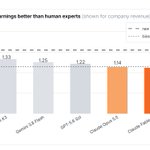
We’re sharing new results showing that frontier AI models are able to outperform human experts on financial predictions for the first time. We built an environment for the challenging task of Earnings Predictions, finding that the most recent frontier models (Opus 5.5, Fable 5.1, Astra) with Samaya’s harness, meaningfully outperform expert consensus predictions on commonly reported earnings metrics such as company revenue, gross margin and more.
We built this environment to have a “point-in-time” gate in the harness to ensure no information leakage, and created financial retrieval and data tools that would respect this gate and give the models access to the same information available to experts. We also adjusted for bias in expert consensus to create a hard, bias-corrected baseline, where outperformance has real signal. Only the most recent frontier AI models are able to beat this hard baseline, pointing to an important inflection point in AI capabilities in finance.
Like with FrontierFinance, we see substantial headroom for further RL training in this environment — the models show large variations in error across different rollouts. We’re continuing research on using earnings prediction and other predictive tasks to post-train models to learn from their mistakes. Get in touch if you’d like to collaborate or try out an alpha version. Link to the full research below.
Nima Alidoust retweeted

Have you ever tried to reuse someone else's spatial-omics dataset and given up halfway? 🔄
A team from Helmholtz Munich and Lamin is running a short community survey on this (spatial transcriptomics, multiplexed imaging and related methods), to help offer potential solutions on what could make it easier. Whether you generate the data, analyse it or manage it, we'd like to hear from you. PhD students, postdocs, PIs, core facility staff and industry are all welcome.
→ 5–10 minutes
→ Anonymous: no name, email or IP address collected
→ Anonymised results may be published openly
Your answers will shape an open, cloud-native repository for spatial-omics data and inform a research funding proposal. Take the survey: docs.google.com/forms/d/1aZW…
📢 Do share with anyone in your lab or network who works with spatial data!

Another wonderful initiative by our friends @biohub. Inspiring to see them paving the way for foundational resources needed for building biological models.

A universal predictive model of the cell would dramatically accelerate science, allowing biologists to perform experiments digitally. Today we’re announcing a major partnership with the DOE and NIH. The goal of this partnership is to generate the data that will be needed to build an accurate model of the cell with artificial intelligence.
Isomorphic, Google DeepMind, and Meta are joining us as founding partners in the Virtual Biology Initiative. This is the beginning of a large scale coordinated effort to map cellular biology to power the development of digital models of life. Other leading scientific institutions and consortia including the Allen Institute, Broad Institute, Gladstone Institutes, the Human Cell Atlas, the Human Protein Atlas, the Wellcome Sanger Institute, as well as NVIDIA, are working together as part of this international scientific project.
Creating a predictive model of the cell is one of the most important challenges for the next decade of science. The insights that come from this could unlock a far greater understanding of disease, and open new paths for cures.
We invite the worldwide scientific community and other funders to join us in this effort.