

I like to work on cool things and write about them. Building something (YC F26)
San Francisco, CA
Joined June 2020
- Tweets342
- Following402
- Followers3.5K
- Likes35K




Pinned Tweet
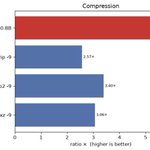
I found out the other day that any compression tool can be contorted to do language modeling. Turns out gzip can generate text that somewhat *resembles* Shakespeare. Short write up linked below
Turns out you can make LLM inference fully deterministic across devices, with no loss to quality or speed.
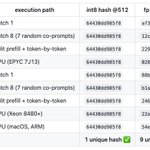
This weekend at the @spacexai hackathon I got Qwen3-0.6B to produce identical hashed logits from a 512-token generation across 2 GPUs and 3 CPUs: an A100, an H100, an Apple M5 Max, an AMD EPYC, and an Intel Xeon.
The main reason why inference isn't deterministic is because floating-point addition is not associative. (a + b) + c ≠ a + (b + c), since every add rounds. Accumulation order changes with the hardware used and kernel selected, so the same prompt can give you different outputs even at temperature 0.
Integers ARE associative. So why doesn't integer quantization already fix this? Because, while weights and activations get quantized, the non-linear ops (softmax, normalization, SiLU) dequantize back to float and requantize afterwards. Each of those steps hands you back to floating point rounding.
True integer-only inference does exist, but it's historically been motivated by edge hardware without FPUs, which doesn't make much sense for LLMs. One 2024 paper (I-LLM) did it on LLaMA from that angle and didn't get much attention. Nobody seems to have looked at it from the determinism side.
I wrote my own implementation, simplifying the approach from the paper, so that every operation between the input ids and the int32 logits is exact integer arithmetic. To test it I chain-hashed the logits at every step and ran that across the devices and configurations below. Every integer run gave the same hash: 64430dd985f8. Every fp16 run gave a different one, all diverging on the very first token.
WikiText2 perplexity came out to 20.72 vs 20.95 for fp16 (slightly better than the float baseline), and CUDA-graphed integer decode hits 106 tok/s at batch 1 on an A100, 3.6x the fp16 eager baseline.
Github repo is listed in the comments. Plan to do a writeup over this eventually!


Nathan Barry retweeted

We introduce Maple-Preview, an open-source 20B-A1B ternary-weight reasoning LLM, SOTA in its weight class.
It solves IMO-level problems and runs at 200+ tokens/s on a Mac Mini M4, 5–16× faster than efficient models like Gemma 4, Qwen3.5, and gpt-oss.
deepgrove.ai/maple-preview

Nathan Barry retweeted

🚨Coming to #ICML2026 🇰🇷
Last year, we introduced Block Diffusion LMs, adopted by dLLMs at Google, NVIDIA, Meta, etc.
🚀Today, we introduce Set Diffusion, a faster, more flexible alternative that combines AR and diffusion by interpolating generation orders.
🧵1/8


New post! A drawback of diffusion LLMs is that bidirectional attention causes keys and values to drift across steps, breaking KV caching. But generation quality is robust to slight KV drift, and much work has gone into maximizing stale KV reuse without causing quality drops (1/3)
I noticed that Apple Notes has a similar UI as the AI chat apps, so I turned it into a Claude/ChatGPT frontend. Use any LLM API to interact or chat with in Apple Notes
osascript lets you script most Apple apps (messages, mail, calendar, safari, etc). Here it exposes the notes SQLite database. Plenty of cool stuff to look into using this.
Repo: github.com/nathan-barry/appl…

Nathan Barry retweeted

We've shipped more than a thousand versions of Zed, but all of them began with zero. Today, that changes.
zed.dev/blog/zed-1-0

Diffusion LLMs are becoming very competitive architectures. But recently, there's also been a lot of progress in flow-based LLMs, which are conceptually similar. Both learn to transport samples from a noise distribution to a data distribution.
Image generation used to be dominated by diffusion models but the leading models have since shifted to flow matching, largely because flow produces straighter trajectories that are easier to traverse in fewer steps without degrading quality.
Categorical data (language) is certainly harder than continuous data (image latents) for flow. It'll be interesting to see whether language ends up following the same trajectory as images (pun intended).

Mercury 2 is live 🚀🚀
The world’s first reasoning diffusion LLM, delivering 5x faster performance than leading speed-optimized LLMs.
Watching the team turn years of research into a real product never gets old, and I’m incredibly proud of what we’ve built.
We’re just getting started on what diffusion can do for language.
Nathan Barry retweeted

We just brought flow maps to language modeling for one-step sequence generation 💥
Discrete diffusion is not necessary -- continuous flows over one-hot encodings achieve SoTA performance and ≥8.3× faster generation 🔥
We believe this is a major step forward for discrete generative modeling and language modeling alike. 🚀
Full thread from first author @chandavidlee: xitter.cf/chandavidlee/status/20…

Can language models generate high quality full sequences in ONE step?
Yes! Using continuous flows.
We introduce Flow Map Language Models (FMLM) — a fundamentally new approach that outperforms discrete diffusion baselines across the board.
🔥SoTA few-step performance
❤️🔥 ≥8.3× faster sampling
🧵👇
“One-step Language Modeling via Continuous Denoising”
(with amazing coauthors @wognsfjq96 , @mananag_007, Sheel Shah, @jrrhuang, @AdtRaghunathan, @hongseu33, @nmboffi, @jw9730)
LLaDA 2.1 was released, a 100B parameter diffusion language model with self-correction capabilities. They are able to fix previous tokens by adopting a mixture of masking/state-absorption and uniform diffusion, similar to GIDD.
In a previous post, I mentioned that Google Gemini and Inception Lab’s Mercury might have done something similar. A few people in the comments suggested that they use masking + re-masking instead (so masking without the state-absorption property).
I wonder how these two approaches compare. They both allow for self-correction and (thus) allow for more progress per step in the diffusion process (by being more robust to taking larger steps through the diffusion process).
Masking + re-masking might have some benefits like a simplified training objective, stronger inductive bias (which is arguably a good thing), and easier use with KVCache approximation (due to fewer tokens changing per step). My only question is: how does the departure from state-absorption change things?
The simplified training objective from masking (which reduces to a weighted MLM training objective) comes from this state-absorption property. But does re-masking actually change this?
The state-absorption property is just that each token undergoes one transition only ([MASK] -> predicted token, and never changes). Re-masking a token, of course, causes it to go through multiple transitions.
But does it really? Re-masking seems like you are just “jumping” to a more likely trajectory to account for the accumulation of errors. So instead of causing multiple state transitions, it could be just viewed as jumping to a better trajectory where that “poor” transition wasn’t made.
Will be interesting to see more formalization of this and how it compares to GIDD at scale.

What if an LLM could EDIT its own tokens in real-time, not just generate them? 🤯
Introducing LLaDA2.1 — a diffusion model that breaks from autoregressive dominance. It drafts fast, then fixes its own mistakes on the fly with Token-to-Token editing.
The result? 892 tokens/sec on a 100B model. 🔥
⚡ 892 TPS on HumanEval+ (coding)
⚡ 801 TPS on BigCodeBench
🧠 Real-time self-correction via T2T editing
✅ @lmsysorg SGLang Day 0 support — production-ready now
A "non-consensus" architecture now challenging the mainstream. Open-sourced TODAY. 👇
#LLaDA #TokenEditing #OpenSource #LLM #dLLM

