

Author of New Currency: How Money Changes The World As We Know It. Automaticity in monetary policy: achieving Friedman's Optimum without deflation. Sculptor 🌱
Joined April 2009
- Tweets19.3K
- Following1K
- Followers1.8K
- Likes65.6K





Pinned Tweet
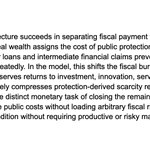
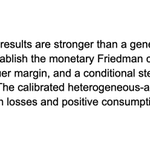
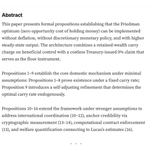
In 1969, Milton Friedman proposed what became known as the "Friedman Rule" - a monetary policy where nominal interest rates should be set to zero, eliminating the opportunity cost of holding money and optimizing monetary efficiency. 🧵 1/15
Jordan MacLeod retweeted

The time is now to formalize all mathematics
xitter.cf/jdlichtman/status/2097…


Jordan MacLeod retweeted
For the Navier-Stokes proof:
"On a technical level, the paper is unbelievable, maybe beyond what a human could have come up with but not beyond human understanding"

Since I'm now blocked by bluey from replying to this thread, I answer here by quote tweet
the openAI construction has more to do with convex integration than anything else.
In convex integration, the oscillations are typically built by hand and the iteration procedure creates wild weak solutions. The non-uniqueness construction of Albritton–Brué–Colombo used an unstable vortex to split solutions apart. The Córdoba–Martínez-Zoroa singularities amplify vorticity across scales by strain. In the openAI paper, a fluid instability is clever made so that the flow itself generates the oscillations: they grow by drawing energy from the background shear. The Reynolds stress then becomes the force that creates the collapsing smooth vortex. Using a physical instability to create the stress in this way has no precedent, and it is what produces a smooth force rather than a merely rough one.
Some on these ideas are in the literature (e.g. Leibovich-Stewartson 1983) but the way they are combined is definitely insane and definitely nowhere in the literature previously.
I also don't know of anyone suggesting that convex integration would play a role in the creation of a blow-up solution like this.
On a technical level, the paper is unbelievable, maybe beyond what a human could have come up with but not beyond human understanding: there are several different groups of pde experts working on understanding it who say that they more or less understand now. I expect digestions soon
td;lr: anyone saying that this OAI result is unsurprising is bullshitting
sorry!
Jordan MacLeod retweeted

This really is one of @BillMaher’s best-ever monologues, and I don’t say that just because I got a namecheck. Tldr: Socialism is what old people already get and young people want a piece of it.

Jordan MacLeod retweeted
Ever wonder if eventually cells could be trained out of disease states? We're on the path; first steps:
New #preprint - @WesleyPClawson
"Goal directed closed-loop training of network bursts in cortical cultures produces improved performance and error correction over days"
biorxiv.org/content/10.64898…

Jordan MacLeod retweeted

Squeezing a fibroblast nucleus for a moment opens chromatin at mappable loci. Yang Song and Song Li at UCLA aimed CRISPRa guides at exactly those spots. Fibroblast to neuron conversion went from under 3% to about 40%, with no virus. In aged mouse fibroblasts, the same mechanically enhanced Oct4 activation lowered DNA methylation age on the mouse skin clock, close to the level of cells from young animals. But global methylation also drops. so how much of this is rejuvenation rather than dilution is the open question. Title: Mechano-epigenetic enhancement of CRISPR activation of target genes fo… sciencedirect.com/science/ar…
Jordan MacLeod retweeted

Last month, we demonstrated high-rate alchemy: turning mercury into real, stable gold, beating CERN’s record by a factor of 10.
Last week, we enriched isotopes in the world’s most powerful plasma centrifuge, beating the Soviet record that stood for 40 years.
Now, we’re building a fusion reactor in San Francisco to achieve record power density.
Jordan MacLeod retweeted

Full details of a remotely exploitable vulnerability in the core engine of *all* PHP versions will be released tomorrow, October 21st. If your organization has internet facing PHP applications then you need to be ready to patch the minute the update is released or *strongly* consider taking the application offline until you can:
php.net/index.php#2026-10-20…


🚨 PHP warns of two critical vulnerabilities as emergency patches arrive tomorrow
The PHP security team will release updates on October 21 at 14:00 UTC for two vulnerabilities, each rated 9.2 under CVSS v4.0.
⠀
Security researchers identified the flaws as CVE-2026-109618 and CVE-2026-109619 and described them as remote code execution vulnerabilities reportedly affecting PHP versions 5 through 8.
PHP has not yet confirmed the affected versions, exploitation requirements or fixed releases.
⠀
The vulnerabilities were reportedly leaked before their planned disclosure. Researchers said they have not observed active exploitation, while PHP warned it may release the patches early if technical details become public or exploitation is detected.
⠀
Administrators should identify PHP installations now and prepare to apply the updates as soon as they become available.


Jordan MacLeod retweeted

C'est à cause de vos amis que des milliers de commerçants ont les larmes aux yeux ce matin. Vous ne m'empêcherez pas d'apporter mon soutien à la police que vous méprisez et que vous insultez en chaque circonstance.
Ma réponse à un député d'extrême gauche ⤵️

Jordan MacLeod retweeted

Starting with the Coleman Report in 1966, continuing with studies of prison rehabilitation, job training programs, causes of poverty, race differences in IQ, and causes of sex differences in occupational preferences. To name a few.

Jordan MacLeod retweeted

J’ai entendu dire que la France était finie, qu’il était trop tard pour la sauver.
Mais la France est toujours aussi belle, enviable même. Sa grandeur n’a pas disparu, elle ne demande qu’à renaître.
Nous avons surmonté en un an un problème cent fois plus grave, sans avoir les moyens dont dispose la France.
La France pourrait y arriver en une semaine.


Jordan MacLeod retweeted

“The most beautiful city in the world, with its wonderful culture, all the things that I’ve just learned to appreciate, & these wretched spoilt brats are trying to pull it all down & smashing windows & burning cars which don’t belong to them.”
Sir Roger Scruton, Paris [May '68]

Jordan MacLeod retweeted

Le physicien Gabriele Carcassi (@UMich) : je bloquais souvent sur des aspects mathématiques techniques en topologie et l'IA me sort désormais d'affaire en 2 minutes ; il me fallait supplier des mathématiciens pendant des mois, maintenant un seul interlocuteur IA me suffit !

➡️ @AntoineTilloy : "si on est un chercheur raisonnable, il y a forcément une part d'enthousiasme avec l'IA", mais le progrès des modèles est inquiétant car "notre part de guide se réduit" ; "on n'a plus besoin de beaucoup l'orienter, on peut le laisser faire comme un post-doc".
Jordan MacLeod retweeted

2/ TL/DR: We found neural activity across both inferotemporal and prefrontal cortex alternates between a conscious mode and an unconscious mode ~ 15 times every second.
Jordan MacLeod retweeted

Wow. I woke up to an impressive number of upset people who apparently don’t understand how LLMs work and can’t cope well with me pointing it out.
An LLM is a statistical next-token prediction model. That’s how it works. It’s an extraordinarily sophisticated calculator performing math you could theoretically do by hand (if you were sufficiently masochistic).
Math doesn’t know what it’s calculating. Pi doesn’t spend its evenings contemplating the nature of circles, and c doesn’t ponder the relationship between matter and energy.
That doesn’t make the results any less accurate, impressive, or useful.
Between inference requests, an LLM isn’t sitting around thinking. It isn’t reconsidering its answers, wondering whether it made a mistake, contemplating its existence, or questioning whether it’s conscious. Its weights remain fixed (it doesn’t learn), and computation resumes when it receives input.
We know this because we designed these systems. The architectures, mathematics, implementations, and research are extensively documented. You can study them yourself.
Of course, some people immediately lean into comparisons of biological intelligence or philosophical debates over consciousness because that is what they know.
But biological intelligence and artificial neural networks are fundamentally different systems. Similar outputs don’t establish equivalent internal experiences.
I experience consciousness directly. I infer that other humans do too because we share biological structures and processes. We don’t have equivalent evidence for an LLM, and nothing about its known operation gives evidence of conscious experience.
Which brings me back to my original point.
To me, understanding is conscious comprehension. It means being aware of information, recognizing its meaning, and experiencing that comprehension. If I wasn’t conscious I could not understand.
We can perform actions unconsciously. We can produce correct results without knowing why they’re correct. But I distinguish those capabilities from consciously understanding what we’re doing.
An LLM can solve complex problems, explain difficult concepts, and produce remarkably accurate information. I give it full credit for those capabilities.
But producing an answer that we rationalize as understanding isn’t the same as experiencing understanding.
You don’t have to agree with my definitions. We can debate functional understanding versus conscious comprehension all day, but that won’t establish whether an LLM actually experiences anything.
The right debate is this…
Could machines exhibit something different from human consciousness, something measurable, meaningful, and worth studying?
I think so, absolutely!
I’m entirely open to discussing “machine consciousness” in terms of observable, testable computational properties. We built these systems, we can instrument them, examine their internal mechanisms, and investigate what they’re capable of.
That seems far more productive than endlessly arguing over whether a machine experiences life the way humans do.
So here’s my question:
How would you define machine consciousness, and more importantly, how would you measure it?

Jordan MacLeod retweeted

Tesla VP of Hardware Engineering Lars Moravy explains to Hagerty how the Roadster borrows SpaceX cold gas thrusters to make 0 to 60 possible in 0.55 seconds.
Truly insane:
▫️ 200L carbon-over wrapped pressure vessel
behind seat holds nitrogen at 10,000 PSI
▫️cold gas thrusters push out 80 kN of thrust (equivalent to a single fighter jet engine)
▫️Tesla went with nitrogen because “it just seemed wrong to put fuel into a car” (air is ~80% nitrogen, fair enough)
▫️thrusters same system satellites use to move in space (eg. the “psh psh psh" from Apollo 13 film)
▫️currently takes 6 to 7 hours to refill all nitrogen but Tesla working for it to be 30 minutes
▫️uses leg actuators from Optimus robot to manage downforce on wing
***
Full 25-min episode with Henry Catchpole here: youtu.be/22rvpUecLts?si=jtwK…
